Why Backflow Prevention Is Essential for Your Home’s Water Safety
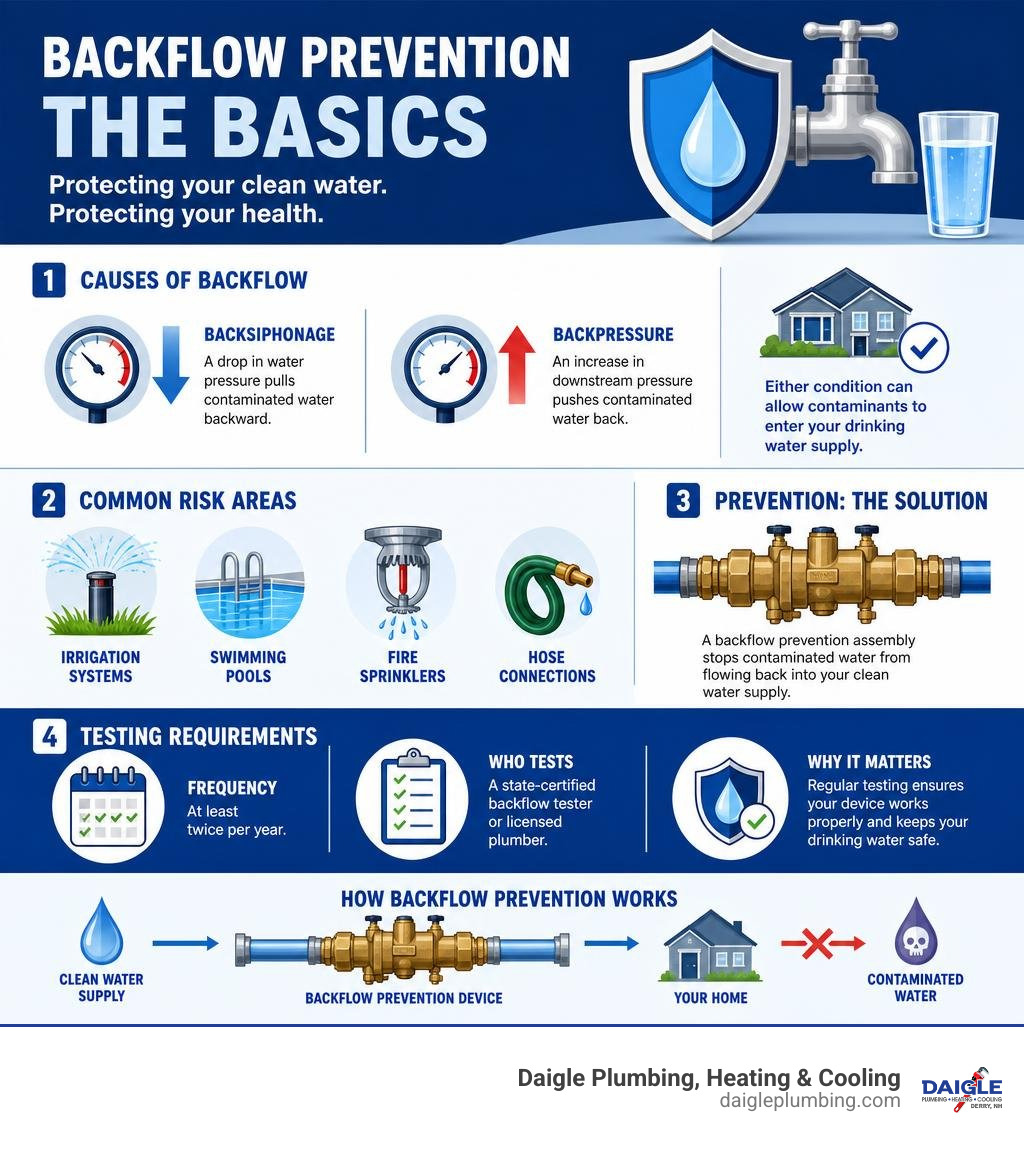
Backflow prevention is the practice of stopping contaminated water from flowing backward into your clean drinking water supply, and it’s required by law for many homes in New Hampshire.
Here’s a quick overview of what you need to know:
| Topic | Key Point |
|---|---|
| What it is | Stopping reversed water flow that can contaminate your drinking supply |
| Main causes | Pressure drops (backsiphonage) or downstream pressure spikes (backpressure) |
| Common risk areas | Irrigation systems, pools, fire sprinklers, hose connections |
| Required device | A backflow prevention assembly, installed and tested by a certified professional |
| Testing frequency | Check your local New Hampshire water authority for the required schedule |
| Who tests it | A state-certified backflow tester or licensed plumber |
Every time you fill a glass of water from the tap, you assume it’s clean. But without the right protections in place, contaminants from irrigation lines, pools, or even chemical systems could silently enter your home’s water supply through a process called backflow.
The risks are real. Chemical and biological contaminants from backflow incidents have caused illness and deaths, and experts believe reported incidents represent only a fraction of those that actually occur.
At Daigle Plumbing, Heating & Cooling, our licensed plumbing team has seen how proper backflow prevention protects families from serious health hazards. In this guide, we’ll walk you through everything, from how backflow works to what New Hampshire homeowners may need to do to protect their water supply.
Understanding Backflow Prevention and Why It Matters
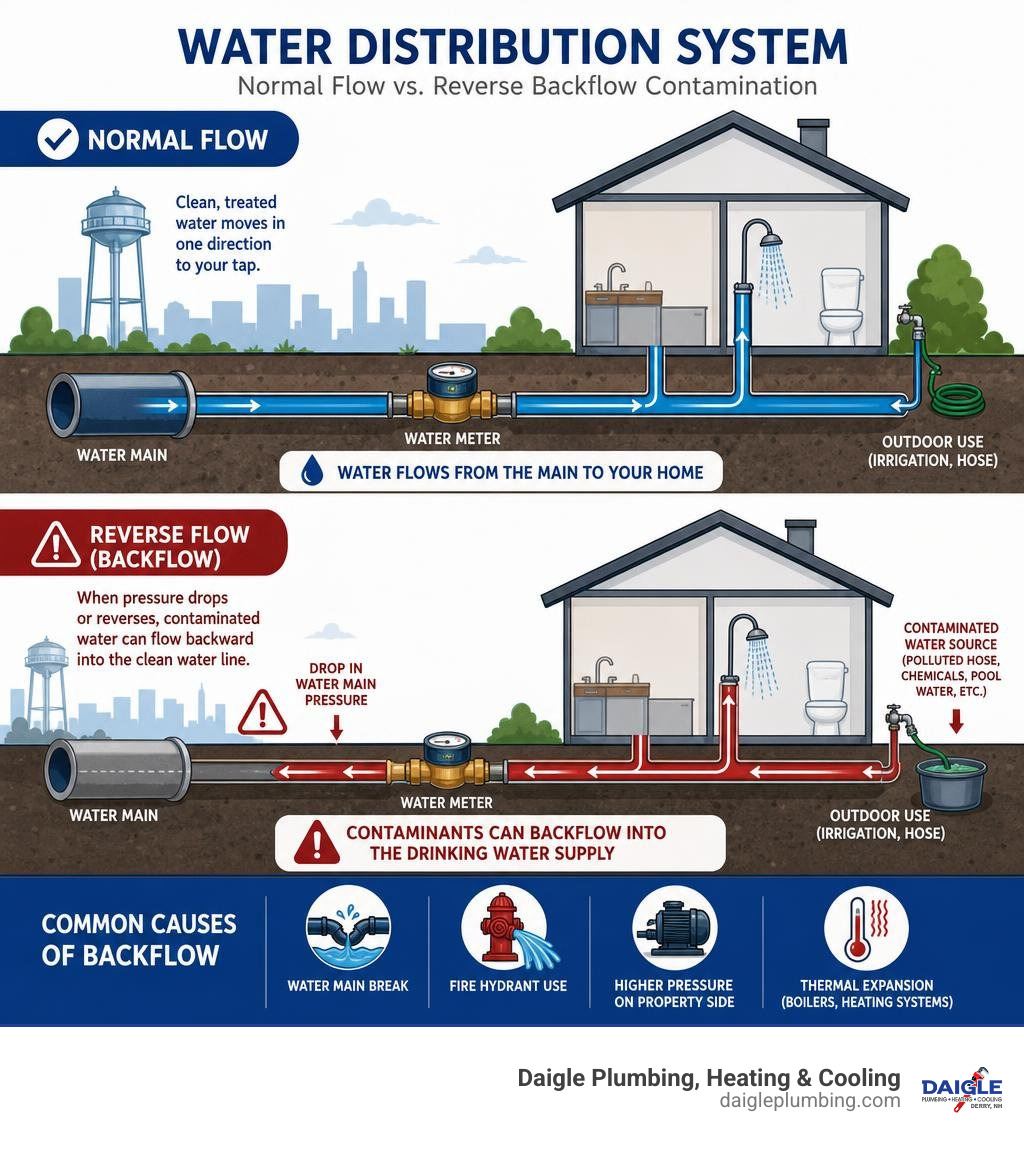
To understand why backflow prevention is so critical, we first have to look at how water gets to your tap. Your municipal water system relies on pressure to keep water moving in one direction: from the water main, through your water meter, and out of your faucets.
But water pressure isn’t always stable. If there is a sudden drop in municipal pressure, or a sudden spike in pressure on your property’s side, the direction of the water flow can reverse. When this happens, whatever is sitting downstream, like stagnant pool water, lawn chemicals, or industrial waste, gets sucked right back into the clean drinking water lines.
Maintaining water pressure is a delicate balance. Uncontrolled water flow can lead to massive waste and contamination. If your system has undetected leaks, it can drop the overall pressure in your home, increasing the risk of backflow. Our team explains how hidden leaks can compromise plumbing performance in the dangers of unrepaired leaks and how professional leak detection can help, which is especially relevant when water pressure changes are part of the concern.
Backsiphonage vs. Backpressure
Backflow happens in one of two ways: backsiphonage or backpressure.
- Backsiphonage: This occurs when there is a drop in the supply pressure of the water main, creating a vacuum or partial vacuum that literally “siphons” non-potable water backward. Think of it like drinking through a straw. If a water main breaks down the street, or if firefighters hook up to a nearby hydrant, the sudden, massive demand for water pulls pressure away from your home, siphoning water backward. This siphon action is incredibly powerful and has been shown to raise liquid in a pipe up to almost 34 feet!
- Backpressure: This happens when the pressure downstream, inside your property, exceeds the supply pressure coming from the city. This can be caused by pumps, elevated piping, such as a heating system on a third floor, or thermal expansion from boilers. If your home’s internal system is highly pressurized and the city’s pressure dips even slightly, your home’s water is pushed backward into the main.
The Danger of Cross-Connections
A cross-connection is any physical link between your clean drinking water (potable water) and a source of non-potable liquid, gas, or other substances.
A classic, everyday example is a garden hose submerged in a swimming pool or a bucket of soapy water. If a backsiphonage event occurs while that hose is submerged, the dirty pool or bucket water will be sucked straight into your kitchen sink.
Cross-connections can result in serious health hazards. If toxic lawn fertilizers, pesticides, or biological pathogens enter the drinking water, the consequences can be devastating. Because of these hidden risks, identifying cross-connections is a top priority for water utilities. These same cross-connection risks often appear alongside other household plumbing concerns, which we cover in the 7 most common plumbing problems and how Daigle Plumbing, Heating & Cooling can help.
Types of Backflow Prevention Assemblies and Devices
To protect our communities, we use specialized mechanical devices designed to stop reversed flow in its tracks. The type of device required depends entirely on the “degree of hazard” present at the cross-connection.
Types of Backflow Prevention Assemblies
There are several types of mechanical assemblies used in residential and commercial plumbing:
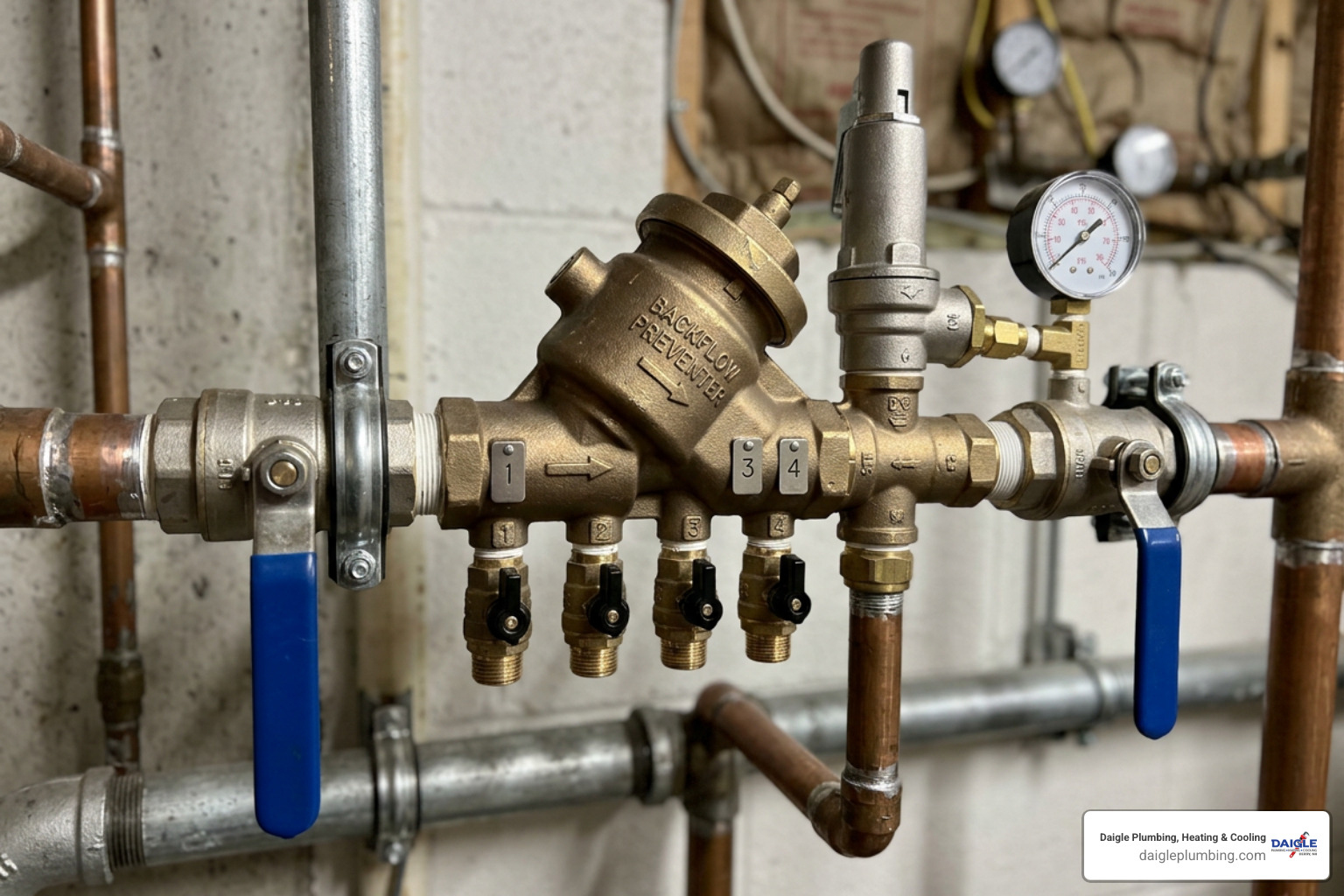
- Reduced Pressure Zone (RPZ) Assembly: The gold standard of protection. It consists of two independent check valves with a hydraulically operated differential relief valve between them. It protects against both backpressure and backsiphonage in high-hazard situations.
- Double Check Valve Assembly (DCVA): Best for low-hazard applications. It uses two spring-loaded check valves to prevent reverse flow but does not have a relief valve to dump water if a check valve fails.
- Pressure Vacuum Breaker (PVB): Designed for backsiphonage protection only. It cannot withstand backpressure. It must be installed at least 12 inches above the highest downstream outlet, like sprinkler heads.
- Atmospheric Vacuum Breaker (AVB): A simpler, non-testable device used for backsiphonage only. It cannot be under continuous water pressure for more than 12 hours at a time.
| Device Type | Hazard Level | Protects Against Backpressure? | Protects Against Backsiphonage? | Continuous Pressure Allowed? |
|---|---|---|---|---|
| RPZ | High | Yes | Yes | Yes |
| DCVA | Low | Yes | Yes | Yes |
| PVB | High/Low | No | Yes | Yes |
| AVB | High/Low | No | Yes | No (Max 12 hours) |
Air Gaps vs. Mechanical Assemblies
The simplest and most reliable way to prevent backflow is an air gap. An air gap is a physical, vertical separation between the end of a water supply pipe and the flood-level rim of the receiving vessel, like a sink or tub.
To be effective, the air gap must be at least twice the diameter of the supply pipe, and never less than one inch. Because it has no moving parts, an air gap cannot mechanically fail.
However, we can’t always use air gaps. For pressurized systems, like lawn irrigation, fire sprinklers, or heating boilers, we must rely on mechanical backflow assemblies. These assemblies contain seals, springs, and internal moving parts that will eventually wear out, which is why they require regular maintenance and testing.
Regulatory Standards and Compliance Requirements
Because public health is on the line, local, state, and federal agencies strictly regulate cross-connection controls.
Testing and Maintaining Your Backflow Prevention System
If you have a testable backflow assembly, like an RPZ or a Double Check Valve, you are legally required to have it tested according to your local water authority’s schedule.
During a standard test, a certified technician will:
- Temporarily shut off your water supply.
- Connect a specialized test kit with pressure gauges to the assembly’s test cocks.
- Measure the pressure differential across the check valves and verify that the relief valves open exactly when they are supposed to.
- Clear out any dirt or debris that might prevent the valves from sealing properly.
When testing identifies a failed valve, aging fixture, or unsafe connection, the next step is often a professional plumbing repair or replacement. Daigle Plumbing, Heating & Cooling provides plumbing services for New Hampshire homes that can help homeowners correct backflow hazards, address pressure issues, and keep water systems working safely.
Local Requirements in New Hampshire
If you live in our service areas, such as Derry, NH, Manchester, NH, Salem, NH, or Nashua, NH, you must comply with specific New Hampshire water codes.
In New Hampshire, homes with higher-risk connections, such as a swimming pool, lawn irrigation system, fire sprinkler system, boiler makeup line, or other cross-connection, may need an approved backflow prevention device installed.
Local requirements can vary by municipality and water provider, so homeowners should confirm the required testing schedule with their local water department or water authority. A certified tester can help determine whether your device needs annual testing, semiannual testing, or another locally required inspection schedule.
If your system is overdue for inspection or you are unsure whether your home has the right device, our plumbing team can evaluate the setup, explain the local requirements, and coordinate the right repair or replacement path.
Practical Steps for Property Owners and Incident Response
As a homeowner, you play a major role in keeping our community’s water clean. Simple daily habits can prevent major backflow hazards. When a plumbing issue seems urgent or unusual, it helps to know which warning signs require fast professional help, and our article on plumbing emergencies that need immediate service explains when to stop using a fixture and call for help.
Common Locations Requiring Protection
Keep a close eye on these high-risk areas around your property:
- Lawn Sprinkler Systems: Fertilizer, animal waste, and pesticides ponding around sprinkler heads can easily siphon backward.
- Swimming Pools and Hot Tubs: Submerged filling hoses can siphon chemically treated water.
- Hose Bibbs (Outdoor Faucets): Always install simple, inexpensive hose bibb vacuum breakers on every outdoor tap.
- Heating Boilers: Boilers use water to heat your home, often mixing it with toxic anti-freeze or conditioning chemicals.
- Fire Sprinkler Systems: Water in these systems sits stagnant for years, accumulating rust, bacteria, and mineral scale.
How to Respond to a Backflow Incident
If you suspect a backflow incident has occurred on your property, for example, if your tap water smells like chemicals, is discolored, or has a strange taste after a local water main break:
- Stop using the water immediately. Do not drink it, bathe in it, or use it for cooking.
- Isolate the source if possible by shutting off the main water valve to your home.
- Notify your local water department immediately so they can investigate potential main contamination.
- Call a licensed plumber to inspect your system, test your backflow devices, and flush your pipes safely.
Backflow concerns can also overlap with broader home comfort and mechanical system needs, especially when boilers, pressure changes, or hydronic heating lines are involved. For homeowners in Derry, NH, Salem, NH, Manchester, NH, Nashua, NH, Auburn, NH, Hampstead, NH, Merrimack, NH, and Bedford, NH, Daigle Plumbing, Heating & Cooling offers heating services for connected home systems that can help identify related equipment concerns before a small issue becomes a larger hazard.
Frequently Asked Questions about Backflow Prevention
What is the difference between pollution and contamination in water systems?
While both are undesirable, they represent different levels of risk. Pollution affects the aesthetic quality of the water, such as its taste, odor, or color, but does not necessarily make you sick. Contamination, on the other hand, introduces hazardous chemicals, heavy metals, or biological pathogens that pose a direct threat to public health and can cause severe illness or death.
How often do backflow preventers need to be tested?
Backflow testing schedules depend on the type of device, the hazard level, and the local water authority. Some residential systems may require annual or semiannual testing, while commercial systems and higher-risk cross-connections may follow different rules. Always check with your local New Hampshire water authority for your specific town’s requirements.
Can I install or test a backflow preventer myself?
No. Because backflow testing requires specialized pressure-testing equipment and specific technical training, tests must be performed by a state-certified backflow prevention device tester. Installations must be handled by a licensed plumber to ensure compliance with the International Plumbing Code (IPC) and local NH amendments.
Conclusion
Protecting your household’s drinking water isn’t just a legal obligation; it’s a vital step in keeping your family and your neighbors safe. From simple hose bibb vacuum breakers to complex RPZ assemblies on commercial lines, proper backflow prevention keeps clean water flowing forward.
At Daigle Plumbing, Heating & Cooling, we’ve spent over 40 years helping our neighbors in Derry, NH, and surrounding communities keep their plumbing systems safe, clean, and compliant. Our family-owned business brings licensed, insured expertise and a 100% satisfaction guarantee to every job we do.
Don’t wait for a water quality notice or a failed inspection. If you need a backflow device installed, repaired, or tested, we are here to help. Contact our professional backflow prevention technicians today!