When Your Heating System Stops Working: What to Know About Boiler Pump Replacement
Boiler pump replacement is one of the most common heating repairs homeowners face, and one of the most disruptive, especially during a cold New Hampshire winter.
Here’s a quick overview of what you need to know:
| Topic | Key Facts |
|---|---|
| What it is | Replacing the circulator pump that moves hot water through your heating system |
| When you need it | Cold radiators, strange noises, leaks, or boiler overheating |
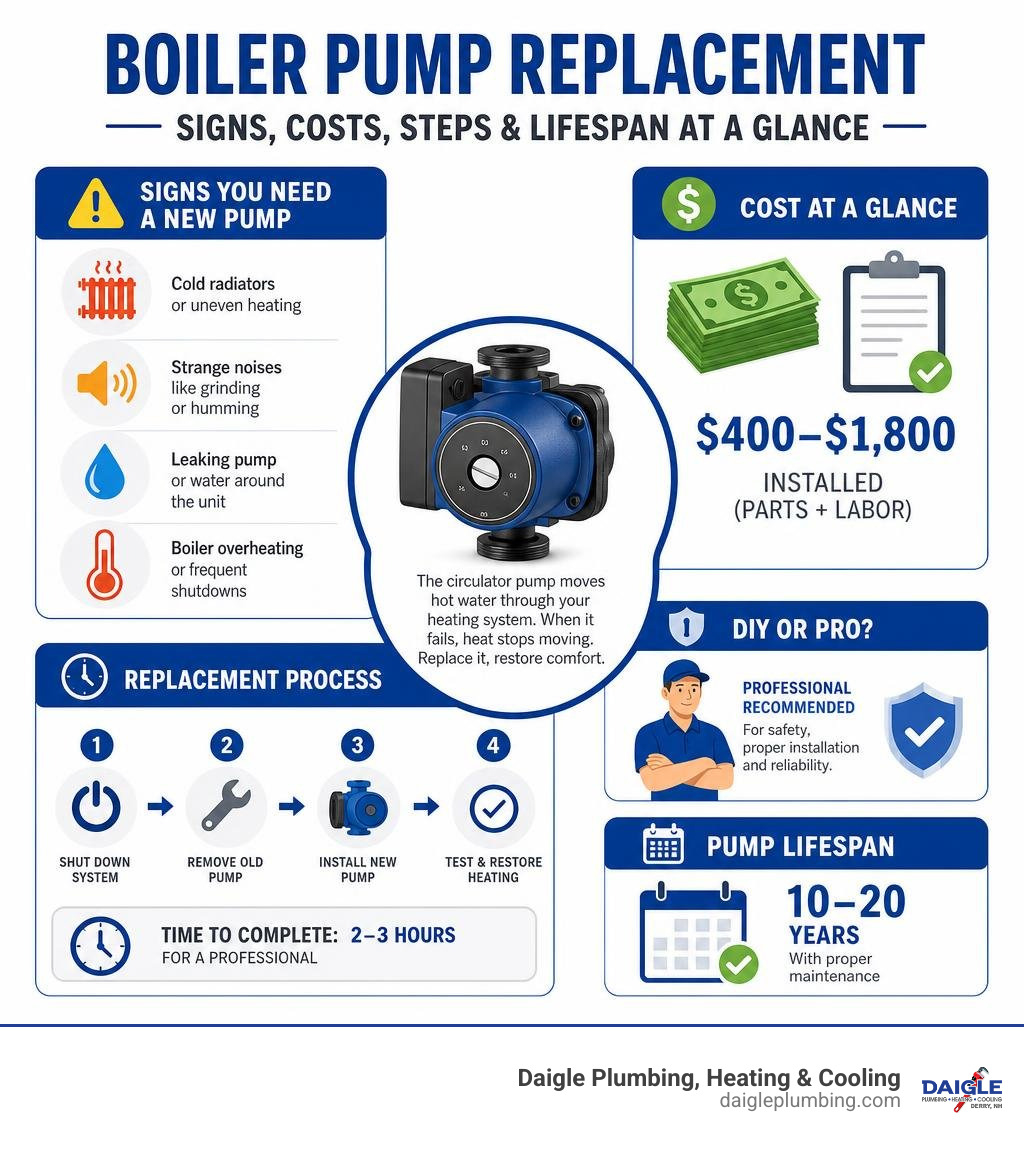
| Time to complete | Often 2 to 3 hours for a professional, depending on system condition and access |
| DIY or pro? | Professional recommended for safety and reliability |
| Pump lifespan | 10 to 20 years with proper maintenance |
Your boiler’s circulator pump is the heart of your heating system. It pushes hot water from the boiler through your pipes, radiators, and baseboards. When it fails, heat stops moving, and your home gets cold fast.
The good news? A failing pump usually gives you warning signs before it quits completely. Knowing what to look for can save you from an emergency breakdown and a much larger repair bill.
At Daigle Plumbing, Heating & Cooling, our licensed and insured HVAC team handles boiler pump diagnostics, replacement, and heating system repairs throughout Southern New Hampshire. In this guide, our team will walk you through what to watch for, how the replacement process works, and how to make the right call for your home.
What is a Boiler Pump and How Does It Work?
A boiler pump, often called a circulator pump, is the small but mighty component that moves heated water through your hydronic heating system. If your boiler is the heat source, the pump is what delivers that heat to the rest of the house.
In a typical hot-water boiler system, the process works like this:
- The thermostat calls for heat.
- The boiler heats water.
- The circulator pump turns on.
- An internal impeller spins and pushes hot water through pipes.
- The water travels to baseboards, radiators, radiant floor loops, or heating coils.
- Cooler water returns to the boiler to be reheated.
That loop continues until the thermostat is satisfied.
Hydronic heating is different from forced-air heating because it uses water instead of air to move heat around the home. If you are still comparing system types, our explanation of how to learn the difference between furnaces and boilers can help you understand why pump-driven boiler heat behaves differently from forced-air HVAC equipment.
Most residential boiler circulator pumps are compact units installed on or near the boiler piping. Many are wet-rotor pumps, meaning the system water helps cool and lubricate the pump. That design is quiet and efficient, but it also means water quality matters. Sludge, air, corrosion, or hard-water deposits can all shorten pump life.
A working boiler pump should be quiet, steady, and warm during operation. It should not sound like a coffee grinder, drip onto the floor, or make your upstairs bedroom feel like an ice cave.
Telltale Signs You Need a Boiler Pump Replacement
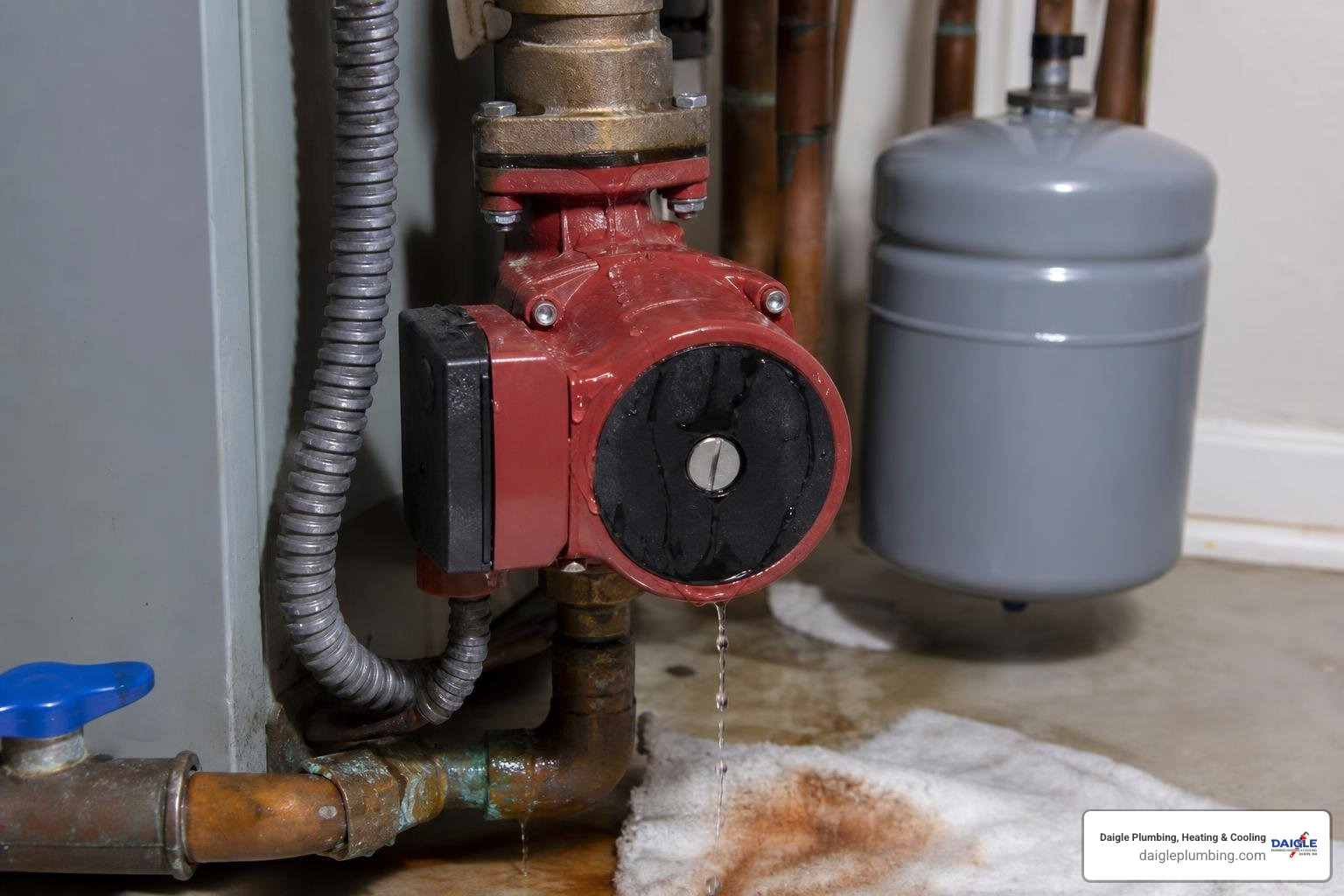
A boiler pump usually does not fail without warning. Here are the most common signs that your system may need boiler pump replacement.
1. Cold radiators, baseboards, or rooms
If the boiler fires but heat does not reach certain rooms, the pump may not be circulating water properly. You may notice:
- Baseboards that stay cold
- Radiators that are warm at the top but cold at the bottom
- One heating zone working while another does not
- Long warm-up times
- Uneven heat from floor to floor
Cold areas can also be caused by trapped air, a stuck zone valve, low water pressure, or thermostat issues. But if the boiler is hot and the water is not moving, the circulator pump becomes a prime suspect. For a closer look at related heating symptoms, our breakdown of common boiler problems and fixes explains how pressure, ignition, leaks, and circulation issues can overlap.
2. Strange noises from the pump or boiler
Boiler pumps are not silent, but they should not be dramatic. Listen for:
- Grinding
- Whining
- Humming without movement
- Clicking
- Banging or knocking
- Gurgling in nearby pipes
A grinding or squealing sound often points to worn bearings. A hum with no circulation may mean the motor is energized but the impeller is seized. Gurgling usually suggests air in the system, which can make the pump work harder and eventually fail.
If your system sounds like it is auditioning for a haunted house, our article on how to diagnose a noisy boiler can help you narrow down whether the sound is coming from the pump, trapped air, kettling, or another boiler component.
3. Water leaks around the pump
Leaks around the circulator pump can come from:
- Failed flange gaskets
- Corroded pump housing
- Loose connections
- Worn seals
- Improper installation
- Excessive system pressure
Even a small drip deserves attention. Water and electrical components are not exactly best friends. Left alone, a leak can damage nearby equipment, introduce fresh oxygen into the system, and accelerate corrosion.
4. Boiler overheating or short cycling
When the pump fails, hot water may stay trapped inside the boiler instead of moving through the heating loop. That can cause the boiler to:
- Hit its high-limit temperature quickly
- Shut down on safety controls
- Turn on and off repeatedly
- Make banging or kettling noises
- Produce little or no heat despite running
Many aquastats are set around 160 to 180 degrees Fahrenheit. If the boiler reaches that range too quickly because water is not circulating, the control may shut it down to prevent damage.
5. Pump feels unusually hot
A circulator pump will often feel warm during normal operation. But if it is too hot to touch, there may be a problem with:
- A seized motor
- Blocked flow
- Incorrect pump speed
- Air trapped in the pump
- Electrical issues
Do not touch suspected hot components with bare hands. Boiler systems can burn you quickly.
6. Higher energy bills
A failing pump may run inefficiently, struggle against debris, or cycle more than normal. You may notice rising heating costs without a clear change in weather or thermostat settings.
Modern high-efficiency ECM pumps can use less electricity than older single-speed pumps because they adjust to system demand. If your pump is older, replacement may improve both comfort and efficiency.
7. Age over 10 to 15 years
A well-installed boiler pump often lasts 10 to 20 years, depending on water quality, usage, maintenance, and pump type. If your pump is over 15 years old and showing symptoms, replacement is usually smarter than repeatedly repairing it.
A simple rule of thumb: if the repair is close to half the cost of a new pump, or the pump is old and unreliable, replacement often makes more sense.
Choosing the Right Replacement Boiler Pump
Choosing a replacement pump is not just a matter of grabbing the same-looking part online and hoping for the best. The pump must match the system.
The most important factors include:
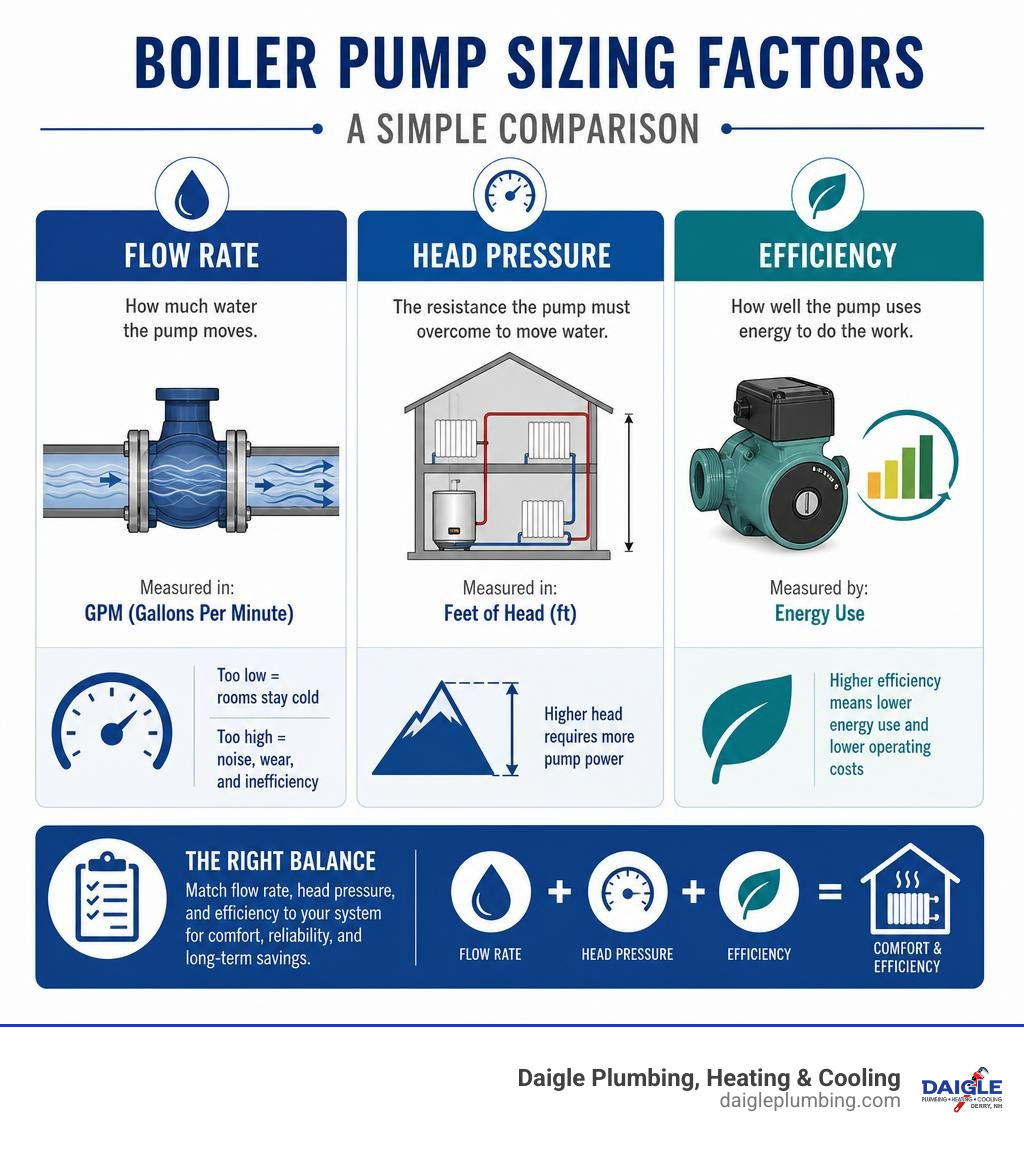
- Flow rate: Usually measured in gallons per minute, or GPM. This tells you how much water the pump can move.
- Head pressure: The resistance the pump must overcome to move water through pipes, fittings, valves, and heating zones.
- Pipe and flange size: The pump must fit the existing piping or be adapted correctly.
- Voltage: Many residential circulators use standard 120V, but some systems differ.
- Material: Cast iron is common for closed-loop heating systems. Bronze or stainless models are used where domestic potable water is involved.
- Pump speed: Single-speed, multi-speed, and variable-speed models all behave differently.
- Boiler type: Conventional boilers, combi boilers, condensing boilers, and electric boilers may have different requirements.
- Control compatibility: Some modern pumps integrate with advanced boiler controls or zone controls.
- Efficiency: ECM pumps cost more up front but can reduce electricity use.
Here is a simple comparison of popular boiler pump brands homeowners often see:
| Brand | Common Strengths | Typical Fit | Notes |
|---|---|---|---|
| Taco | Reliable cast iron circulators, simple installation, widely available parts | Residential hydronic heating, baseboard systems, zone pumping | Taco 007 models are common replacements in many homes |
| Grundfos | Multi-speed options, high-efficiency models, strong performance range | Systems needing speed flexibility or efficiency upgrades | UPS15-58FC is a popular 3-speed circulator |
| Bell & Gossett | Durable commercial and residential circulators, strong legacy reputation | Residential and light commercial heating systems | Often used where robust construction and serviceability matter |
The right choice depends on your system design, not just brand popularity. A pump that is too small may leave rooms cold. A pump that is too large can create noise, velocity issues, and premature wear. Bigger is not always better, despite what the internet may tell you at 11:47 p.m.
Key Features of a Taco Boiler Pump Replacement
Taco circulator pumps are common in New Hampshire boiler systems. One widely used model is the Taco 007-F5 cast iron circulator.
Key features often associated with Taco boiler pump replacements include:
- Cast iron body for closed-loop heating systems
- Quiet wet-rotor design
- Common flange compatibility
- Widely available replacement parts
- Dependable performance in baseboard and radiator systems
- Some models include an internal flow check, depending on configuration
Taco pumps are often a good fit when replacing a standard residential circulator, but sizing and system compatibility still matter.
Key Features of a Grundfos Boiler Pump Replacement
Grundfos is another popular name in hydronic heating. A common residential example is the Grundfos UPS15-58FC, a 3-speed circulator used in many hydronic heating applications.
Common Grundfos features include:
- 3-speed operation for system tuning
- Compact, durable construction
- Cast iron options for closed-loop heating
- Good efficiency compared with older circulators
- Flexibility for different heating zones and flow needs
Three-speed pumps can be useful because they allow a technician to adjust circulation without replacing the pump again. For boiler-specific pumps, always verify the exact model and part number. Combi and condensing boilers may require manufacturer-approved parts rather than a universal circulator.
How to Replace a Boiler Pump: Step-by-Step Guide
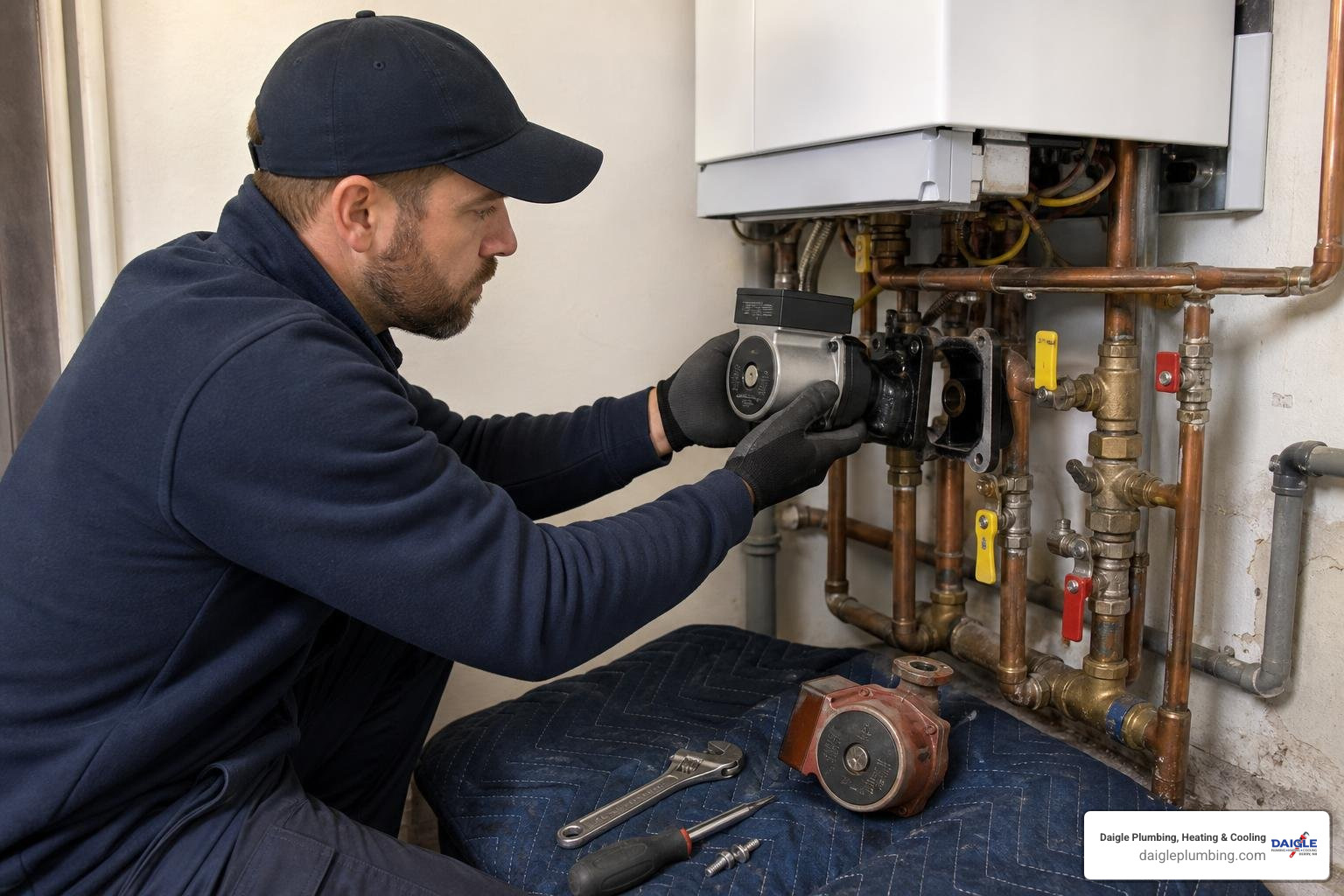
Before we walk through the process, an important safety note: replacing a boiler pump involves hot water, system pressure, electricity, and sometimes gas-fired equipment. Manufacturer instructions commonly specify that qualified service professionals should perform this work. Some electric boiler pump procedures also involve high voltage, and some combi boiler procedures warn of fire, explosion, or carbon monoxide risks if service is done incorrectly.
So, can a homeowner replace a boiler pump? Technically, some very experienced DIYers may be able to replace a simple circulator on a cooled, isolated hydronic system. But for most homeowners, we recommend hiring a professional. The risk of leaks, burns, wiring mistakes, airlocks, boiler damage, and warranty issues is not worth saving a few dollars.
If you want to understand what happens during boiler pump replacement, here is the typical professional process.
1. Confirm the pump is actually the problem
A technician should diagnose before replacing parts. Common checks include:
- Thermostat call for heat
- Boiler temperature and pressure
- Zone valve operation
- Power to the pump
- Pump motor function
- Air in the system
- Pipe temperature before and after the circulator
- Error codes or aquastat behavior
Sometimes the pump is fine and the real issue is a relay, zone valve, airlock, thermostat, or low system pressure. If the problem points beyond the pump, Daigle Plumbing, Heating & Cooling can inspect the full system through our professional heating services so the repair targets the actual cause instead of replacing parts by guesswork.
2. Shut off power and let the system cool
Power should be turned off at the service switch and breaker. The boiler should cool before work begins. Hot water under pressure can cause serious burns.
Manufacturer instructions for many boiler pumps emphasize disconnecting power, cooling the system, and draining or isolating the boiler before service.
3. Isolate the pump
If the system has isolation valves above and below the pump, the technician can often close those valves and avoid draining the entire heating system. This saves time and reduces the amount of fresh water introduced into the system.
If isolation valves are missing or seized, more draining may be required. In some cases, adding isolation flanges during replacement is a smart upgrade because it makes future service much easier.
4. Reduce pressure and drain the affected section
The system pressure is reduced safely, often to 0 PSI in the section being serviced. Water is drained into a bucket or hose connection. The technician will control where the water goes, because boiler water is not something you want making a surprise appearance on a finished basement floor.
5. Disconnect wiring
The pump wiring is carefully disconnected and labeled if needed. A photo may be taken before removal. This is one of the reasons professional service matters: incorrect wiring can damage controls or create unsafe conditions.
6. Remove the old pump
The technician loosens the flange bolts or union nuts, removes the old pump, and inspects the flanges, gaskets, bolts, and nearby piping.
Corroded bolts can make this step interesting. By interesting, we mean the kind of interesting that involves patience, penetrating oil, and possibly a few muttered words.
7. Install the new pump in the correct direction
Every circulator pump has a flow arrow on the body. That arrow must match the direction of system water flow. The technician installs new gaskets, positions the pump correctly, tightens connections evenly, and verifies that the pump is properly supported.
For certain boiler-specific components, the process can be more involved. Model-specific procedures may include draining both sides of the boiler, reusing specific cables, and bleeding air during startup.
8. Reconnect wiring and restore water
The wiring is reconnected according to the pump and boiler requirements. Isolation valves are reopened, the system is refilled, and pressure is brought back to the proper range. Many residential boiler systems are often around 12 to 15 PSI when cold, but the correct pressure depends on the building and system design.
9. Bleed air from the system
Air is one of the biggest enemies of good hydronic heating. After pump replacement, air must be purged from the boiler, piping, radiators, baseboards, or purge stations.
If air remains trapped, you may hear gurgling, experience cold zones, or even damage the new pump.
10. Test for leaks and proper operation
The technician runs the boiler, checks for leaks, verifies pump operation, confirms heat reaches each zone, and monitors system pressure and temperature.
A typical professional replacement often takes about 2 to 3 hours, though complicated systems, poor access, corroded piping, or missing isolation valves can extend the job.
Boiler Pump Replacement Cost Breakdown
Most homeowners can expect boiler pump replacement pricing to vary based on the pump, the boiler setup, system access, and whether any related piping, wiring, valve, or air-removal work is needed. A standard single-circulator replacement is usually more straightforward, while high-efficiency pumps, multi-zone systems, difficult access, or additional repairs can raise the final total.
Here is a practical cost breakdown without specific dollar amounts:
| Cost Item | What Affects It |
|---|---|
| Standard circulator pump | Brand, material, flange size, and availability |
| High-efficiency ECM pump | Efficiency features, controls, and system compatibility |
| Labor | Diagnosis, access, draining, purging, and testing time |
| Isolation valves or flanges | Whether the existing valves are present and usable |
| Electrical wiring corrections | Control wiring condition and compatibility |
| Disposal and miscellaneous materials | Gaskets, fasteners, sealants, and cleanup needs |
| Typical installed total | Final price depends on the system and scope of work |
Factors that affect the final price include:
- Pump brand and model
- Standard vs high-efficiency ECM pump
- Number of heating zones
- Whether the system must be fully drained
- Condition of valves, flanges, and piping
- Accessibility around the boiler
- Electrical or control issues
- Emergency vs scheduled service
- Whether additional air elimination or pressure issues need correction
Labor needs commonly vary by market and complexity. In Southern New Hampshire communities like Derry, Salem, Manchester, Nashua, Auburn, Hampstead, Merrimack, Bedford, Windham, Hooksett, Hudson, and Londonderry, winter demand can also affect scheduling.
A pump replacement is usually far less involved than replacing the entire boiler. But if the boiler is 15 to 20 years old, inefficient, leaking, or requiring frequent repairs, it may be time to discuss bigger-picture options. Our team can help you compare repair, replacement, and system-upgrade paths through our broader plumbing and HVAC services when the pump issue is part of a larger comfort or reliability concern.
Maintenance Tips to Extend the Lifespan of Your New Pump
A new boiler pump should not be a “set it and forget it forever” part. A little care goes a long way.
Here are the best ways to extend the life of your new circulator pump.
Schedule annual boiler maintenance
Annual service helps catch small issues before they become no-heat emergencies. During maintenance, a technician can inspect the circulator, check system pressure, test safety controls, inspect for leaks, and verify proper operation. Our article on why regular boiler maintenance is essential explains how routine care supports heating efficiency and helps protect key boiler components.
Keep system pressure in the proper range
Low pressure can reduce circulation and introduce air. High pressure can stress seals and valves. Many residential systems are around 12 to 15 PSI when cold, but your system may need a different setting depending on height, layout, and design.
Bleed air from radiators or purge zones when needed
Air pockets can stop circulation, create noise, and make the pump work harder. If you hear gurgling or have cold radiators, the system may need bleeding or purging.
Address leaks quickly
Even small leaks can lead to corrosion, pressure loss, and fresh oxygen entering the system. Oxygen speeds up internal corrosion, which is bad news for pumps, piping, and boiler components.
Consider system flushing if sludge is present
Dirty system water can wear down the impeller and clog small passages. If your system has black sludge, rusty water, or repeated pump issues, flushing and water treatment may be needed.
Keep the area around the boiler clean
Dust, stored items, and clutter can make service harder and hide leaks. Keep the boiler area accessible so problems are easier to spot.
Use the right replacement parts
A mismatched pump can fail early. Correct sizing, material, voltage, and installation position all matter.
Do not ignore strange noises
Grinding, whining, banging, or persistent humming should be checked. Noise is often an early warning sign, not background music.
Frequently Asked Questions about Boiler Pumps
How long does a boiler pump typically last?
A quality boiler pump usually lasts 10 to 20 years with proper installation and maintenance. Many pumps land closer to 10 to 15 years, especially in systems with poor water quality, air problems, leaks, or heavy seasonal use.
Factors that affect lifespan include:
- Water quality
- Correct pump sizing
- Annual maintenance
- Air removal
- System pressure
- Electrical stability
- How often the system runs
- Whether the pump was installed correctly
If your pump is over 15 years old and causing heat problems, replacement is usually more practical than repair.
Can I replace just the pump motor instead of the entire unit?
Sometimes, yes. Many wet-rotor circulator pumps allow the motor cartridge or drive assembly to be replaced while the pump housing remains connected to the piping. This can save labor and reduce draining if the housing and flanges are in good condition.
Motor-only replacement may make sense when:
- The pump body is not leaking
- The flanges are sound
- The model supports cartridge replacement
- The motor failed but the volute is still usable
- Parts are readily available
Full pump replacement is usually better when:
- The housing is corroded
- Seals or flanges are leaking
- The pump is very old
- Replacement parts are expensive or unavailable
- You want to upgrade to a more efficient model
- The repair cost is more than about half the price of a new pump
We can help determine which option makes the most sense for your system.
What happens if my boiler pump fails completely?
If the pump fails completely, hot water stops circulating through the heating system. The boiler may still fire, but the heat will not reach your radiators, baseboards, or radiant loops.
A complete pump failure can cause:
- No heat in the home
- Cold rooms or heating zones
- Boiler overheating
- Safety shutdowns
- Short cycling
- Banging or kettling noises
- Potential stress on boiler components
If you suspect total pump failure, turn the thermostat down and call for service. Do not keep resetting the boiler repeatedly. That usually does not fix the underlying issue, and it can make the problem worse.
Conclusion
A failing boiler pump can turn a comfortable New Hampshire home cold in a hurry, but the warning signs are usually there: cold radiators, uneven heat, strange noises, leaks, overheating, or an older pump that has reached the end of its service life.
The right next step is proper diagnosis. Sometimes the issue is the circulator pump. Other times it is air in the system, a zone valve, low pressure, wiring, or a control problem. Replacing the wrong part is frustrating, expensive, and does absolutely nothing for your heating comfort.
At Daigle Plumbing, Heating & Cooling, we provide professional heating service throughout Derry, Salem, Manchester, Nashua, Auburn, Hampstead, Merrimack, Bedford, Windham, Hooksett, Hudson, Londonderry, and nearby New Hampshire communities. We are family-owned, licensed and insured, backed by 40+ years of experience, and committed to your satisfaction.
If your boiler is noisy, leaking, overheating, or not moving heat through the house, we can help you decide whether boiler pump replacement is the right fix.
Contact our professional boiler pump replacement technicians today, and we will help get your heat moving again.