Why Your AC Is Not Cooling Downstairs (And What to Do About It)
If your AC is not cooling downstairs while the rest of your home feels fine, you’re not alone, and the fix is usually more straightforward than you’d expect.
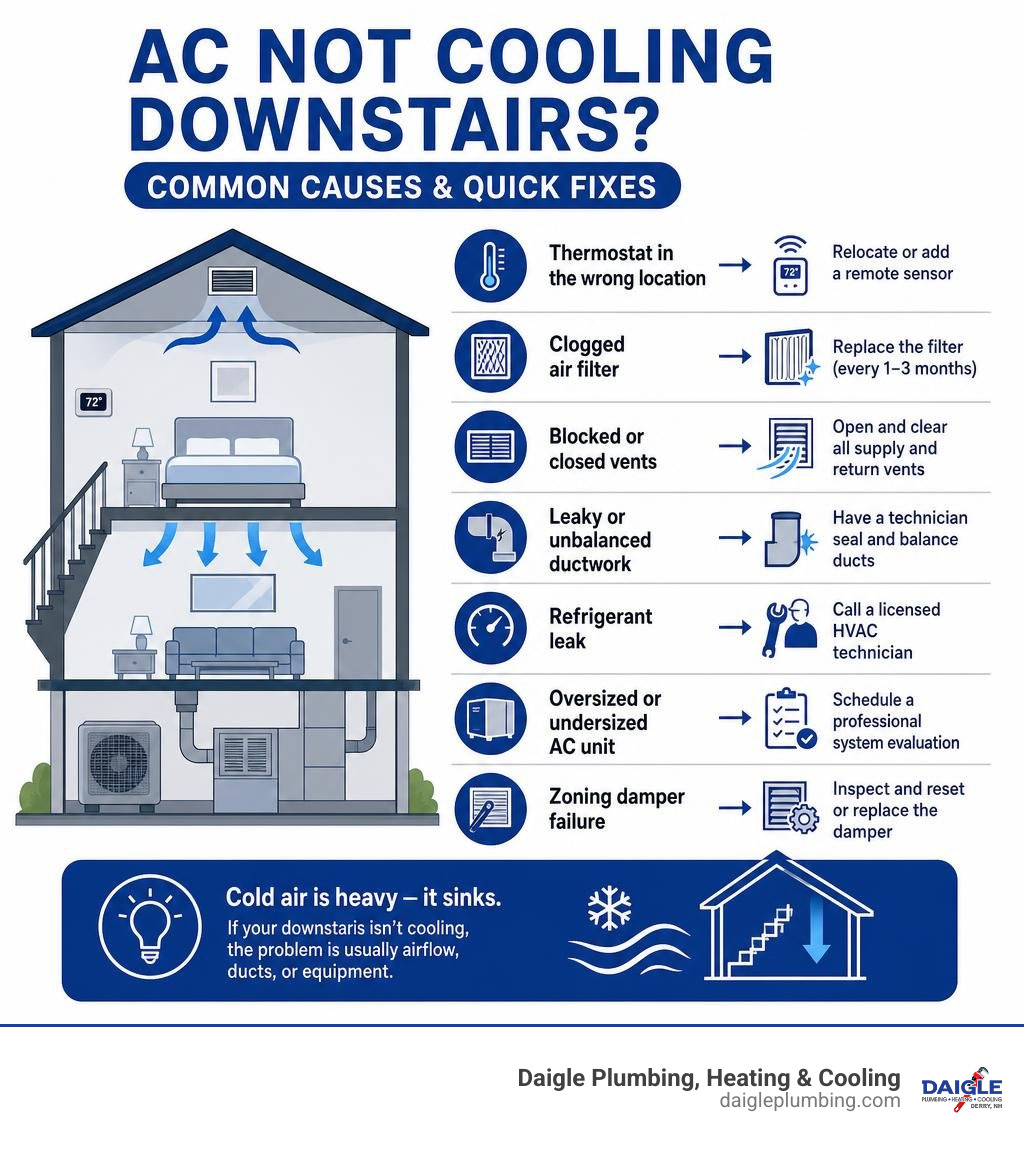
Here are the most common reasons and quick fixes:
| Cause | Quick Fix |
|---|---|
| Thermostat in the wrong location | Relocate or add a remote sensor |
| Clogged air filter | Replace the filter (every 1–3 months) |
| Blocked or closed vents | Open and clear all supply and return vents |
| Leaky or unbalanced ductwork | Have a technician seal and balance ducts |
| Refrigerant leak | Call a licensed HVAC technician |
| Oversized or undersized AC unit | Schedule a professional system evaluation |
| Zoning damper failure | Inspect and reset or replace the damper |
Cold air is heavy, so it sinks. That means your downstairs should, in theory, be the easiest floor to cool. When it isn’t, something specific is interfering with airflow, equipment performance, or your home’s design.
The problem is almost always one of three things: restricted airflow, a ductwork issue, or an equipment problem specific to the zone or unit serving the lower level. Up to 30% of conditioned air can be lost through poorly sealed ductwork alone, which means your system may be working hard and still coming up short.
At Daigle Plumbing, Heating & Cooling, our HVAC team has diagnosed and resolved many cases where an AC is not cooling downstairs due to issues that are easy to miss without the right training. Let’s walk through what you need to know to find and fix the problem.
Common Causes of Your AC Not Cooling Downstairs
When one floor cools and the other does not, the issue is usually not random. The downstairs level is either not receiving enough cold air, not returning enough warm air, or not being controlled properly by the thermostat or zoning system.
In multi-story homes around Derry, Salem, Manchester, Nashua, Londonderry, Bedford, and nearby New Hampshire communities, we often see uneven cooling caused by a mix of older ductwork, additions, finished basements, thermostat placement, and normal summer humidity.
If you want a broader overview of whole-home cooling issues, we cover more possible causes in 7 Reasons Your AC Is Not Cooling the House Properly. But if the problem is mainly downstairs, start with the causes below.
Thermostat Placement and Calibration Issues
Your thermostat is the “decision maker” for your cooling system. If it is reading the wrong temperature, installed in a poor location, or assigned to the wrong zone, your AC may shut off before the downstairs has actually cooled.
Common thermostat problems include:
- A thermostat located near a sunny window, kitchen, lamp, TV, or exterior door
- A thermostat placed upstairs while the downstairs is on the same system
- A smart thermostat using the wrong sensor or schedule
- Weak batteries or wiring issues
- A thermostat that is out of calibration
- A downstairs thermostat set to “Fan” instead of “Cool”
- A zone thermostat that is calling for cooling but not opening the proper damper
Thermostat placement can have a major impact. Research shows placement issues can cause up to 25% of multi-zone AC systems to underperform in one or more areas. A single thermostat can only measure the air around it, which is why one sensor often struggles to control several floors.
Quick thermostat checks:
- Make sure it is set to “Cool.”
- Set the temperature at least 3 to 5 degrees below the current room temperature.
- Confirm the fan is set to “Auto” for normal operation.
- Replace batteries if the display is dim or inconsistent.
- Check the schedule on smart or programmable thermostats.
- Compare the thermostat reading to a separate room thermometer.
If the thermostat says it is 72 downstairs but the room feels like a toaster with furniture, the thermostat may be misreading the space.
Clogged Filters and Restricted Airflow
A dirty filter is one of the simplest problems and one of the most common. Your AC needs steady airflow across the evaporator coil. When the filter is clogged, airflow drops, cooling capacity falls, and the system may even freeze.
Signs of restricted airflow include:
- Weak air from downstairs vents
- Some rooms cooling while others stay warm
- Longer run times
- Higher electric bills
- Ice on the refrigerant line or indoor coil
- A musty or stale feeling in downstairs rooms
- More dust around vents and returns
Most 1-inch filters should be checked monthly and replaced every 1 to 3 months depending on pets, allergies, dust, and system usage. Thicker media filters may last longer, but they still need inspection.
Do not assume a “high efficiency” filter is always better. Some dense filters can restrict airflow if the system was not designed for them. If your downstairs cooling problem started shortly after changing filter types, switch back to the recommended size and MERV rating or ask a technician to verify airflow.
For more on cooling symptoms related to airflow, see our guide on AC Not Blowing Cool Air in Derry NH.
Leaky or Unbalanced Ductwork
Ductwork is the delivery system for your cooled air. If ducts leak, sag, disconnect, or are poorly balanced, the downstairs may never get the airflow it needs.
This is especially common when:
- The downstairs was finished or remodeled after the original HVAC installation
- Duct runs are long, undersized, or crushed
- Flex duct is kinked or sagging
- Dampers were closed and never reopened
- Duct seams are leaking into basements, crawlspaces, garages, or wall cavities
- Return ducts are too small or missing
- One floor has much stronger airflow than the other
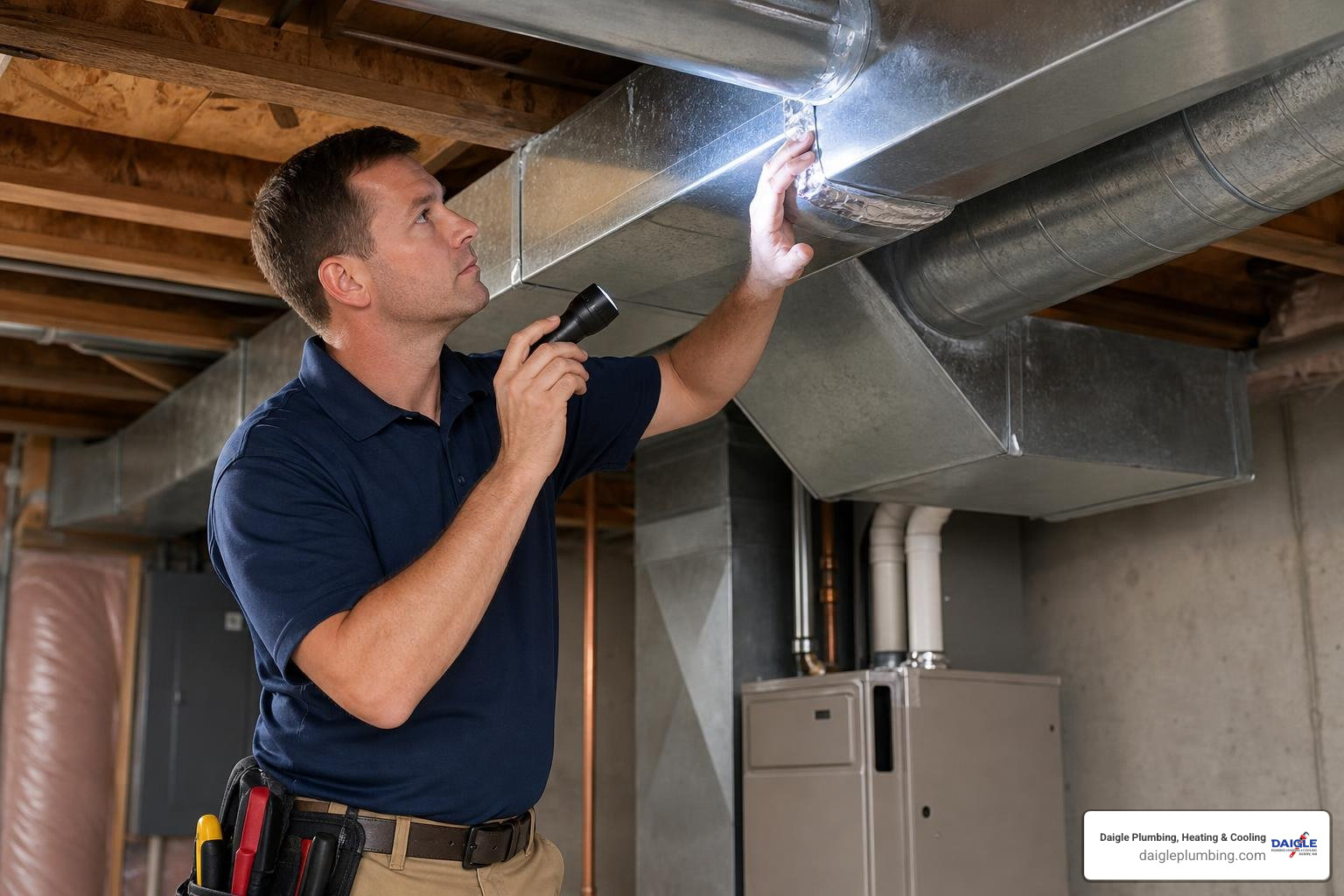
Poorly sealed or unbalanced ductwork can lose 20% to 30% of conditioned air. That is paid-for cooling disappearing before it reaches the room. Not exactly the kind of magic trick anyone wants on their utility bill.
A professional can measure static pressure, airflow, supply temperature, and return temperature to find out whether the downstairs is receiving enough air. We explain related performance and cost symptoms in poor cooling, high utility bills: what is wrong with your air conditioning unit?.
How Home Design and Physics Impact Multi-Floor Cooling
Home design matters. Your AC is not only fighting the thermostat setting. It is also fighting sunlight, insulation gaps, duct routing, humidity, room layout, and air movement between floors.
In most homes, hot air rises and cold air sinks. So if the upstairs is cool but the downstairs is warm, we look for a specific barrier to downstairs cooling, such as poor duct delivery, a closed damper, a thermostat problem, or inadequate return air.
Still, multi-floor cooling is affected by natural air movement:
| Factor | Upstairs Effect | Downstairs Effect |
|---|---|---|
| Hot air rising | Upstairs often gains heat faster | Downstairs may stay cooler if airflow is balanced |
| Cold air sinking | May make upper floors harder to cool | Should help downstairs unless airflow is blocked |
| Open stairways | Air mixes between floors | Cool air can pool or be pulled away from rooms |
| Poor insulation | Roof and exterior walls add heat load | Basement or slab areas may feel damp or uneven |
| Duct location | Attic ducts can gain heat | Basement ducts can leak or lose pressure |
| Return air design | Missing returns cause pressure issues | Poor returns can trap warm, humid air downstairs |
A home with open stairs, high ceilings, sunroom additions, finished basements, or rooms over garages can behave very differently from a simple box-shaped home. For more general background on floor-to-floor temperature differences, this article on upstairs being hotter than downstairs explains how heat movement and home design affect comfort.
The key point: if the downstairs is not cooling, do not only blame the AC unit. The home itself may be changing how air moves.
DIY Troubleshooting Steps for Homeowners
Before calling for service, there are several safe checks you can do. These steps will not solve every problem, but they can help you rule out the easy stuff.
Start here:
-
Check the thermostat
- Set it to “Cool.”
- Lower the setpoint a few degrees.
- Confirm the correct schedule or zone is active.
- Replace batteries if needed.
-
Inspect the air filter
- If it is dirty, replace it.
- Make sure the filter is installed in the correct direction.
- Use the proper size.
-
Open and clear vents
- Open all downstairs supply vents.
- Make sure furniture, rugs, curtains, and toys are not blocking vents.
- Check return grilles too. Returns are just as important as supplies.
-
Check airflow room by room
- Hold a tissue near each vent.
- Compare downstairs airflow to upstairs airflow.
- Weak or missing airflow downstairs may point to duct or damper trouble.
-
Look at the circuit breaker
- If the downstairs has a separate air handler, condenser, or zone system, check for a tripped breaker.
- Reset a breaker only once. If it trips again, call a professional.
-
Inspect the outdoor unit
- Clear leaves, grass, and debris.
- Keep about 2 feet of clearance around the condenser.
- Make sure the outdoor fan is running when cooling is on.
-
Listen and observe
- Buzzing, grinding, clicking, hissing, or repeated starting and stopping are signs you should not ignore.
-
Do a basic temperature split check
- Measure air temperature at a return grille.
- Measure air temperature at a nearby supply vent.
- Many healthy systems deliver supply air about 15 to 20 degrees cooler than return air.
If you replace a dirty filter or clear blocked vents, give the system time to recover. A properly sized AC may cool a home slowly, often around a degree per hour depending on outdoor conditions, humidity, insulation, and heat gain.
For prevention tips, visit: How to Get the Most Out of Your Cooling Equipment.
Troubleshooting a Zoned AC Not Cooling Downstairs
If your home has separate thermostats for upstairs and downstairs, you may have a zoned HVAC system. A zoning system uses dampers inside the ductwork to send air where it is needed.
When the downstairs zone is not cooling but the upstairs is fine, possible causes include:
- Downstairs thermostat not calling for cooling
- Faulty zone damper motor
- Damper stuck closed
- Zone control board issue
- Loose wiring
- Failed temperature sensor
- Incorrect thermostat programming
- Air bypass problem causing poor pressure balance
Try these safe checks:
- Set the downstairs thermostat lower than room temperature.
- Listen for airflow changes at downstairs vents.
- Check whether the air handler and outdoor unit start.
- Look for error messages on smart thermostats.
- Make sure no one manually closed a damper handle near the ductwork.
Do not force a motorized damper by hand unless you know it is designed for manual adjustment. Breaking a damper blade or actuator can turn a small repair into a bigger one.
If you have ductless equipment instead of central zoning, our Mini Split AC Not Cooling Troubleshooting guide may be more relevant.
Checking the Outdoor Condenser and Evaporator Coil
Your AC removes heat from inside the home and releases it outdoors. If either side of that process is restricted, cooling suffers.
Check the outdoor condenser for:
- Leaves or grass clippings around the cabinet
- Cottonwood, pollen, or dirt on the coil
- A fan that is not spinning
- Warm air not blowing out of the top
- Ice on the refrigerant line
- Unusual buzzing or humming
Check the indoor side for:
- Ice on the copper refrigerant line
- Water around the indoor unit
- Weak airflow
- A dirty filter
- A blower that does not start
If you see ice, turn cooling off and set the fan to “On” if it runs. Let the system thaw before restarting. Running a frozen AC can damage the compressor.
Low refrigerant, dirty coils, blower problems, and airflow restrictions can all contribute to frozen coils. Refrigerant is not used up like fuel. If it is low, there is usually a leak that must be found and repaired by a licensed professional. For general guidance, Carrier explains common reasons for an AC not blowing cold air.
Professional HVAC Solutions for Uneven Cooling
Some problems need tools, training, and licensing. A professional HVAC technician can test the system as a whole instead of guessing.
Professional solutions may include:
- Measuring airflow and static pressure
- Testing refrigerant charge
- Finding and repairing refrigerant leaks
- Cleaning evaporator or condenser coils
- Repairing blower motors, capacitors, contactors, or control boards
- Inspecting ductwork with pressure testing or visual inspection
- Sealing leaky ducts with mastic or approved materials
- Balancing airflow between floors
- Adding return ducts or transfer grilles
- Repairing zoning dampers
- Replacing outdated thermostats or adding remote sensors
- Evaluating whether the AC is oversized or undersized
An oversized system can short cycle, which means it cools quickly near the thermostat but shuts off before air circulates evenly or humidity is removed. An undersized system may run constantly and still never satisfy the downstairs zone during hot, humid New Hampshire summer days.
For more repair-related warning signs, see common AC problems needing repair.
When to Call a Professional for an AC Not Cooling Downstairs
Call a licensed HVAC technician for AC repair service if you notice:
- The downstairs is consistently 3 to 5 degrees warmer than the rest of the home
- Airflow from downstairs vents is very weak
- You see ice on refrigerant lines or the indoor coil
- The breaker trips more than once
- The outdoor unit hums but does not start
- The AC runs constantly but downstairs stays warm
- You hear hissing, buzzing, grinding, or repeated clicking
- The system blows warm air
- Your home feels humid even when the temperature looks normal
- Your energy bills rise without a clear reason
- The problem returns after replacing the filter and opening vents
Refrigerant issues, compressor problems, electrical failures, and sealed-system repairs are not DIY projects. Refrigerant handling requires proper certification, and electrical components can be dangerous even after the system is turned off.
If your system is older and repair costs are climbing, it may be time to compare repair versus replacement. Our guide to common AC repairs and replacements in Derry, NH can help you understand common next steps.
Benefits of Multi-Zone HVAC Systems
Separate thermostats or HVAC zones can make a big difference in multi-story homes. Instead of one thermostat trying to control every room, zoning lets each floor call for cooling based on its own temperature.
Benefits of multi-zone HVAC include:
- Better comfort on each floor
- Less overcooling in one area to satisfy another
- Improved humidity control when properly designed
- More control over bedrooms, finished basements, and additions
- Potential energy savings by cooling only the areas that need it
- Better performance in homes with different sun exposure or insulation levels
A true zoning system usually includes:
- Multiple thermostats or sensors
- Motorized dampers
- A zone control panel
- Properly sized ductwork
- Bypass or pressure control when needed
- Professional setup and balancing
Smart thermostats with remote sensors can help in some homes, but they are not the same as full zoning. A sensor can tell the system what a room feels like, but without dampers or separate equipment, it cannot fully control where the air goes.
Frequently Asked Questions about Uneven Home Cooling
Why is my downstairs AC not working while the upstairs AC is functioning normally?
If the upstairs AC works but the downstairs does not, the downstairs likely has a zone-specific issue. That may mean a thermostat problem, closed damper, tripped breaker, failed blower, duct leak, blocked return, or refrigerant issue on the system serving the lower level.
If you have two separate AC systems, the downstairs unit may have its own electrical, refrigerant, condensate, or blower problem. If you have one system with zoning, the issue may be with the zone controls or dampers.
Because cool air naturally sinks, a warm downstairs is a clue that something is interrupting normal airflow or equipment operation. This is different from the more common issue of upstairs rooms being hotter, which is often driven by heat rising and attic heat gain.
Can a dirty air filter cause only one floor to stop cooling?
Yes, although it usually affects the whole system to some degree. A dirty filter reduces total airflow. If the downstairs ductwork is already long, undersized, leaky, or poorly balanced, that floor may show symptoms first.
Restricted airflow can also increase static pressure, reduce coil performance, and cause freezing. Once the coil freezes, airflow and cooling can drop dramatically.
Replace the filter first, then check whether downstairs airflow improves over the next several hours. If it does not, the filter may have been part of the problem but not the whole story.
How do I know if my downstairs AC has a refrigerant leak?
Possible signs of a refrigerant leak include:
- Warm air from vents
- Ice on the evaporator coil or refrigerant line
- Hissing or bubbling sounds
- Longer run times
- Higher energy bills
- Poor humidity control
- A system that cools less each season
A basic temperature split test can provide a clue. If return air and supply air are only a few degrees apart, the system may not be removing enough heat. However, low refrigerant is not the only possible cause. Dirty coils, airflow restrictions, compressor issues, and metering device problems can create similar symptoms.
Do not add refrigerant yourself. A licensed technician should test the charge, locate the leak, repair it when possible, and confirm proper operation.
Conclusion
An AC not cooling downstairs is frustrating, but it is usually diagnosable. Start with the basics: thermostat settings, filter condition, open vents, airflow, breakers, and outdoor unit clearance. If those checks do not solve it, the next likely suspects are duct leakage, zoning damper problems, refrigerant issues, or system sizing.
At Daigle Plumbing, Heating & Cooling, we help homeowners throughout Derry, Salem, Manchester, Nashua, Auburn, Hampstead, Merrimack, Bedford, Windham, Hooksett, Hudson, Londonderry, and nearby New Hampshire communities solve cooling problems the right way. We are family-owned, licensed and insured, and backed by more than 40 years of experience.
If you are not sure what maintenance should include, and if your downstairs still feels warm no matter what you try, contact our HVAC experts and schedule service with our professional cooling services team. We will help you get comfortable again, preferably before your downstairs starts feeling like a sauna with furniture.