Benefits of Switching to an On-Demand Water Heater in Derry
Switching from a bulky storage vessel to an on-demand system changes how your household experiences daily routines. Traditional units continuously burn energy to keep 40 to 80 gallons of water hot around the clock, even while your family sleeps or stays away at work. Tankless units activate their high-efficiency burners or electric elements only when a hot water tap opens somewhere in your home.
| Feature | Traditional Storage Tank | On-Demand Tankless System |
|---|---|---|
| Hot Water Supply | Limited to stored volume (40–80 gallons) | Continuous flow on demand |
| Average Equipment Lifespan | 8 to 12 years | Up to 20+ years with regular care |
| Physical Space Requirement | Large floor footprint (10–15 sq. ft.) | Compact, wall-mounted cabinet |
| Energy Consumption | Continuous standby heat loss | Zero standby loss; heats only during use |
| Risk of Catastrophic Flood | High risk of tank wall rupture | Low risk due to lack of stored water |
For busy households running morning showers, dishwashers, and laundry back-to-back, running out of warm water becomes a relic of the past. Beyond the constant hot water, reclaiming floor space in your basement or utility room gives you extra storage. Tankless equipment also reduces long-term operating costs by eliminating standby energy losses, which can account for up to 15 to 20 percent of a home’s water heating energy expenditure. Because the system only heats water when a tap opens, it avoids the round-the-clock cycling that makes storage tanks work harder than necessary.
If you are evaluating whether to repair an aging unit or upgrade your system completely, exploring a comprehensive guide to water heater replacement and maintenance can help you weigh efficiency gains against your current utility bills. A careful comparison of equipment age, repair history, and monthly energy use often shows that a tankless upgrade pays for itself through lower operating costs and fewer service calls.
Our team delivers residential plumbing services that ensure your new equipment runs reliably from day one.
Managing Derry’s Hard Well Water and Mineral Scale in Tankless Systems
A significant portion of properties across Derry, NH rely on private well water rather than municipal supplies. While well water is fresh and cost-effective, Southern New Hampshire groundwater frequently carries elevated concentrations of dissolved calcium and magnesium. In traditional tanks, these minerals settle at the base, creating rumbling sounds. In a compact tankless unit, high temperatures cause these minerals to precipitate rapidly inside narrow heat exchanger passages.
When scale coats the internal walls of a heat exchanger, it acts as an insulating barrier. This forces the unit to fire hotter and longer to reach your desired water temperature, accelerating component wear and restricting water flow. Homeowners dealing with reduced fixture pressure often find that learning strategies for boosting your household hot water flow can diagnose whether mineral accumulation is choking their pipe network.
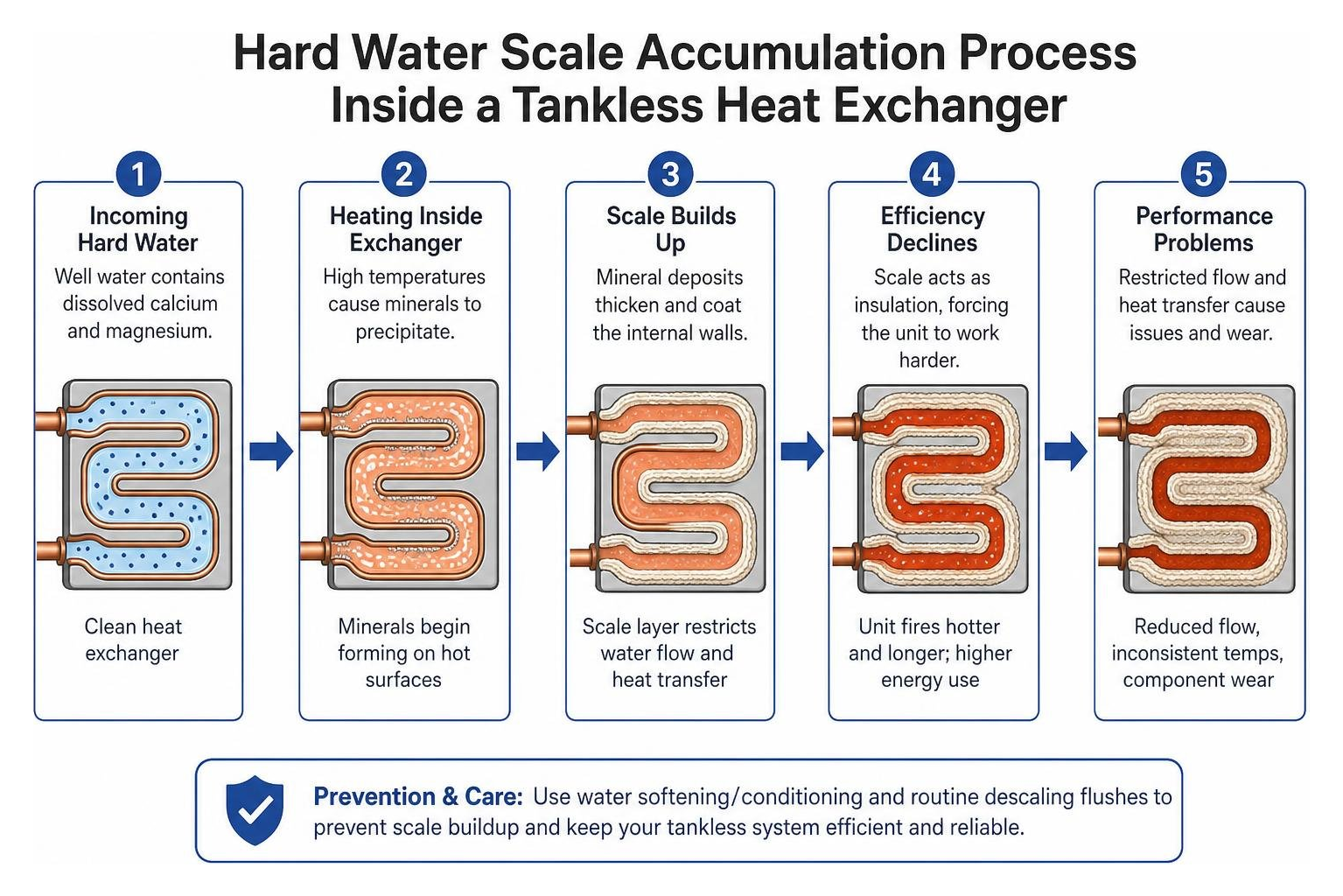
Untreated water hardness exceeding 7 to 10 grains per gallon (GPG) can shorten the lifespan of a tankless heat exchanger considerably. To protect your investment, we recommend pairing your tankless unit with dedicated service isolation valves and a whole-home water softening or conditioning system. Routine descaling flushes dissolve these mineral crystals before they restrict flow or cause temperature fluctuations.
Tankless Hot Water Heater Installation Derry NH: Costs, Sizing, and Infrastructure Needs
Sizing a tankless unit in New Hampshire requires precise engineering because our incoming groundwater drops significantly in winter, often dipping to 40°F or lower. To deliver comfortable 120°F tap water, your system must generate an 80°F temperature rise (known as Delta T). This steep temperature climb demands substantial heating power compared to warmer southern climates. For many Derry households, a professionally planned tankless hot water heater installation in Derry NH is the most reliable way to match that heating demand with the right equipment and fuel supply.
Homeowners researching project scopes should review clear insights on understanding new water heater installation costs to plan appropriately for both equipment and site modifications. Natural gas or propane tankless units typically require a dedicated 3/4-inch gas supply line rather than a standard 1/2-inch line to support higher firing rates. For whole-home electric models, electrical panels often need dedicated 120-amp to 150-amp breaker capacity.
Integrating these high-demand appliances pairs naturally with comprehensive home heating and mechanical system upgrades to keep your utility infrastructure running safely.
The U.S. Department of Energy’s guide to demand-type water heaters highlights that properly sized systems can operate 24% to 34% more efficiently than conventional storage tank models for homes that use 41 gallons or less of hot water each day. This efficiency gain, combined with the elimination of standby losses, is one of the main reasons so many Derry households are making the switch.
Step-by-Step Tankless Hot Water Heater Installation Derry NH Process
A proper installation follows a systematic workflow to ensure safety, efficiency, and code compliance:
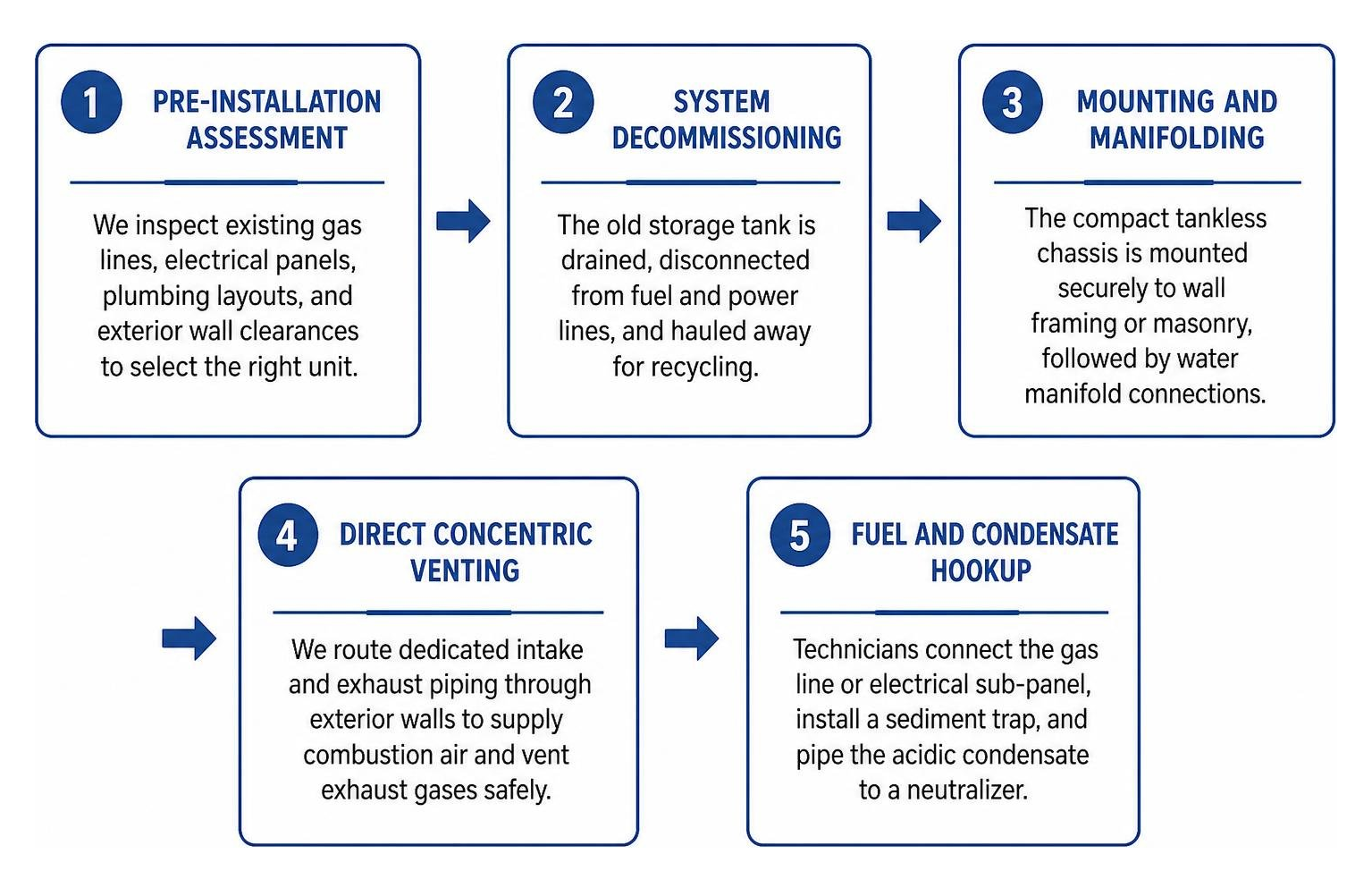
- Pre-Installation Assessment: We inspect existing gas lines, electrical panels, plumbing layouts, and exterior wall clearances to select the right unit.
- System Decommissioning: The old storage tank is drained, disconnected from fuel and power lines, and hauled away for recycling.
- Mounting and Manifolding: The compact tankless chassis is mounted securely to wall framing or masonry, followed by water manifold connections.
- Direct Concentric Venting: We route dedicated intake and exhaust piping through exterior walls to supply combustion air and vent exhaust gases safely.
- Fuel and Condensate Hookup: Technicians connect the gas line or electrical sub-panel, install a sediment trap, and pipe the acidic condensate to a neutralizer.
- Pressure Testing and Commissioning: The system is pressure-tested for leaks, purged of air, calibrated to target temperature settings, and tested under simultaneous fixture demands.
Preparing for Tankless Hot Water Heater Installation Derry NH in Older Homes
Older housing stock across Derry, NH presents unique structural quirks, from fieldstone foundations to dated distribution plumbing. Historic properties often feature legacy galvanized piping or older 100-amp electrical panels that cannot shoulder modern mechanical loads without upgrades.
When transitioning away from masonry chimney vents, direct-vent concentric PVC or polypropylene piping routed through rim joists provides a safer, code-compliant path for condensing units. Condensing tankless models extract maximum heat from exhaust gases, creating cooler, acidic flue gas and condensate that cannot safely vent into standard chimneys. Our licensed technicians navigate these retrofits cleanly, updating local plumbing runs and ensuring every installation meets current safety standards and local permitting requirements.
Essential Maintenance and Warranty Protection for Long-Term Performance
Tankless systems are durable machines, but they require periodic care to maintain peak thermal efficiency. Most major manufacturers require documentation of annual maintenance by a licensed plumber to keep their 10- to 15-year heat exchanger warranties valid.
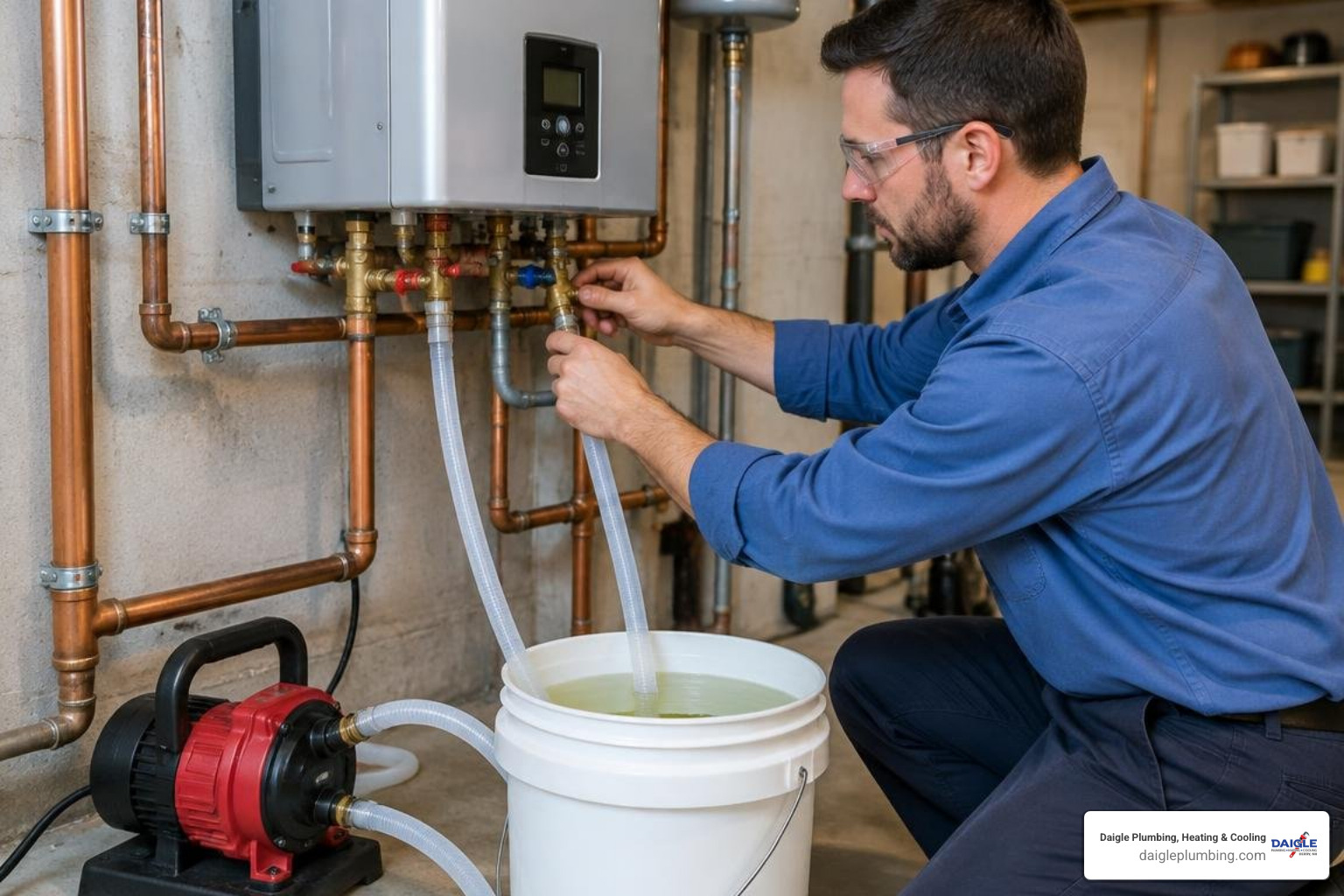
An annual maintenance appointment includes circulating a food-grade descaling solution through the unit’s isolation valves to clear calcium deposits from the copper or stainless-steel heat exchanger. Plumbers also clean the in-line water inlet filter, check exhaust vent pathways for obstructions, inspect ignition rods, test flame sensors, and verify that the condensate drain flows freely. Taking these simple steps protects against unexpected system lockouts, maintains factory-rated energy efficiency, and keeps your morning shower steaming for decades.
Frequently Asked Questions About Tankless Water Heaters in Derry, NH
What size tankless water heater is recommended for a typical Derry home?
For an average Derry home with two to three bathrooms, a gas-fired unit rated between 199,000 BTU and producing 8.0 to 10.0 gallons per minute (GPM) is standard. This capacity accounts for cold winter groundwater and allows you to run two showers and a washing machine at the same time without losing water temperature.
How does hard well water affect a tankless water heater warranty?
Untreated hard well water accelerates mineral scaling, which insulates heat exchangers and causes hot spots. Many manufacturer warranties explicitly exclude damage caused by scale buildup. Installing a water softener or scheduling yearly descaling flushes keeps the heat exchanger protected and preserves your warranty coverage.
How long does a tankless water heater installation take in Derry?
A standard conversion from a traditional storage tank to a wall-mounted tankless unit usually takes one full working day (roughly 6 to 8 hours). Complex retrofits involving main gas line upsizing, extensive venting reroutes, or electrical panel upgrades may require additional time, which our team reviews with you during the initial site assessment.
Conclusion
Upgrading to an on-demand water heating system gives your home endless hot water, lower monthly operating costs, and valuable reclaimed square footage. While our cold New Hampshire winters and local well water require proper system sizing and mineral management, a professionally designed installation ensures decades of smooth operation.
Daigle Plumbing, Heating & Cooling has delivered dependable mechanical expertise across Southern New Hampshire since 1986. As a family-owned business, our licensed and insured team focuses on thorough diagnostics, straightforward communication, and lasting quality. Whether you need planned equipment replacements or urgent service, turn to our team for professional water heater and plumbing solutions tailored to your home.