Why Ductless Air Conditioning Systems Are Becoming the Smart Choice for Homeowners
Air conditioning systems ductless, also called mini-splits, are heating and cooling systems that work without ductwork. Instead, they connect a small outdoor compressor to one or more indoor air handlers through a narrow conduit in the wall.
Here’s a quick overview of what makes them different:
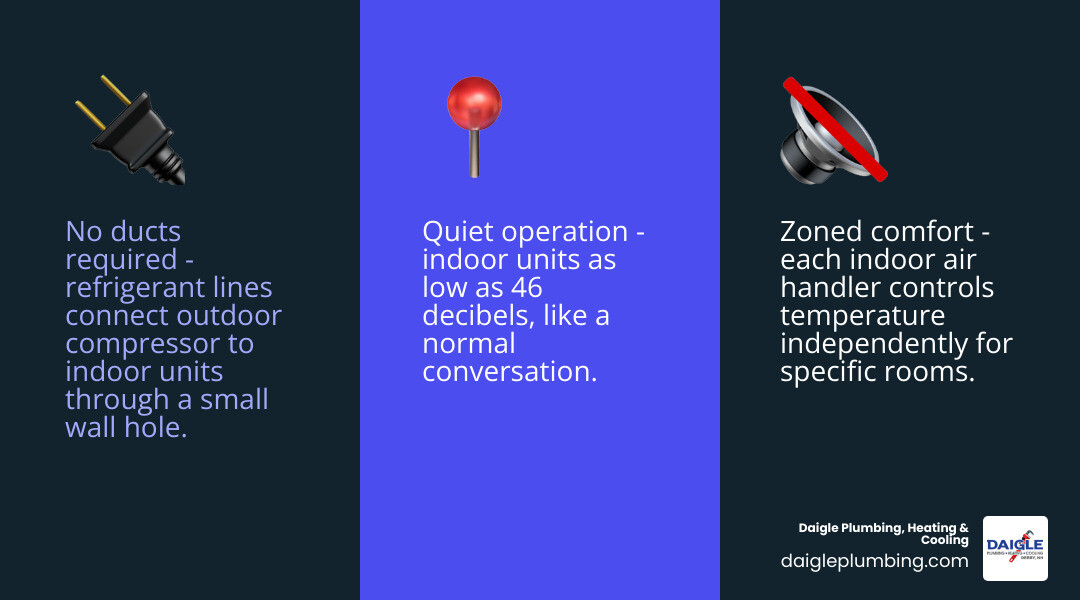
- No ducts required — refrigerant lines run through a small hole in the wall
- Zoned comfort — each indoor unit controls its own space independently
- Heating and cooling — most models work as heat pumps year-round
- High efficiency — ductwork in central systems can waste more than 30% of energy; mini-splits avoid that loss entirely
- Quiet operation — outdoor units run as low as 46 decibels, about the level of a normal conversation
If you’re a homeowner dealing with rooms that never seem to reach the right temperature — or you’re adding space to your home where ductwork isn’t practical — a ductless system is worth a serious look.
Traditional central AC works well when you already have ducts. But in older homes, additions, garages, or finished attics, running new ductwork is expensive and invasive. Ductless systems solve that problem with minimal disruption to your home.
At Daigle Plumbing, Heating & Cooling, we’ve helped countless homeowners evaluate and install air conditioning systems ductless for everything from single bedrooms to whole-home setups. In this guide, we’ll explain exactly how they work and what you need to know before choosing one.
Defining Air Conditioning Systems Ductless
When we talk about air conditioning systems ductless, we are referring to a highly flexible HVAC solution known formally as a ductless mini-split. Unlike a central air conditioner that sits outside and blows air through a complex web of metal or plastic ducts hidden in your attic or crawlspace, a ductless system delivers conditioned air directly into the room where the unit is installed.
According to the Department of Energy, these systems have two main components: an outdoor compressor/condenser and an indoor air-handling unit (or units). What makes them “ductless” is the way these two halves communicate. Instead of bulky ducts, they are linked by a sleek conduit that houses the power cable, refrigerant tubing, suction tubing, and a condensate drain.
One of the biggest selling points for our customers in Derry and Salem, NH, is how non-invasive the installation is. We don’t have to tear apart your ceilings or walls. Instead, we only need to make a small wall penetration—usually about three to four inches in diameter—to pass the conduit through. This makes it an ideal choice for historic New Hampshire homes that weren’t originally built with cooling in mind.
Components of a Mini-Split
To understand the magic of these systems, you have to look at what’s inside that conduit. It isn’t just a “pipe”; it’s a lifeline for your home comfort.
- Refrigerant Lines: These small copper tubes carry the refrigerant back and forth between the indoor and outdoor units. This is how heat is actually moved—either pulled out of your house in the summer or brought in during the winter.
- Power Cable: This provides the electricity needed to run the indoor fan and the electronic components of the air handler.
- Suction Tubing: This is part of the refrigerant cycle, ensuring the gas returns to the compressor at the right pressure.
- Condensate Drain: As the indoor unit cools the air, it also removes moisture (dehumidification). That water has to go somewhere, so a small drain line carries it safely outside.
How Mini-Split Technology Operates
The way air conditioning systems ductless work is actually quite fascinating. Most traditional AC units are either “on” or “off.” Think of it like a light switch. When your house gets too warm, the AC kicks on at 100% power, blasts cold air until the thermostat is satisfied, and then shuts off. This leads to those annoying temperature swings and high energy spikes.
Mini-splits use inverter technology, which means the compressor can run at variable speeds instead of simply turning on and off. Think of it more like a dimmer switch than a basic light switch. It adjusts up or down to keep the temperature steady. If a room needs only a small amount of cooling, the system can run at a low, quiet speed, which helps improve comfort and reduce energy use.
Year-Round Comfort with Air Conditioning Systems Ductless
Many people ask us, “Does this only provide cooling?” The answer for most modern systems is a resounding no. Most ductless units are actually heat pumps. By using a reversing valve, the system can flip its operation. In the summer, it pumps heat out of your house. In the winter, it extracts heat from the outdoor air (yes, even when it’s cold!) and pumps it inside.
For our neighbors in Manchester and Nashua, this is a game-changer. Modern “hyper-heat” models can provide reliable warmth even when New Hampshire temperatures drop well below zero. You can learn more about why homeowners in our area love this versatility in the essential guide to mini splits.
Single-Zone vs. Multi-Zone Configurations
One of the best things about air conditioning systems ductless is their scalability.
- Single-Zone: This consists of one outdoor unit connected to one indoor unit. It’s perfect for a master bedroom, a new sunroom, or a garage workshop.
- Multi-Zone: A single, more powerful outdoor unit can be connected to multiple indoor units (sometimes up to eight!). This allows you to create “zones” throughout your home. You can keep the kitchen at 68 degrees while the guest room stays at 72. This level of control is why many people find these systems more comfortable than central air.
However, keep in mind that in a multi-zone setup, all units generally need to be in the same mode—either all cooling or all heating. If you’re running into issues with your multi-zone setup, check out our solutions for mini-split AC problems.
Advantages of Ductless HVAC Over Traditional Systems
Why choose ductless over a traditional forced-air system? The biggest reason is efficiency. In a standard central AC system, the air has to travel through long stretches of ductwork. If those ducts are leaky or located in a hot attic, you can lose more than 30% of your cooling power before the air even reaches your bedroom. Ductless systems eliminate that loss entirely because there are no ducts.
Another major advantage is noise—or the lack of it. Traditional window units are loud enough to drown out a TV, and even central AC systems have that “pinging” sound of metal ducts expanding and contracting. A ductless indoor unit operates as quietly as 21 to 27 decibels. To put that in perspective, the outdoor units often run at about 46 decibels, which is quieter than a typical conversation.
For a deeper dive into which system is right for your specific home layout, see our comparison of ductless systems vs traditional HVAC.
| Feature | Ductless Mini-Split | Central AC | Window Unit |
|---|---|---|---|
| Installation | Easy (3″ hole) | Invasive (Ductwork) | Temporary (Window) |
| Energy Loss | Near 0% | 30%+ via Ducts | High (Air Leaks) |
| Noise Level | Whisper Quiet | Moderate | Loud |
| Zoning | Individual Rooms | Whole House | Single Room |
| Heating | Yes (Heat Pump) | Often Separate | Rarely |
Improved Indoor Air Quality
We often forget that ducts can be breeding grounds for dust, pet dander, and even mold. When you turn on a central system, you might be blowing those allergens all over your house. Air conditioning systems ductless feature multi-stage filtration systems that are much easier to maintain. Most have washable filters that you can simply pop out, rinse in the sink, and put back in. This leads to a significant reduction in airborne particulates. For more on how this compares to other options, read our mini-splits and window units comparison.
Sizing and Installation Considerations
Choosing the right air conditioning systems ductless isn’t just about picking a brand; it’s about the math. If you buy a unit that is too small, it will run constantly and never get the room cool. If it’s too big, it will “short cycle,” turning on and off so quickly that it never has a chance to dehumidify the air, leaving your room feeling cold but clammy.
We look at several key ratings:
- BTU (British Thermal Units): This measures cooling capacity. A typical 12,000 BTU unit can cool about 500 square feet.
- SEER2 (Seasonal Energy Efficiency Ratio): This tells you how much cooling you get for every dollar of electricity. Modern units can reach SEER2 ratings of 30 or higher—nearly double that of many older central systems!
- HSPF2 (Heating Seasonal Performance Factor): This is the equivalent of SEER for the heating side.
Proper Sizing for Air Conditioning Systems Ductless
To get the sizing right, we perform what’s called a “load calculation.” We don’t just look at square footage; we look at how many windows you have, the quality of your insulation, and even which direction the room faces. A room with huge south-facing windows in Londonderry is going to need more cooling power than a shaded basement in Merrimack. We discuss the importance of this in our pros and cons of mini-split systems guide.
Professional vs. DIY Installation
You might see “DIY” mini-split kits at big-box stores. While they are tempting, we strongly recommend professional installation. Why? First, handling refrigerant requires a federal EPA license. Second, if a DIY install leaks refrigerant, it can damage the environment and kill your system’s efficiency.
Furthermore, most manufacturers will only honor their warranty (which can be up to 10 or 12 years) if the system was installed by a licensed HVAC professional. At Daigle, we ensure the lines are vacuum-tested and the refrigerant charge is exact to the ounce. This precision is what allows the system to handle those spring temperature swings we get here in New Hampshire.
Maintenance and Longevity
One of the best things about air conditioning systems ductless is their lifespan. With proper care, these systems can easily last 15 to 20 years. However, “proper care” is the operative phrase.
The most important thing you can do is clean the filters every month during heavy use. If the filters are clogged, the system has to work twice as hard, which wears out the motor and spikes your electric bill. We also recommend a professional tune-up once or twice a year to check the outdoor coils and clear the condensate drain lines.
Troubleshooting Common Issues
Even the best systems can run into hiccups. If your unit isn’t cooling properly, it’s often one of three things:
- Dirty Filters: This is the cause of 90% of airflow issues.
- Refrigerant Leaks: If the air coming out isn’t cold, you might have a slow leak in the copper lines.
- Drainage Clogs: If you see water dripping from the indoor unit, the condensate drain is likely backed up with dust or algae.
Frequently Asked Questions
How much does a ductless mini-split cost?
In our region, a single-zone system typically costs between $3,000 and $5,000 installed. Multi-zone systems for an entire home can range from $8,000 to $15,000 or more, depending on the number of units and the complexity of the electrical work. While the upfront cost is higher than a window unit, the energy savings and home value increase often make it the cheaper option over time.
Can ductless systems handle extreme New Hampshire winters?
Yes! While older heat pumps struggled in the cold, modern “Cold Climate” or “Hyper-Heat” models are designed to provide 100% heating capacity down to 5°F and continue operating efficiently even at -13°F. They are a reliable primary heat source for many homes in Derry and Nashua.
Are ductless air conditioners noisy?
Not at all. In fact, they are among the quietest HVAC options available. The noisy compressor is located outside, far from your living space. The indoor unit only contains a small, balanced fan that is often quieter than a desktop computer fan.
Conclusion
Air conditioning systems ductless have truly changed the way we think about home comfort in New Hampshire. Whether you are looking to fix a “hot room” in your Bedford home or you want to completely move away from expensive oil heat in Windham, ductless technology offers a path to lower bills and better comfort.
At Daigle Plumbing, Heating & Cooling, we’ve been serving the Derry, NH area for over 40 years. As a family-owned business, we take pride in our “Satisfaction Guarantee” and our deep expertise in these systems. We are particularly proud of our work with Mitsubishi Ductless Systems, which are widely considered the gold standard in the industry.
If you’re ready to see how a mini-split can transform your home, or if you need expert repairs with genuine parts, we are here to help. From Salem to Manchester and everywhere in between, our licensed experts are just a phone call away. Contact our mini-split specialists to find the perfect climate control solution for your family.