When Your Well Stops Working: What to Do About Well Pump Repair
Well pump repair is something most homeowners with a private well will face at some point, and knowing what to do first can save you time, money, and a lot of frustration.
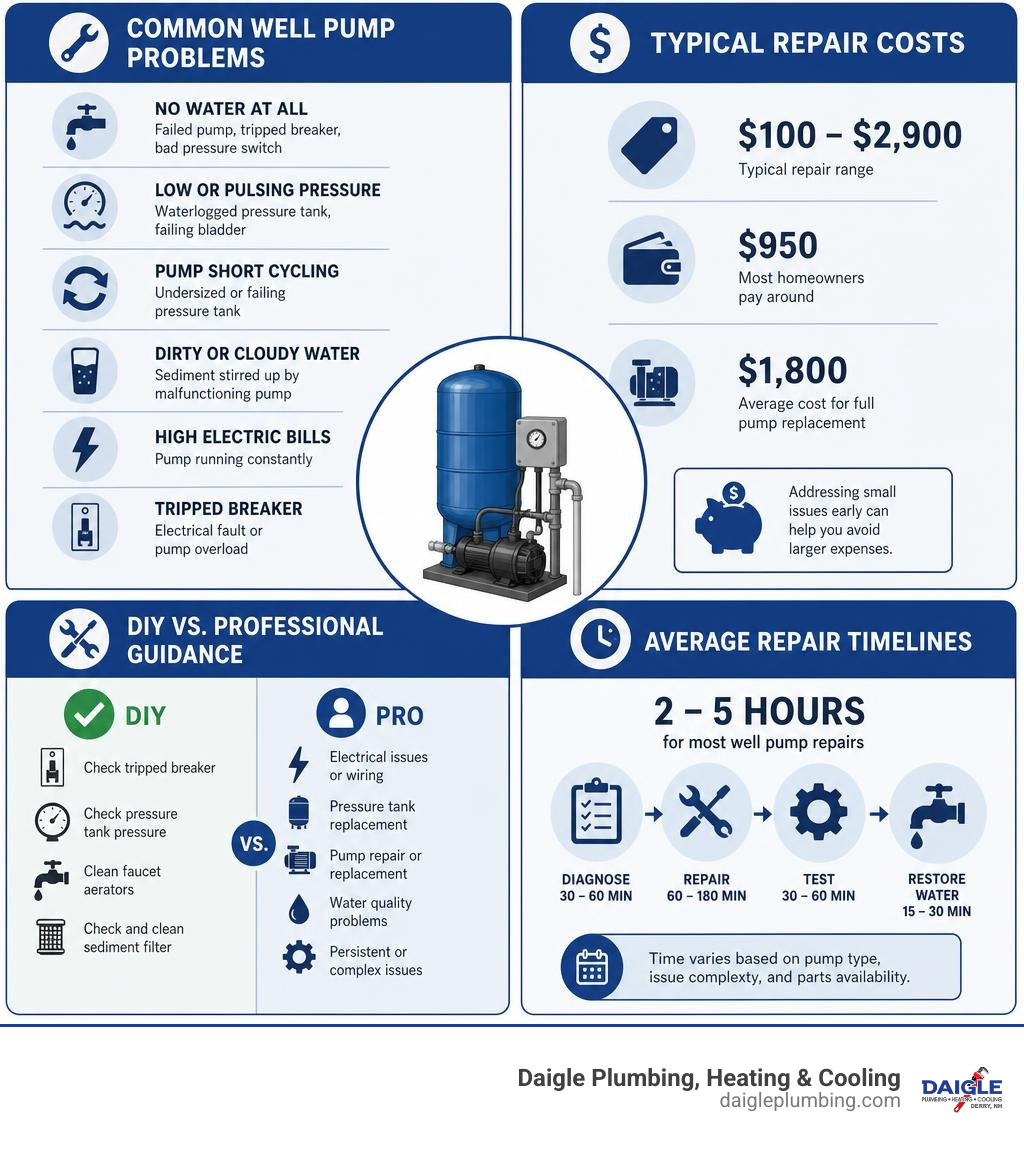
Here’s a quick overview of the most common well pump fixes:
| Problem | Likely Cause | DIY or Pro? |
|---|---|---|
| No water at all | Failed pump, tripped breaker, bad pressure switch | Check breaker first; call a pro if it persists |
| Low or pulsing pressure | Waterlogged pressure tank, failing bladder | DIY pressure tank check; pro for replacement |
| Pump short cycling | Undersized or failing pressure tank | Pro recommended |
| Dirty or cloudy water | Sediment stirred up by malfunctioning pump | Call a pro |
| High electric bills | Pump running constantly | Call a pro |
| Tripped breaker | Electrical fault or pump overload | Call a pro |
Repair costs can vary widely based on the pump type, well depth, parts needed, and how accessible the system is. In many cases, a technician can diagnose the issue first and explain whether a targeted repair or full pump replacement makes the most sense.
Losing water pressure mid-shower or turning on a faucet and getting nothing are not just inconveniences. For homeowners in Derry, NH, who depend on a private well for every drop of water in their home, a failing well pump is a genuine emergency.
The good news? Some well pump problems are surprisingly simple to diagnose and fix yourself. Others need a licensed professional with the right tools and parts. This guide walks you through both.
At Daigle Plumbing, Heating & Cooling, our plumbing team has spent decades helping Southern New Hampshire homeowners diagnose well pump problems, restore water pressure, and decide when a repair or replacement is the safer long-term choice.
Understanding Your System: Types of Well Pumps
Before diving into troubleshooting, it helps to understand what kind of equipment is hiding in your basement or down in your well. Different pumps function in entirely unique ways, which means their repair processes and failure points differ too.
In Southern New Hampshire homes, we typically see two primary configurations:
- Jet Pumps (Above-Ground): These are usually mounted inside the home, a basement, or an attached utility shed. Jet pumps operate using suction to pull water up from the ground.
- Shallow Well Jet Pumps: Designed for water tables 25 feet deep or less, these use a single inlet pipe to pull water.
- Deep Well Jet Pumps: Rated for depths down to about 110 feet, these utilize a two-pipe system to push water down to help force more water back up.
- Submersible Pumps (In-Well): These are long, cylindrical units lowered directly down into the well casing, deep underground. Submersible pumps are submerged in water and push water upward rather than pulling it. They are highly efficient, quieter than jet pumps, and typically last much longer because they don’t have to work against gravity in the same way. They are ideal for deep wells ranging from 70 to over 500 feet.
Knowing which system you have is the first step in diagnosing issues. If you are considering transitioning from an older jet pump to a modern, reliable system, our well pump installation and repair services can help you evaluate whether repair, replacement, or a submersible conversion is the right fit for your home.
Common Signs You Need Well Pump Repair
When a well pump begins to struggle, it rarely goes silent without warning. Usually, it sends out several clear distress signals. Recognizing these signs early can save you from a total water outage.
- Low Water Pressure: If your shower feels more like a gentle drizzle than a refreshing rinse, your pump may be struggling to maintain pressure.
- Sputtering Faucets: If your faucets gasp, spit, or cough air when turned on, there is likely an issue with air entering your water lines.
- Short Cycling: This is when your pump turns on and off rapidly every few seconds. It is a major warning sign that puts immense wear on your motor.
- Dirty, Cloudy, or Discolored Water: Malfunctioning pumps can stir up sediment from the bottom of your well, bringing dirt directly into your home’s plumbing.
- Spiking Electric Bills: If your electric bill suddenly shoots up, your pump may be running constantly without reaching its cutoff pressure.
- Tripped Breakers: A pump motor that is overheating or short-circuiting will draw too much electrical current, causing your breaker to trip repeatedly.
Dirty water, pressure changes, and unreliable flow can also point to issues elsewhere in the plumbing system. If you are unsure whether the problem starts at the pump, tank, or plumbing lines, Daigle Plumbing, Heating & Cooling provides full residential plumbing services to help homeowners in Derry, Salem, Manchester, Nashua, Auburn, Hampstead, Merrimack, and Bedford, NH, find the source of the issue.
Sputtering Faucets and Fluctuating Water Pressure
Sputtering faucets indicate that air has found its way into what should be a closed, pressurized water system. This usually happens when the water level in the well drops below the pump intake, or when there is a crack in the drop pipe inside the well.
Fluctuating pressure, on the other hand, is often rooted in the pressure switch. The pressure switch acts as the brain of the system, telling the pump when to turn on (cut-in pressure) and when to turn off (cut-out pressure). If the switch is dirty, worn, or improperly calibrated, your water flow will surge and fade unpredictably.
Well Pump Short Cycling and Constant Running
Short cycling is one of the most destructive things that can happen to a well system. Every time a pump motor starts up, it experiences a high surge of electrical current and mechanical stress. If it starts and stops constantly, the motor will quickly burn out.
Short cycling is almost always caused by a failure in the pressure tank. Inside the tank is a rubber bladder filled with air, which keeps the water pressurized so your pump doesn’t have to turn on every single time you flush a toilet or wash your hands. Homeowners dealing with rapid on-off cycles can use Daigle Plumbing, Heating & Cooling‘s article on well pump short cycling causes and solutions to better understand why the tank, switch, or pump may be overworking.
How to Troubleshoot and Perform Safe DIY Repairs
Before you panic and schedule an emergency service call, there are a few safe, straightforward troubleshooting steps you can perform.
Safety First: Always turn off the electrical power to your well pump at the main breaker panel before touching any electrical components. Use a reliable voltage tester to verify that the power is completely off.
Step 1: Check the Power and Reset the Breaker
It sounds simple, but a surprising number of “no water” calls are resolved by resetting a tripped circuit breaker.
- Locate your main electrical panel.
- Look for the double-pole breaker labeled “Well Pump.”
- If it has tripped, flip it completely to the “Off” position, then flip it back to “On.”
- If the breaker trips again immediately, do not try to reset it again. This indicates a direct electrical short or a seized pump motor, and trying to force it can cause an electrical fire.
Step 2: Inspecting the Pressure Switch for DIY Well Pump Repair
The pressure switch is usually located on a small, quarter-inch pipe near the base of your pressure tank.
- Turn off the power at the breaker panel.
- Remove the plastic cover of the switch by unscrewing the nut on top.
- Inspect the electrical contacts (the small metal pads that press together). If they look burnt, pitted, or covered in black soot, they may not be making a clean connection.
- As a temporary, emergency fix, you can gently clean the contacts with a fine nail file or emery cloth to restore contact. However, a pitted switch should be replaced promptly.
- If you need to wire a new switch or adjust its operation, use the manufacturer’s wiring diagram and call a licensed professional if you are not fully comfortable working around 220V electrical equipment.
Step 3: Test the Pressure Tank Air Valve
If your pump is short cycling, you need to check if your pressure tank is waterlogged.
- Locate the Schrader valve (it looks exactly like a bicycle tire valve) on top of your pressure tank.
- Remove the cap and gently depress the center pin with a small screwdriver.
- If water squirts out of the valve, your tank’s internal bladder has ruptured. The tank is waterlogged and must be replaced.
- If only air comes out, you can check the pressure with a standard tire gauge. The air pressure should be exactly 2 PSI below your pump’s cut-in pressure (for example, if your switch turns the pump on at 30 PSI, the tank air pressure should be 28 PSI).
For homeowners comparing a repair against a system upgrade, Daigle Plumbing, Heating & Cooling‘s well pump upgrade guide explains how newer pump configurations, properly sized pressure tanks, and efficiency improvements can make a private well system more reliable.
Professional Repair Costs and Timelines
When DIY troubleshooting isn’t enough, it’s time to bring in the professionals. Having realistic expectations about the repair process can help you plan, ask better questions, and understand why one well system may need a simple part replacement while another may need more involved service.
What Affects Well Pump Repair and Replacement Costs?
Instead of relying on a generic price range, it is more useful to understand what drives the scope of the job:
| Service | What Usually Affects the Scope |
|---|---|
| Well Pump Repair | Pump type, system age, electrical condition, pressure switch issues, and whether the pump is accessible above ground or located inside the well |
| Well Pump Replacement | Well depth, pump horsepower, wiring condition, pipe condition, and the equipment needed to safely remove and install the pump |
| Pressure Tank Replacement | Tank size, bladder failure, waterlogged tank symptoms, available installation space, and whether related valves or fittings also need attention |
| Pressure Switch Replacement | Switch condition, wiring condition, pressure settings, sediment buildup, and whether the issue is isolated or tied to a larger pressure problem |
Note: A technician can diagnose the system, explain what failed, and provide options before repair or replacement work begins.
How Long Does a Well Pump Repair or Replacement Take?
No one likes being without water, which is why we work quickly to restore your service.
- Above-Ground Jet Pumps: Replacing an above-ground pump is relatively straightforward and typically takes our technicians two to four hours.
- Submersible Pumps: Because these pumps must be pulled up from deep underground using specialized hoists, replacing a submersible pump typically takes four to five hours.
Key Factors to Consider for Residential Well Pump Repair
When choosing a service provider in Southern New Hampshire, make sure they offer:
- Proper Licensing and Certification: Ensure they are fully licensed New Hampshire water system professionals.
- Comprehensive Parts Inventory: Technicians should arrive in “rolling warehouses” stocked with pressure switches, control boxes, and multiple pump sizes to ensure same-day repair.
- Solid Warranties: Look for companies that stand behind their work with robust labor and parts warranties.
For local homeowners, a well pump issue can also overlap with water heater, pipe, or fixture concerns. Daigle Plumbing, Heating & Cooling‘s plumbing installation and replacement services give Southern New Hampshire homeowners a single team to evaluate related plumbing upgrades while restoring reliable water flow.
Differences in Residential, Commercial, and Agricultural Systems
The scale of your well system dictates its complexity.
- Residential Systems: Typically utilize smaller, single-phase pumps (1/2 to 1.5 horsepower) designed to supply 10 to 20 gallons per minute.
- Commercial & Agricultural Systems: These demand high-capacity, three-phase pumps that can handle constant, high-volume water needs. Repairs on these systems require heavy-duty hoisting rigs and advanced electrical diagnostic tools.
Frequently Asked Questions about Well Systems
How often should a well pump system be serviced or inspected?
We highly recommend having your well pump system professionally inspected once a year. An annual checkup allows us to test the electrical draw of the motor, verify the pressure tank’s air charge, clean out the pressure switch, and test your water quality. This preventative maintenance can catch minor issues before they turn into expensive, mid-winter emergencies.
What size well pressure tank do I need for my home?
Your pressure tank needs to be sized based on your pump’s flow rate (measured in Gallons Per Minute, or GPM). A general rule of thumb is that the tank should provide a “drawdown” (the amount of water stored before the pump turns on) equal to one gallon per GPM of pump capacity.
Tank sizing also depends on how many fixtures your household uses at once, whether the pump is short cycling, and how much usable water you want available between pump cycles. If the tank is too small, the pump may start and stop more often than it should, which can shorten the life of the system and create frustrating pressure swings.
For homeowners who want to understand the basics before choosing a replacement, Daigle Plumbing, Heating & Cooling explains how to properly size a well pressure tank based on pump capacity, drawdown, and household demand.
A 40-gallon tank can be a practical option for some homes, but it is not automatically the right size for every well system. The best choice depends on your pump output, pressure switch settings, available space, and how much water your home typically uses during peak demand.
If you are comparing common tank sizes, Daigle Plumbing, Heating & Cooling also covers what to know about 40-gallon water well pressure tanks so you can better understand where that size fits and when a different tank may be more reliable.
Can a bad well pump cause high energy bills?
Yes, absolutely. If your pump has worn-out internal impellers, a failing motor, or is paired with a waterlogged pressure tank, it will have to run much longer, or even constantly, to maintain water pressure. Because well pumps draw a significant amount of electricity, a constantly running pump will cause your monthly energy bills to skyrocket.
Conclusion
A failing well pump can throw your entire household into chaos, but you don’t have to navigate it alone. Whether you need a quick pressure switch adjustment or a complete submersible pump replacement, having an experienced team on your side makes all the difference.
At Daigle Plumbing, Heating & Cooling, we have spent over 40 years helping families throughout Derry, NH, and surrounding communities keep their water flowing cleanly and reliably. As a family-owned business, we pride ourselves on our licensed expertise, upfront pricing, and our 100% satisfaction guarantee.
If you are experiencing low water pressure, sputtering faucets, or a total loss of water, don’t wait for the problem to get worse. Contact our professional well pump repair technicians today to schedule your diagnostic visit. We are here to help!