When Your Water Stops: What You Need to Know About Water Well Pump Repairs
Water well pump repairs are needed when your home’s well system fails to deliver water at the right pressure, or stops working altogether. Here’s a quick overview of the most common issues and what causes them:
| Symptom | Likely Cause |
|---|---|
| No water at all | Pump failure, tripped breaker, or broken pipe |
| Low or pulsing water pressure | Waterlogged pressure tank or failing pump |
| Sputtering or spitting faucets | Air leak in the pressure tank |
| Pump runs constantly | Waterlogged tank or bad pressure switch |
| Clicking sounds near the tank | Faulty pressure switch |
| Rising electric bills | Pump motor working harder than it should |
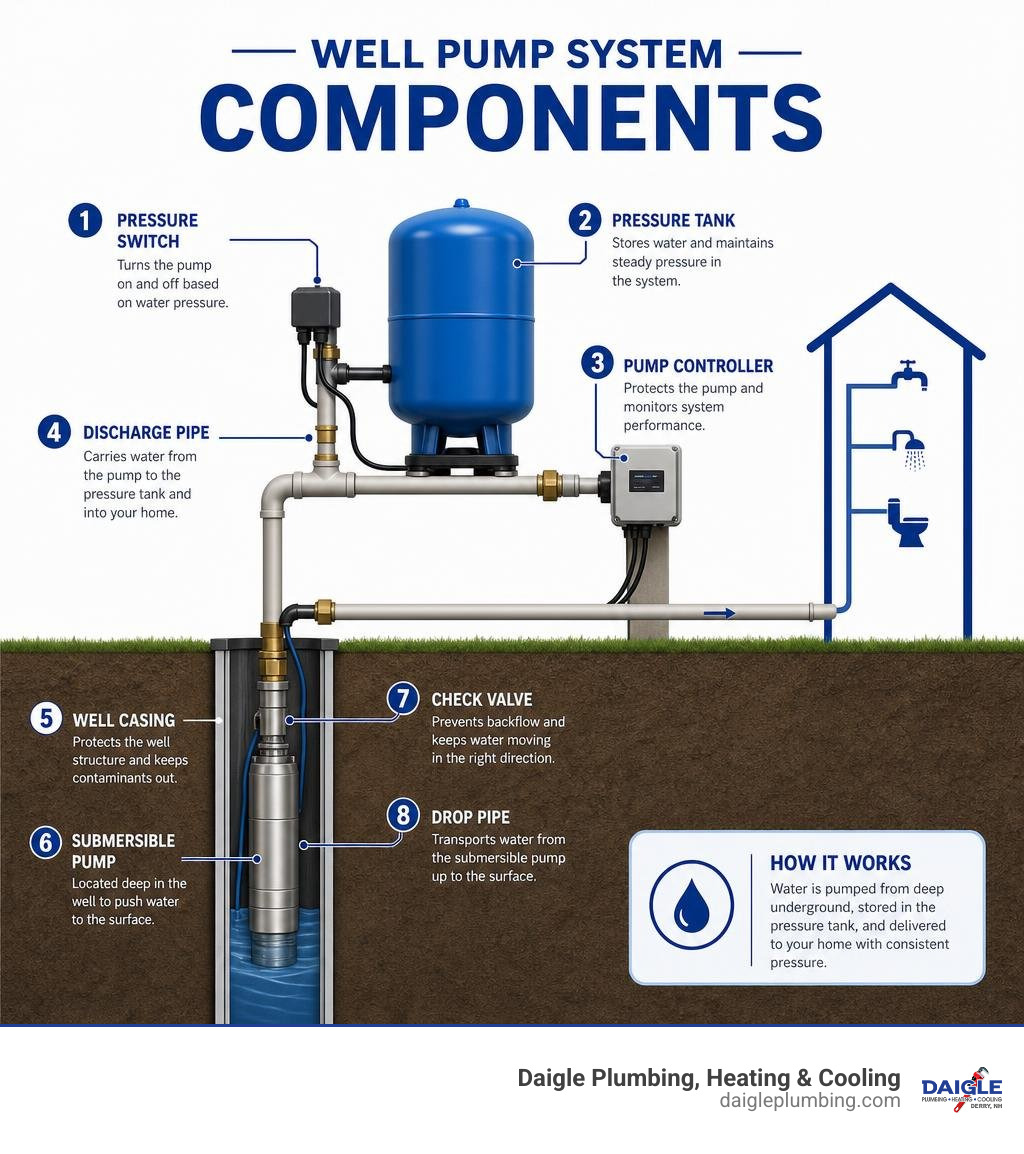
Most well pump problems trace back to just a few components: the pump itself, the pressure switch, the pump controller, or the pressure tank. Knowing which part is causing trouble is half the battle.
Well systems today are far more complex than the hand pumps of the past. A modern system is an electromechanical setup that depends on every component working together. When one part fails, the whole system feels it.
At Daigle Plumbing, Heating & Cooling, our team brings hands-on service experience and operational leadership across the plumbing and HVAC industry, including extensive expertise with water well pump repairs and system diagnostics. In this guide, we walk you through exactly how to identify, troubleshoot, and fix the most common well pump problems, step by step.
Recognizing Common Signs Your Well System Needs Attention
When a well pump system begins to wear down, it rarely fails without giving off warning signs first. Recognizing these red flags early helps you fix small mechanical issues before you find yourself staring at an empty faucet on a weekend morning. Maintaining active oversight of private water well equipment is essential for protecting household supply.
One of the most noticeable indicators is sputtering faucets. If water bursts out of your spigot in uneven spurts mixed with air, it usually points to air entering the water lines. While many homeowners assume the pump itself is broken, this symptom is frequently caused by a leak in the pressure tank bladder or a compromised suction line pulling air into the supply stream.
Another common symptom is low or fluctuating water pressure. If your morning shower suddenly drops to a weak trickle when someone turns on the kitchen tap, your system is struggling to match demand. This can stem from clogging inside your pipe network, mineral scale buildup on the pump screen, or a pump motor that is losing mechanical efficiency.
You might also hear rapid clicking sounds near your utility area. This clicking comes from the pressure switch turning the pump on and off in rapid succession, a condition known as short cycling. Short cycling places massive stress on electrical contacts and can cause the pump motor to overheat. Identifying these early well pump repair signs and solutions prevents localized issues from turning into complete system failures.
Finally, keep a close eye on your monthly electrical bill. Because well pumps run on dedicated 220V power lines, a pump that is running non-stop due to a bad control switch or a waterlogged pressure tank will quickly drive up your energy consumption. If your power costs jump without any change in household usage, your well pump may be working overtime in the background.
Understanding Jet vs Submersible Pump Failures
To properly diagnose water well pump repairs, you need to know which type of pump system powers your home. The two primary designs used in residential properties are shallow well jet pumps and deep well submersible pumps.
Jet pumps are typically installed above ground inside a basement, garage, or utility closet. They draw water up through a suction pipe using vacuum pressure. Because jet pumps sit above ground, they are easier to inspect and service. However, because they rely on suction, they are susceptible to losing their prime if a foot valve at the bottom of the well pipe fails or if air enters the intake line.
Submersible pumps, on the other hand, are submerged deep beneath the water line inside the well casing. They operate by pushing water upward into the home rather than pulling it. Submersible pumps are quieter, highly efficient, and less prone to freezing in cold New Hampshire winters. However, diagnosing physical mechanical damage on a submersible unit requires specialized pulling equipment to haul the pump up out of the well casing.
| Pump Type | Typical Location | Depth Rating | Common Failure Points | Service Accessibility |
|---|---|---|---|---|
| Shallow Well Jet Pump | Indoors / above ground | Up to 25 feet | Loss of prime, foot valve leaks, impeller wear | Easy direct access |
| Deep Well Jet Pump | Indoors / above ground | Up to 110 feet | Venturi tube clogs, double-pipe air leaks | Moderate access |
| Submersible Pump | Submerged in well | Up to 500+ feet | Motor winding failure, check valve wear, wire chafing | Requires specialized hoist |
Troubleshooting Guide for DIY Water Well Pump Repairs
Before calling in professional plumbing assistance, there are several straightforward diagnostic steps you can perform to narrow down why your pump isn’t delivering water.
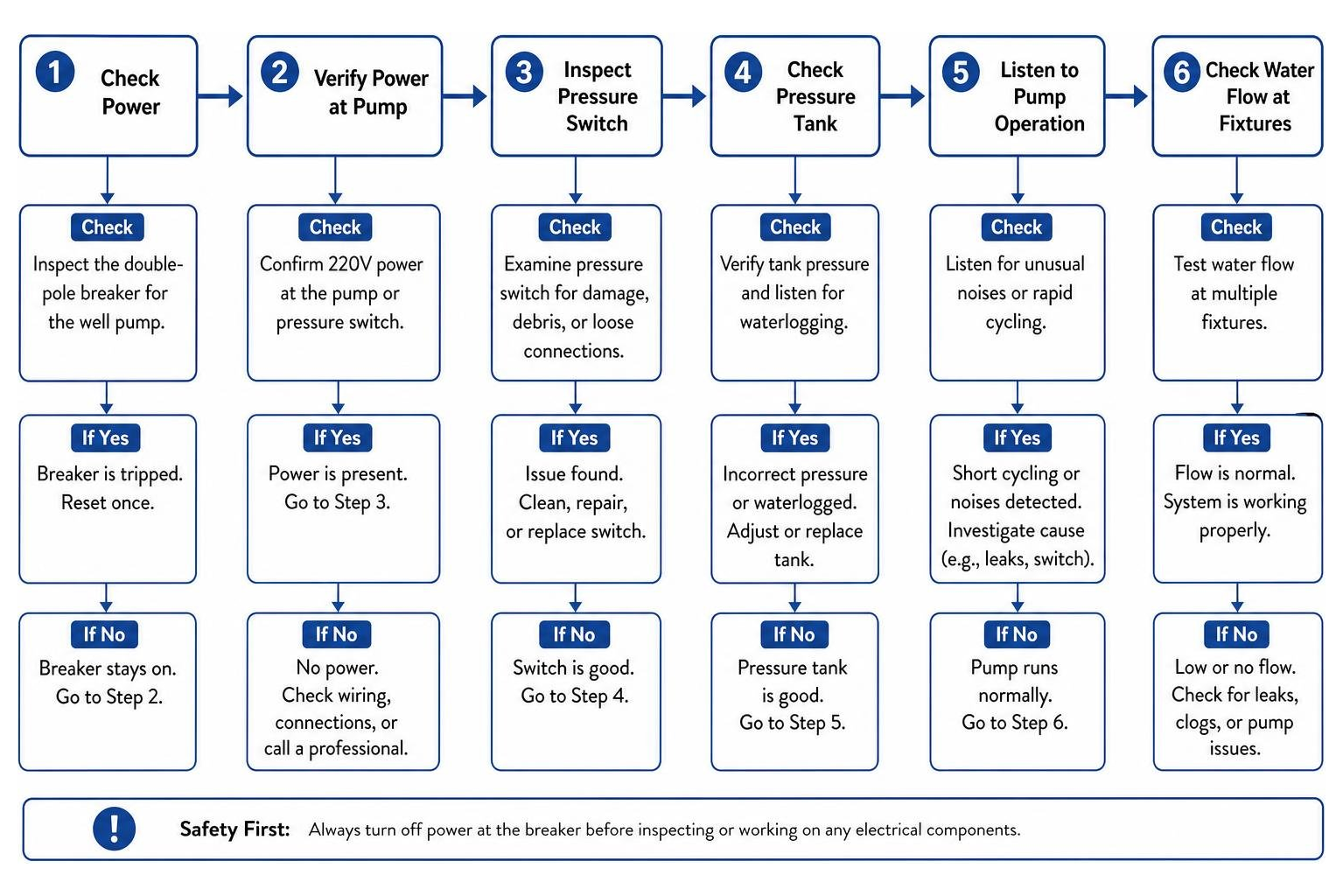
First, always inspect your home’s main electrical breaker panel. Well pumps draw significant current during startup, and a power surge can easily trip the double-pole breaker powering the system. If the breaker is tripped, reset it once. If it trips again immediately, do not force it back on; this indicates an active short circuit or a grounded motor winding that requires professional repair.
If the breaker is on, move to the pressure switch near your pressure tank. The pressure switch serves as the brain of the well system, sensing water pressure drops and signaling the pump to start. Over time, the electrical contacts inside the switch can become pitted, burned, or covered in insect debris, preventing current from reaching the pump motor.
When working around electrical components, safety is paramount. Always verify that power is disconnected before touching any exposed terminals or wiring. Properly adjusting well pump pressure switch settings and following a step-by-step 220V well pump wiring guide will help protect both yourself and your equipment.
Essential Tools for DIY Water Well Pump Repairs
Having the right diagnostic tools on hand makes isolating well pump problems significantly easier. Before attempting any inspection, gather these basics:
- Digital Multimeter: Used to check voltage at the pressure switch and pump controller terminals, as well as testing motor winding resistance.
- Non-Contact Voltage Tester: Essential for verifying that electrical current is completely cut off before removing protective covers.
- Screwdriver with Insulated Handle: Useful for adjusting switch springs and performing the screwdriver handle tap test on stuck pressure switches.
- Tire Pressure Gauge: Used to measure the pre-charge air pressure inside your pressure tank’s Schrader valve.
- Pipe Wrench and Teflon Tape: Necessary if you need to replace a threaded pressure switch or gauge fitting.
Diagnosing Pressure Switch, Control Box, and Pressure Tank Issues
When a well system fails, the problem often lies with control hardware near the pressure tank rather than the pump submerged in the ground.
To test a pressure switch safely, turn off the power breaker, remove the plastic cover, and inspect the four electrical contact points. If the points look blackened, charred, or pitted, electrical current cannot pass through efficiently. In an emergency, turning off power and lightly filing down oxidized contacts with a fine nail file or emery board can clear enough debris to temporarily restore power until a replacement switch can be installed.
Another key component is the pump control box, usually mounted on the wall near deep well submersible systems. This box contains a start capacitor that gives the pump motor the extra burst of electrical torque it needs to overcome inertia. If the capacitor fails, the pump motor will hum loudly without turning, quickly tripping the circuit breaker. Replacing a burnt control box cover or internal capacitor can often restore full system operation.
Finally, test the condition of your pressure tank. Pressure tanks contain an internal rubber bladder that separates air and water. If that bladder tears, the tank becomes waterlogged, meaning it is entirely filled with water and lacks the compressed air cushion needed to push water through your plumbing lines.
To check for a waterlogged tank, depress the Schrader air valve on top of the tank with your thumb. If water spurts out of the air valve instead of compressed air, the internal bladder has ruptured and the entire pressure tank must be replaced. Addressing well pump short cycling causes and solutions helps eliminate bladder stress before permanent tank failure occurs.
When to Repair vs Replace Your Well Pump System
Deciding whether to perform water well pump repairs or install a completely new pump comes down to system age, repair costs, and overall mechanical condition.
The average lifespan of a quality submersible well pump ranges from 10 to 15 years, while well-maintained pressure tanks generally last 7 to 10 years. If your pump is under 8 years old and suffers from a failed pressure switch, a bad starting capacitor, or a damaged surface wire, repairing the individual component is almost always the most cost-effective path.
However, if your pump is over 12 years old and experiences motor winding failure, severe internal bearing wear, or persistent electrical shorts, replacing the pump is the smarter long-term investment. Repeatedly spending money on emergency service calls for an aging pump quickly eats into the cost of installing a brand-new system backed by a multi-year manufacturer warranty.
A practical well pump upgrade guide can help homeowners compare replacement options, while a clear horsepower vs pressure guide explains why bigger equipment is not always the best fit for household water usage. Recognizing broader well problems and solutions also provides useful context for maintaining long-term water system reliability.
Factors That Impact Well Pump Repair and Replacement Costs
When pricing well system repairs or replacements in Derry, NH, and surrounding communities like Londonderry, NH, and Windham, NH, several critical job factors influence total costs:
- Well Depth: Deeper wells require heavier electrical wiring, longer drop pipes, and higher-horsepower pumps capable of pushing water hundreds of feet vertically.
- Accessibility: If your wellhead is buried beneath thick snow, located in a tight crawlspace, or blocked by landscaping, additional labor is required to access components safely.
- System Sizing: Upgrading from a standard single-speed pump to a modern constant pressure system with a variable frequency drive (VFD) requires specialized electronic controllers.
- Electrical Code Upgrades: Replacing older control boxes may require updating dedicated 220V lines or installing proper grounding rods to ensure code compliance.
Preventive Maintenance and Emergency Action Steps
Taking care of your well system proactively prevents unexpected breakdowns and keeps your tap water flowing cleanly.
We recommend performing basic monthly visual checks of your pressure tank pressure gauge, listening for odd clicking noises at the switch, and verifying that the area around your wellhead is free from standing water or debris. Additionally, property owners should schedule a full professional inspection at least every 5 years to verify electrical amp draw, test water yield, and evaluate pressure tank pre-charge.
For homeowners who want professional support before a breakdown, Daigle Plumbing, Heating & Cooling provides well pump installation and repair in Derry, NH for diagnostics, repairs, replacements, and pressure system service. Our broader plumbing services also help address connected pipe, fixture, and water supply issues that can affect well system performance.
Implementing routine well pump maintenance tips keeps component wear in check, while exploring well pump energy efficiency upgrades introduces smart control systems that reduce operating costs and stress on your motor.
What to Do During Sudden Loss of Water Pressure
If your home experiences a sudden drop in water pressure or a total loss of water, act quickly to protect your mechanical equipment:
- Shut off power to the pump: Immediately switch off the double-pole circuit breaker labeled for your well pump. Running a pump without water can burn out impellers and destroy shaft seals within minutes.
- Stop running fixtures: Turn off all household spigots, dishwashers, and washing machines to prevent air locks from forming inside your domestic plumbing lines.
- Check external breakers and fuses: Verify whether power was interrupted by a storm or localized utility surge.
- Inspect the pressure gauge: Look at the gauge near your tank. If it reads zero, the system is completely depressurized.
- Call for professional emergency service: Avoid trying to force a frozen or jammed pump motor to run repeatedly.
When to Call a Professional for Water Well Pump Repairs
While minor switch adjustments or circuit breaker resets are simple DIY tasks, complex mechanical and high-voltage electrical repairs require trained technicians.
You should always hire licensed specialists when:
- The circuit breaker repeatedly trips immediately after being reset.
- You need to pull a deep submersible pump out of a 200+ foot well casing.
- You suspect a broken underground supply pipe between the wellhead and your home foundation.
- Water comes up muddy, sandy, or heavily discolored.
For homeowners in Salem, NH, Manchester, NH, Nashua, NH, and across Southern New Hampshire, Daigle Plumbing, Heating & Cooling brings over 40 years of family-owned experience to every project. Our technicians deliver complete diagnostics, honest upfront pricing, and guaranteed labor to keep your household water flowing smoothly.
Frequently Asked Questions About Water Well Pump Repairs
How do I know if my pressure tank is waterlogged?
A pressure tank becomes waterlogged when its internal rubber bladder ruptures, allowing compressed air to escape and causing water to fill the entire tank volume. The clearest sign is short cycling, where your well pump turns on and off rapidly every few seconds whenever a tap is running. You can confirm this by depressing the Schrader valve on top of the tank. If water squirts out instead of air, or if rocking the tank proves it is extremely heavy and unmovable, the tank is waterlogged and requires replacement.
Can a burned-out well pump pressure switch be fixed temporarily?
Yes, if your pressure switch contacts are covered in carbon deposits or surface oxidation, you can temporarily file them down. First, switch off electrical power at your breaker box and verify the power is off with a voltage tester. Remove the switch cover and gently rub a fine emery board or nail file between the small circular contact points until bare metal is exposed. Reassemble the cover and turn power back on. This is strictly a temporary stopgap to restore water for a day or two while you procure a replacement switch.
How often should my well pump system be inspected?
You should perform basic DIY checks on your system every month by looking for leaks around fittings, checking tank pressure, and listening for unusual cycling patterns. A professional inspection by a licensed plumbing contractor should be conducted every 1 to 3 years. These professional checkups include measuring motor winding resistance, checking electrical amperage draw, testing tank bladder pressure, and verifying overall well flow rates to catch minor component wear before total system failure occurs.
Conclusion
Restoring a failing well pump doesn’t have to be overwhelming when you follow a clear diagnostic roadmap. By knowing how to identify pressure switch issues, test control boxes, and check pressure tank bladders, you can troubleshoot basic water loss problems safely and effectively.
When troubleshooting reveals deep well motor burnout, underground pipe leaks, or complex electrical faults, expert help ensures the job is done right the first time. At Daigle Plumbing, Heating & Cooling, our licensed plumbing experts serve Derry, NH, and surrounding towns including Auburn, NH, Hampstead, NH, Merrimack, NH, Bedford, NH, Hooksett, NH, Hudson, NH, and Londonderry, NH. We stand behind our work with a 100% satisfaction guarantee.
If you are dealing with low water pressure, noisy equipment, or a total loss of water, don’t wait for the problem to escalate. Contact our professional water well pump technicians today to get your home’s water running smoothly again!