Your Well Pump Is the Heart of Your Home’s Water Supply
Upgrading your well pump system is one of the most impactful things you can do to restore reliable water pressure, cut energy costs, and avoid emergency repairs. Here’s a quick overview of your main upgrade options:
| Upgrade Option | Best For | Typical Budget Range |
|---|---|---|
| Variable Frequency Drive (VFD) | Constant pressure, energy savings | Moderate investment |
| Submersible pump replacement | Deep wells, aging pumps | Moderate to higher investment |
| Larger pressure tank | Reducing pump short-cycling | Lower cost upgrade |
| Booster pump | Multi-story homes, low pressure | Moderate investment |
| Water filtration system | Sediment, hardness, odor issues | Varies by system |
Most residential well pumps last 10 to 15 years. If yours is getting close to that age range, or you are noticing sputtering faucets, uneven pressure, or higher electric bills, it is probably time to take a closer look.
The good news? You don’t always need a full replacement. Sometimes a pressure tank adjustment or a sediment flush is all it takes. Other times, stepping up to modern technology like a VFD system can cut your energy use by as much as 80% while delivering steady pressure no matter how many faucets are running at once.
This guide walks you through everything, from spotting the warning signs to choosing the right technology and budgeting wisely.
At Daigle Plumbing, Heating & Cooling, our team brings extensive hands-on experience with well pump installation, repair, and system upgrades across southern New Hampshire. Whether you’re troubleshooting a failing system or planning a proactive upgrade well pump system project, the sections below will help you make a smart, cost-effective decision.
Recognizing When to Upgrade Your Well Pump System
We often don’t think about our well pumps until the shower goes cold or the kitchen faucet starts coughing like it has a seasonal allergy. However, your system usually gives off “smoke signals” long before it completely quits.
Signs to Watch For
The most obvious red flag is inconsistent water pressure. If your shower pressure drops significantly when someone flushes a toilet or the dishwasher starts, your pump is struggling to keep up with the demand. You might also notice sputtering faucets. This often means air is getting into the system, which could be a sign of a failing pump or a drop in the water table.
Another sneaky sign is a sudden spike in your electricity bill. An obsolete or worn-out pump has to work twice as hard to move the same amount of water, sucking up “electrical excess” that shows up on your monthly statement. If your pump is constantly running, it’s not just wasting power; it’s burning itself out.
The Danger of Short Cycling
One of the most serious warning signs is well pump short cycling causes and solutions. Short-cycling happens when the pump switches on and off too often in a short period. That repeated starting puts extra heat and wear on the motor and other components. In plain English: every rapid restart takes a toll. If you hear frequent clicking or notice the pump running every few seconds, do not ignore it. Left unchecked, short cycling can shorten pump life and lead to a full system failure.
Pump Age: The 12-Year Rule
While most residential pumps have a lifespan of 10 to 15 years, we’ve found that proactive replacement is common once a system hits the 12-year mark. If your pump is over a decade old and you’re starting to see reduced water flow or hear unusual clicking noises from the pressure tank area, an upgrade well pump system project is likely in your near future.
Choosing the Right Technology: Submersible vs. Jet Pumps
When planning an upgrade well pump system, picking the right pump is a big part of the job. In southern New Hampshire, from rocky lots to more rural properties, well depths and water needs can vary a lot.
Comparing Performance
| Feature | Submersible Pump | Jet Pump (Shallow/Deep) |
|---|---|---|
| Location | Inside the well, underwater | Above ground (basement/well house) |
| Efficiency | High (pushes water up) | Lower (pulls water up) |
| Lifespan | 12–15+ years | 8–12 years |
| Noise | Silent (it’s deep underground) | Can be noisy |
| Best For | Wells deeper than 25 feet | Shallow wells or easy access |
Submersible pumps are the gold standard for most modern residential applications. Because they stay underwater, they remain cool during operation and don’t have to worry about “priming” issues. They push water upward, which is far more efficient than the suction method used by jet pumps.
GPM vs. PSI: The Power Struggle
A common myth is that a higher horsepower (HP) pump automatically means higher water pressure. In reality, increasing HP primarily boosts your Gallons Per Minute (GPM)—the volume of water moved—rather than the Pounds Per Square Inch (PSI). If you want a more “intense” shower, you need to look at the pump curve to ensure the unit is designed for higher PSI at your specific well depth.
Before you buy, you must learn to properly size a well pressure tank to match your new pump. An oversized pump on a tiny tank is a recipe for short-cycling disaster.
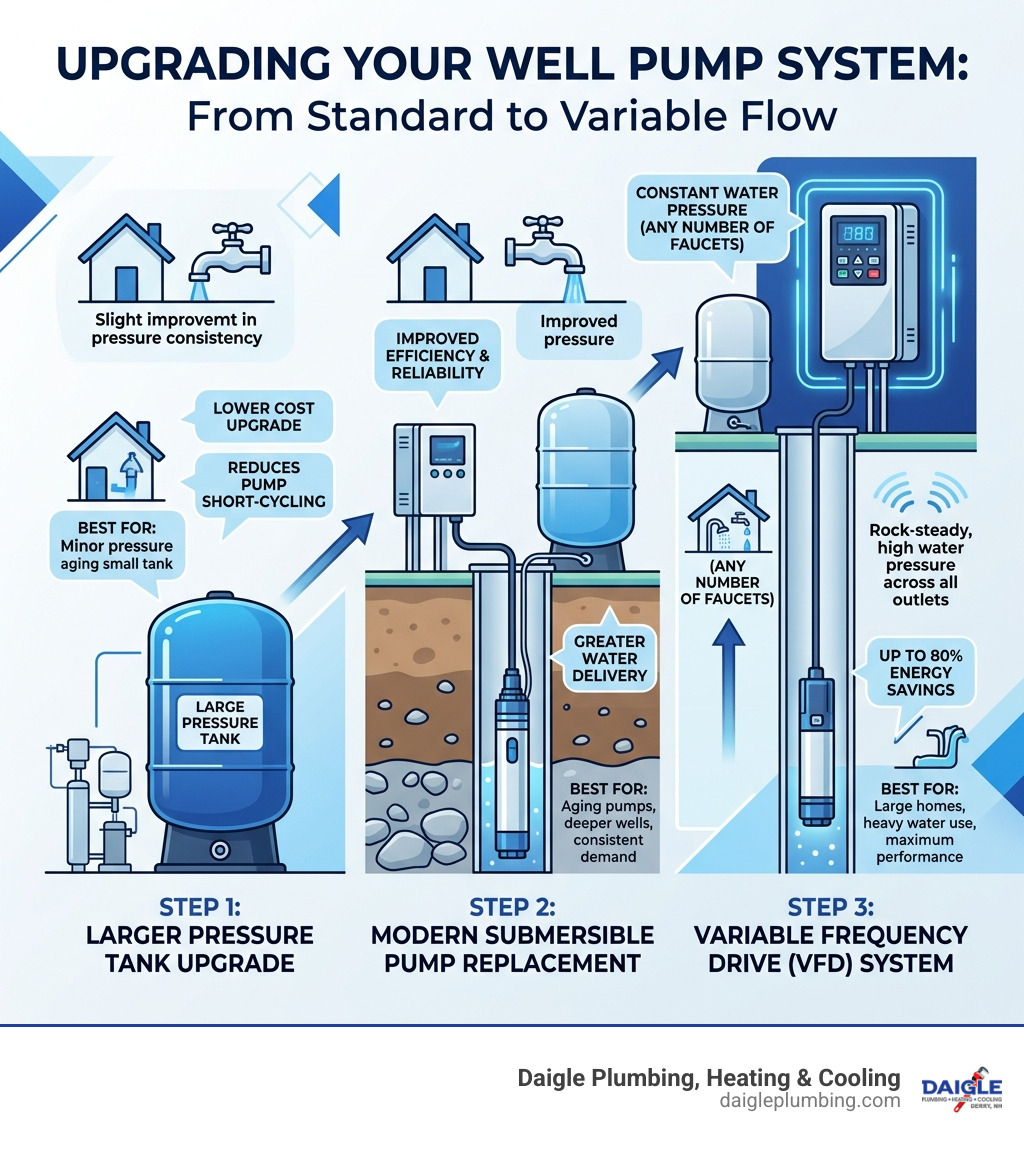
Traditional pumps are like a light switch: they are either 100% on or 100% off. When the pressure in your tank hits 40 PSI, the pump kicks on at full speed until it hits 60 PSI, then shuts off. This creates a “seesaw” effect in your shower.
A VFD upgrade well pump system works more like an accelerator pedal on a car. It senses exactly how much water you are using and tells the pump to spin just fast enough to meet that demand.
- 80% Energy Savings: By not running at full speed every time you wash your hands, VFDs can slash power consumption significantly.
- Constant PSI: You can set your system to a steady 60 or 75 PSI. Whether you’re running the laundry, the dishwasher, and the shower at once, the pressure won’t budge.
- Motor Longevity: VFDs eliminate the “hard starts” that kill motors. They “soft start” the pump, gradually ramping up speed, which can extend the life of your equipment by years.
Optimizing Performance with Pressure Tanks and Switches
Your pump might be the engine, but the pressure tank is the battery. It stores pressurized water so your pump doesn’t have to turn on every time you get a glass of water.
Why Well Tanks Matter
A healthy pressure tank is essential. We often see 3 water issues well tanks can cause, ranging from inconsistent flow to complete pump failure. If the tank’s internal bladder fails, the tank can become waterlogged.
When that happens, the air cushion that helps maintain pressure disappears. If you are wondering what happens when well pressure tank goes bad, the short answer is often early pump failure. A waterlogged tank can shorten pump life dramatically by forcing it to cycle far too often each day.
The Role of the Pressure Switch
The pressure switch is the system’s control point. In many homes, it uses a 40/60 PSI setting, which means the pump turns on at 40 PSI and shuts off at 60 PSI. If your water pressure feels too low, you may be able to adjust well pump pressure switch settings, but only if the pump and tank are sized to handle the added demand.
If you suspect your tank is failing, check out our guide on waterlogged pressure tank troubleshooting fixes prevention. A simple “tap test” by tapping the top and bottom of the tank and listening for the difference between air and water can often reveal a problem.
Addressing Sediment and Water Quality During an Upgrade Well Pump System
New Hampshire is famous for its beautiful scenery and its… let’s say “interesting” well water. From the iron-rich soil in Merrimack to sediment issues in Hudson, water quality plays a huge role in your pump’s health.
Sediment is the “sandpaper” of the plumbing world. It wears down pump impellers and clogs pressure switches. If you notice cloudy or rust-colored water, you’re likely dealing with common water-pressure-tank problems caused by mineral buildup.
When you upgrade well pump system components, it’s the perfect time to add:
- Pre-filtration: A simple spin-down filter can catch sand and grit before it enters your tank.
- UV Disinfection: If your well has a history of bacteria, UV light kills microorganisms without chemicals.
- Iron Removal: New Hampshire wells are notorious for “orange” staining. An iron filter protects your new pump and your white laundry.
- Wellhead Protection: Ensure your well cap is sealed tight to prevent insects and surface runoff from contaminating your aquifer.
Budgeting and Installation: DIY vs. Professional Expertise
We get it—everyone loves a good DIY project. But when it comes to your water supply, the “Oops” factor can be very expensive.
What Affects Well Pump Upgrade Costs
- Type of upgrade: A basic pump swap is usually the most straightforward. Adding a new pressure tank, controls, or a constant pressure system increases the overall investment.
- Well depth and accessibility: Deeper wells, difficult access, and older plumbing or wiring can make installation more involved.
- System components: Pressure switches, check valves, wiring, drop pipe, and fittings may also need replacement to ensure the new system works reliably.
- DIY vs. professional installation: Doing it yourself may reduce labor costs, but it also raises the risk of wiring mistakes, improper sizing, equipment damage, or even dropping the pump into the well.
Why Go Pro?
Well systems involve high-voltage electricity and pressurized water—a dangerous combination. Furthermore, New Hampshire has specific codes regarding well construction and plumbing. A professional team like ours at Daigle brings specialized tools, like pump hoists and electronic testers, to ensure the job is done right.
If you’re in Derry, Salem, or nearby areas, our services/plumbing/well pump installation repair Derry NH team can perform a full diagnostic to determine whether you need a complete pump upgrade or a simpler component repair.
Frequently Asked Questions about Well Pump Upgrades
How long do well pumps typically last?
On average, you can expect 10 to 15 years. However, factors like water quality (acidic water eats components), the size of your pressure tank (larger tanks mean fewer cycles), and electrical stability (lightning strikes are a pump’s worst enemy) will all affect that timeline. If your pump is over 12 years old, you are in the “bonus round.”
Will a larger pump increase my water pressure?
Not necessarily. A “larger” pump usually refers to horsepower, which increases the volume (GPM). If your goal is higher pressure (PSI), you need to choose a pump with a curve designed for higher lift. Think of it like a truck: a bigger engine helps you carry more weight (GPM), but it doesn’t necessarily mean you’ll go faster (PSI). You also have to ensure your well “yield” can handle the extra flow, or you’ll run your well dry.
What is the average cost of a well pump upgrade?
The total cost of an upgrade well pump system depends on the pump type, well depth, electrical work, pressure tank size, and whether you add controls like constant-pressure equipment or water treatment. A basic replacement usually costs less than a full system upgrade, but higher-quality components often deliver better reliability, efficiency, and long-term value.
Conclusion
Upgrading your well system doesn’t have to be a headache. By recognizing the warning signs early and choosing modern, efficient technology like VFDs or larger pressure tanks, you can ensure your home has a reliable, high-pressure water supply for the next two decades.
At Daigle Plumbing, Heating & Cooling, we’ve been serving the Derry, NH area for over 40 years. We’re family-owned, licensed, and we stand behind our work with a satisfaction guarantee. Whether you’re in Nashua, Windham, or Bedford, we know the local “water quirks” and can help you design a system that fits your budget and your family’s needs.
Don’t wait for the water to stop running. Contact our well pump plumbing experts and schedule your well pump consultation with us today and let’s get your water pressure back where it belongs!