How to Increase Hot Water Pressure in Your Home
If you want to increase hot water pressure in your Derry, NH home, you do not have to live with a weak, trickling shower.
Quick Answer: How to Boost Your Hot Water Flow
Here is a quick checklist of the most effective ways to solve weak hot water flow:
- Clean Clogged Fixtures: Soak your showerhead and faucet aerators in white vinegar to dissolve hard water mineral scale.
- Open All Valves: Check the cold inlet and hot outlet valves on your water heater to make sure they are turned completely on.
- Flush Your Water Heater: Clear out the thick sediment that settles at the bottom of your tank and blocks the hot water outlet.
- Adjust the PRV: Locate your home’s main Pressure Reducing Valve and turn the screw clockwise to increase pressure (keep it between 40 and 60 PSI).
- Install a Booster Pump: If your municipal supply or well system is naturally weak, a professional booster pump can instantly solve the issue.
As of July 2026, modern water-saving fixtures and local plumbing standards make managing your home’s water flow more critical than ever. Whether you are dealing with mineral buildup from Southern New Hampshire’s hard water or a failing water heater, getting your pressure back to normal is key to avoiding utility room headaches and long-term plumbing damage.
At Daigle Plumbing, Heating & Cooling, our licensed plumbing and HVAC team has helped thousands of Southern New Hampshire homeowners safely increase hot water pressure and keep their systems running at peak performance.
Diagnosing Low Water Pressure and Flow Rate
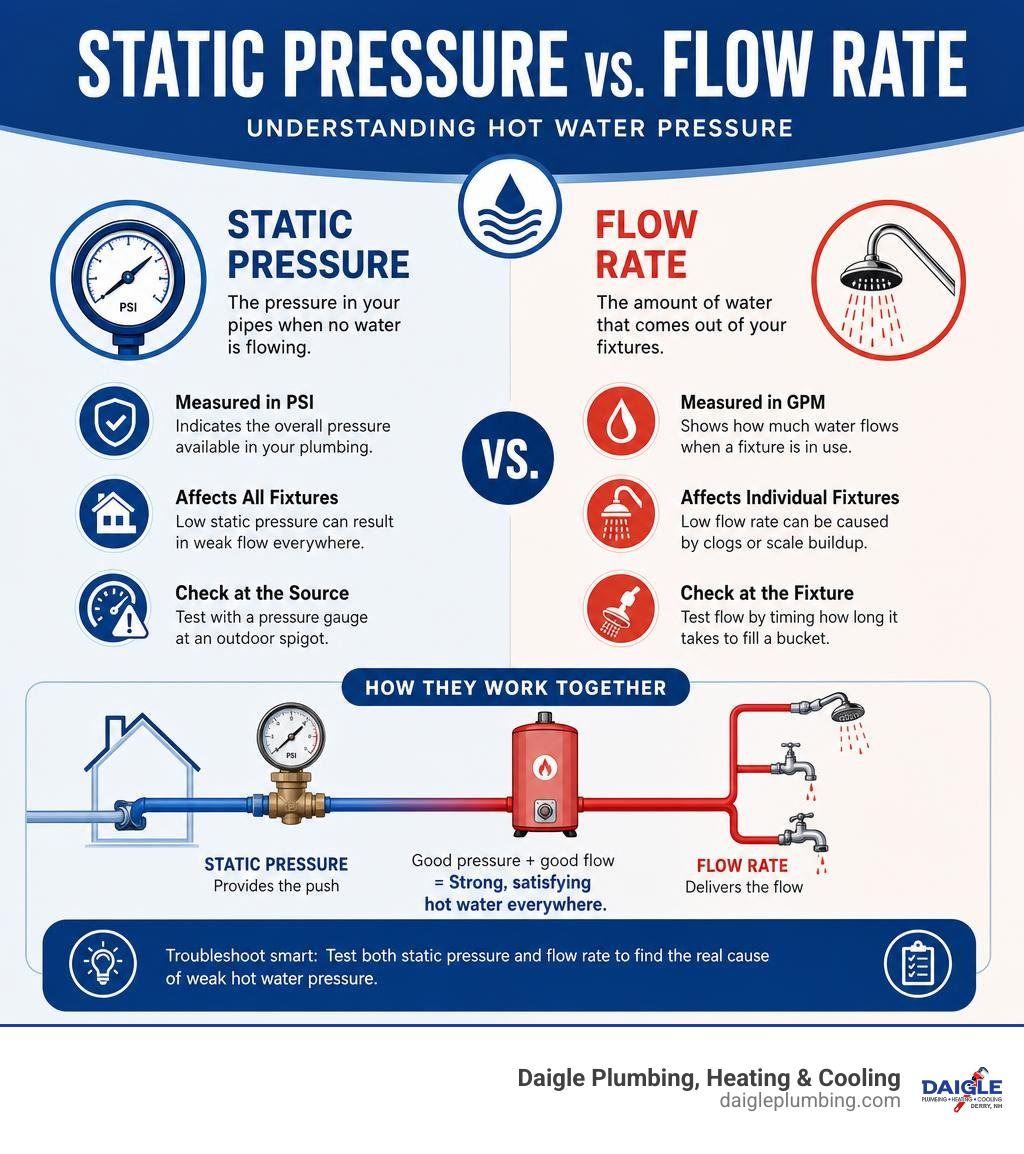
Before you spend a single dollar on new hardware, you must figure out exactly what is causing your weak hot water flow. A common mistake we see in Southern New Hampshire homes, from Manchester to Salem, is confusing static water pressure with dynamic water flow.
- Static Pressure: The physical force pushing water through your pipes when all your faucets are turned off. This is measured in pounds per square inch (PSI).
- Dynamic Flow: The actual volume of water moving through your pipes and out of your fixtures when they are fully open. This is measured in gallons per minute (GPM).
If you have great static pressure but terrible dynamic flow, it means something is physically restricting the water as it tries to escape.
To pinpoint the root cause of your low hot water pressure, we recommend running three simple diagnostic tests:
- The “Hot vs. Cold” Test: Run the cold water at a faucet, then run the hot water. If the cold water blasts out with plenty of force but the hot water feels tired and weak, the problem is isolated specifically to your hot water system (such as your water heater, a hot-water mixing valve, or scaled-up hot water lines).
- The “One vs. All” Test: Check every fixture in your house. Is the pressure low only in the master bathroom shower, or is it equally weak at the kitchen sink, the laundry room, and the guest bath? If it is just one fixture, you are likely dealing with a clogged aerator or a worn-out shower cartridge. If it is the whole house, you have a systemic issue.
- The “Floor by Floor” Test: If you live in a multi-story home in Nashua or Londonderry, compare the pressure on your ground floor to your top floor. Gravity naturally reduces water pressure as it travels upward. If the top floor is significantly weaker, your system may lack the head pressure required to push water vertically.
If your home relies on a private well rather than municipal water, your pressure issues are often tied directly to your well system’s pressure tank settings. Comparing hot and cold fixtures can help you narrow the problem before calling for help with plumbing services in Derry, NH.
How to Measure Flow Rate to Increase Hot Water Pressure
To get an accurate picture of your plumbing health, you should measure your actual water flow rate and static pressure. Fortunately, you can do this yourself with a few basic household items.
To measure your static water pressure, purchase a standard water pressure gauge from a local hardware store. Screw the gauge directly onto an outdoor hose bib or your washing machine’s cold water faucet. Make sure all other water fixtures in the house are turned off, then open the valve completely.
- Ideal Pressure: A healthy residential plumbing system should sit comfortably between 50 and 60 PSI.
- The Danger Zone: Any pressure reading of 70 PSI or above poses a severe risk to your plumbing. High pressure can rupture flexible supply lines, cause toilet cistern fill valves to fail, and damage the internal valves of expensive appliances like your dishwasher and washing machine.
To measure your dynamic flow rate, grab a 5-gallon bucket and a stopwatch (your smartphone works perfectly). Run your shower or faucet on hot at full blast, place the bucket underneath, and time how long it takes to fill to the top.
To calculate your GPM, use this simple formula:
Flow Rate (GPM) = (Gallons / Seconds) x 60
For example, if your hot water takes 1 minute and 15 seconds (75 seconds) to fill a 5-gallon bucket, your flow rate is 4 GPM. Under federal regulations, the maximum legal flow rate for a modern showerhead in the United States is 2.5 GPM, though many water-saving models operate around 1.5 to 1.8 GPM. If your calculated flow rate is significantly lower than these numbers, a step-by-step troubleshooting plan can help you decide whether the issue is a fixture, valve, water heater, or whole-house supply problem.
Gravity-Fed vs. Mains Pressure Systems
The design of your home’s hot water system plays a massive role in how much pressure you experience. In older homes or specific system designs, you may find a gravity-fed hot water system. In modern construction, mains pressure systems are the standard.
- Gravity-Fed Systems: These systems rely entirely on the physical height of a cold water storage tank (often located in an attic or loft) to create water pressure. The vertical distance between the bottom of the water tank and your faucet is called the “head height.” Gravity-fed systems deliver very low pressure. A typical low-pressure hot water cylinder delivers between 36.26 kPa (about 3.7 meters of head height) and 119.56 kPa (about 12.2 meters of head height).
- Mains Pressure Systems: These systems feed cold water directly from the municipal water main or your well pump into a sealed hot water cylinder. Because the water is already pressurized by the city or your pump, mains pressure systems deliver a robust 350 to 500 kPa (roughly 50 to 72 PSI) directly to your fixtures.
| System Type | Typical Pressure Range | Primary Source of Pressure | Common Issues |
|---|---|---|---|
| Gravity-Fed | 36.26 kPa – 119.56 kPa | Physical height of storage tank | Weak showers, highly sensitive to vertical height |
| Mains Pressure | 350 kPa – 500 kPa | Municipal main or well pump | Scaled-up cylinders, failing pressure reducing valves |
If you are on a private well system, your pressure tank acts as your home’s pressurized storage. When the bladder or air pressure inside this tank fails, you will experience rapid pressure drops and fluctuating flow. Our breakdown of common water pressure tank problems explains how pressure switches, tank bladders, and pump cycling issues can affect hot water performance.
How to Increase Hot Water Pressure with DIY Fixes
If you want to increase hot water pressure without spending a fortune, there are several quick, highly effective DIY fixes you can try. However, before you touch your plumbing or water heater, you must prioritize safety.
Always take these safety precautions before starting any plumbing work:
- Turn Off the Power: If you have an electric water heater, turn off the dedicated circuit breaker at your main electrical panel. If you have a gas water heater, turn the control dial to “Pilot” or “Off.”
- Let the Water Cool: Hot water can cause third-degree burns in just 5 seconds at 140°F. Always let your water heater cool down for several hours before flushing the tank or replacing valves.
- Know Your Main Shutoff: Make sure you know exactly where your home’s main water shutoff valve is located and verify that it works before loosening any plumbing connections.
- Avoid Chemical Cleaners: Never pour harsh chemical drain cleaners or industrial solvents into your potable water lines to clear scale; they can ruin your pipes and contaminate your drinking water.
If your pressure loss is getting worse over time, our article on troubleshooting low hot water pressure can help you connect symptoms like weak shower flow, noisy pipes, and inconsistent temperatures to the most likely cause.
Cleaning Fixtures and Removing Flow Restrictors
The absolute quickest and cheapest way to boost water pressure at an isolated fixture is to clean out mineral scale and check for flow restrictors.
Southern New Hampshire water is notorious for containing hard minerals like calcium and magnesium. Over time, these minerals precipitate out of your hot water and form a crusty, white scale inside your showerheads and faucet aerators. This scale acts like a tiny dam, choking off your dynamic water flow.
To clean your showerhead or faucet aerator:
- Carefully unscrew the fixture from the wall pipe or faucet spout. Wrap a rag around the connection before using a wrench to avoid scratching the finish.
- Submerge the fixture completely in a bowl of warm, undiluted white vinegar.
- Let it soak for at least 4 to 6 hours (overnight is best) to dissolve the calcium deposits.
- Remove the fixture and scrub the rubber nozzles gently with an old toothbrush to clear away any remaining debris.
- Rinse thoroughly with clean water and reinstall.
While you have the showerhead off, look inside the threaded collar. You will see a small plastic disk with a tiny hole in the center. This is the water-saving flow restrictor. While these are designed to conserve water, they can make your shower feel like a sad drizzle if your home’s incoming pressure is already low.
Using a small flathead screwdriver or a paperclip, you can carefully pry the flow restrictor out. Just keep in mind that removing this entirely will increase your water usage, which means your hot water supply may run out slightly faster.
Flushing the Water Heater and Adjusting the PRV
If your low pressure is affecting every hot water faucet in your house, the issue is likely sitting in your utility room. Over time, loose minerals and sediment settle at the bottom of your water heater tank. As this sediment layer grows, it can physically block the hot water outlet pipe or clog the mixing valves, severely restricting hot water flow.
To flush your water heater:
- Turn off the power (breaker for electric, pilot mode for gas).
- Close the cold water shutoff valve at the top of the tank.
- Attach a standard garden hose to the drain valve at the bottom of the heater and run the other end to a safe drainage spot (like a floor drain or driveway).
- Open a hot water faucet upstairs to allow air into the system, then open the water heater’s drain valve.
- Once the tank is empty, flip the cold water inlet valve back on for a few short bursts to stir up and wash out any stubborn sediment.
- Close the drain valve, disconnect the hose, let the tank refill completely, and turn the power/gas back on.
If flushing the tank does not restore your pressure, locate your home’s Pressure Reducing Valve (PRV). This bell-shaped brass valve is typically installed on your main water line right after it enters your home.
To adjust your PRV, loosen the locknut on the top of the valve. Use a wrench or screwdriver to turn the adjustment bolt clockwise to increase pressure, or counterclockwise to decrease it. Make adjustment turns in small, half-turn increments, and monitor your progress using your water pressure gauge on a nearby faucet. Always keep the pressure below 60 PSI to prevent appliance damage. If your PRV is old and rusted, turning the bolt may do nothing, indicating that the valve’s internal diaphragm has failed and the valve needs to be replaced.
To keep your system running safely, we also recommend regularly testing your water heater’s Temperature and Pressure Relief (TPR) valve. This valve is your tank’s primary safety mechanism; operating it at least once every 6 months ensures it won’t seize up when you need it most. Routine water heater maintenance, descaling, and inspection can also reduce sediment buildup before it turns into a bigger pressure problem.
Upgrading Your System for Better Flow
If DIY fixes do not solve your low pressure, or if your plumbing system is simply too old to deliver the performance you want, it is time to look at professional upgrades.
In older homes with original galvanized steel water lines, rust and corrosion build up inside the pipes over time. This narrows the internal diameter of the pipe, a phenomenon plumbers call the “Galvanized Ghost,” until a 3/4-inch pipe has a opening no larger than a drinking straw. In these cases, the only permanent solution to restore your water flow is a professional repipe of your home’s water lines.
However, if your pipes are in good shape but your supply pressure is naturally weak, installing a water pressure booster pump is an excellent option. The licensed team at Daigle Plumbing, Heating & Cooling can evaluate whether the restriction is in the fixture, the water heater, or the main supply before recommending a booster pump, pipe repair, or targeted water heater installation and repair service.
Upgrading Your Water Heater to Increase Hot Water Pressure
If your water heater is more than 10 to 15 years old, internal scaling may be so thick that flushing will no longer help. Upgrading your water heater is one of the most effective ways to permanently increase hot water pressure while lowering your monthly energy bills.
When upgrading, you have three primary options:
- Mains Pressure Cylinder (Unvented System): Upgrading from an old gravity-fed system to a modern unvented mains pressure cylinder will instantly transform your home’s water pressure. However, keep in mind that upgrading to a high-pressure system can sometimes cause issues with existing shower mixers that were originally calibrated for unequal pressure, requiring precise professional calibration to prevent temperature fluctuations.
- Combination (Combi) Boiler: A combi boiler heats both your home’s radiators and your domestic hot water on demand, eliminating the need for a separate hot water tank. However, their hot water flow rate is strictly limited by their heating capacity (measured in kilowatts). A 24KW combi boiler can deliver up to 11.5 liters of hot water per minute (enough for 2 showers), a 30KW boiler delivers 14.5 liters per minute (2.4 showers), and a large 42KW boiler delivers 20 liters per minute (3 showers).
- Tankless Water Heater: Tankless systems heat water instantly as it flows through a high-powered burner. They provide an endless supply of hot water and take up very little space. To maximize your system’s output, you can install a thermostatic mixing valve. By storing water in your tank at a high, bacteria-killing temperature of 140°F and mixing it with cold water down to a safe 120°F at the outlet, you can increase your effective hot water capacity by 44%.
Choosing Between Single and Twin Impeller Pumps
If you have a gravity-fed or low-pressure system and only want to boost pressure in a specific bathroom, installing a shower pump is a highly targeted, cost-effective solution. When shopping for a booster pump, you must choose between a single impeller and a twin impeller design.
- Single Impeller Pumps: These pumps are designed to boost a single water line. If your cold water pressure is already great (because it is mains-fed) but your hot water pressure is weak, you can install a single impeller pump directly on the hot water line near your water heater to balance the system.
- Twin Impeller Pumps: These pumps feature two separate internal chambers to boost both the hot and cold water supplies simultaneously. This is the ideal choice for bathrooms where both hot and cold lines suffer from poor pressure, ensuring a perfectly balanced, comfortable shower temperature.
Additionally, you must select either a positive head or negative head pump based on your system’s natural flow rate:
- Positive Head Pumps: These rely on gravity to start up. They require a minimum natural flow rate of at least 2 liters per minute to push water through the pump and trigger the internal flow switch.
- Negative Head (Universal) Pumps: If your natural flow rate is worse than 2 liters per minute, gravity cannot prime the pump. A negative head pump uses a pressure sensor instead of a flow switch, automatically turning on whenever it detects a drop in line pressure (such as when you turn on a faucet).
If your current heater cannot deliver steady pressure or consistent hot water, a professional replacement may be safer than forcing more pressure through an aging system. Daigle Plumbing, Heating & Cooling can help homeowners in Derry, Salem, Manchester, Nashua, Auburn, Hampstead, Merrimack, and Bedford compare repair, replacement, and booster options for their home.
Frequently Asked Questions About Water Pressure
Why is my hot water pressure low but cold water pressure is normal?
When low pressure only affects the hot water side, it points directly to a restriction in your hot water plumbing. The most common causes are thick sediment buildup at the bottom of your water heater blocking the hot outlet, a hot-water shutoff valve that is partially closed, or a clogged thermostatic mixing valve. In older water heaters, a disintegrating plastic dip tube can also release small plastic shards that travel down the line and clog your faucet cartridges.
Can a water heater cause low hot water pressure?
Yes, absolutely. Over time, hard water mineral scale coats the inside of your water heater’s tank and heating elements. This scale reduces the physical volume of the tank and restricts the flow of water exiting the system. Additionally, corroded anode rods can shed debris into the tank, and failing heat exchangers in tankless units can quickly become choked with mineral deposits, severely restricting your flow.
Is it safe to adjust my home’s pressure reducing valve (PRV) myself?
While adjusting a PRV is a relatively straightforward DIY task, you must proceed with caution. Never adjust your home’s pressure above 60 PSI. Exceeding 70 to 80 PSI can cause your water heater’s Temperature and Pressure (T&P) relief valve to leak, rupture your washing machine hoses, and cause toilet fill valves to run continuously, potentially leading to thousands of dollars in water damage.
Conclusion
Restoring strong, consistent hot water flow to your home does not have to be a stressful guessing game. By systematically testing your system, cleaning out mineral scale, and keeping up with basic water heater maintenance, you can solve most common pressure issues on your own.
However, when DIY fixes are not enough, or if you are dealing with complex plumbing upgrades like a whole-house repipe, a new water heater installation, or a booster pump setup, the team at Daigle Plumbing, Heating & Cooling is here to help.
With over 40 years of family-owned experience serving Derry, Salem, Manchester, and the surrounding Southern New Hampshire communities, our licensed and insured experts are committed to getting your home’s plumbing running perfectly. We back all of our work with a satisfaction guarantee, convenient financing options, and seasonal specials to keep your project affordable.
Don’t settle for weak, frustrating showers. If you are ready to permanently increase hot water pressure in your home, contact our professional hot water pressure technicians to schedule an appointment with our local experts!