Set a Furnace Filter Replacement Schedule That Fits Your Home
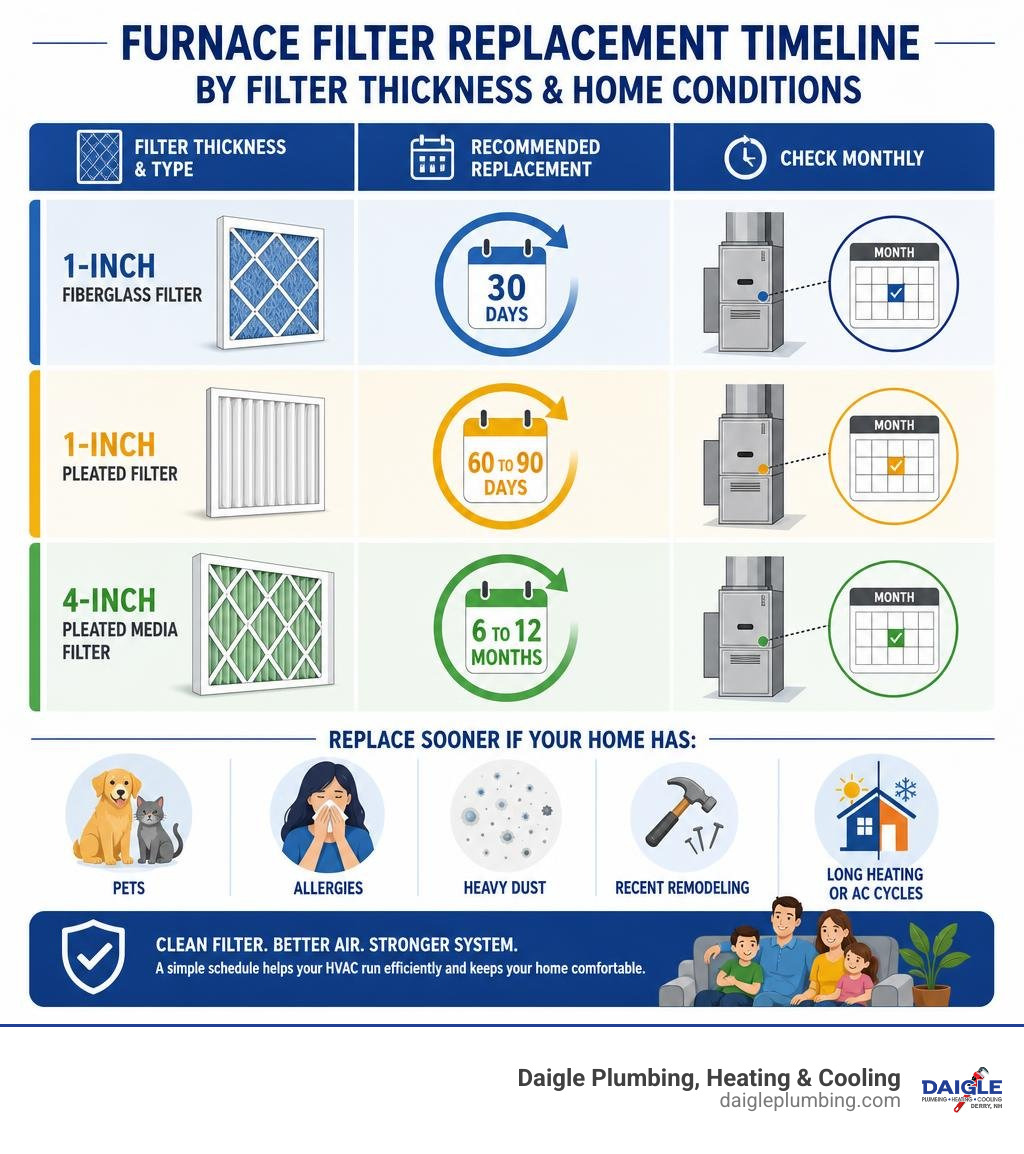
For most homes, check your furnace filter every month and replace it based on its type and how hard your HVAC system runs:
- 1-inch fiberglass filter: every 30 days
- 1-inch pleated filter: every 60 to 90 days
- 4-inch pleated media filter: every 6 to 12 months
Change it sooner if you have pets, allergies, heavy dust, recent remodeling, or long heating and AC cycles. A clogged filter restricts airflow, can raise energy use, and puts extra strain on the blower and other HVAC parts.
A good filter schedule is not just a calendar task. It is a simple way to support cleaner indoor air, steadier comfort, and a longer-lasting heating and cooling system.
Our HVAC operations team combines field service experience with practical maintenance knowledge to help homeowners build a furnace filter replacement schedule that suits their equipment and household. The guide ahead explains how to choose the right filter, spot trouble early, and replace it correctly.
Understanding Filter Types, Thickness, and MERV Ratings
Every furnace filter serves a primary mechanical purpose: protecting your heating equipment’s blower motor, heat exchanger, and internal components from airborne dust and debris. As an added benefit, quality filters clean the air your family breathes every day.
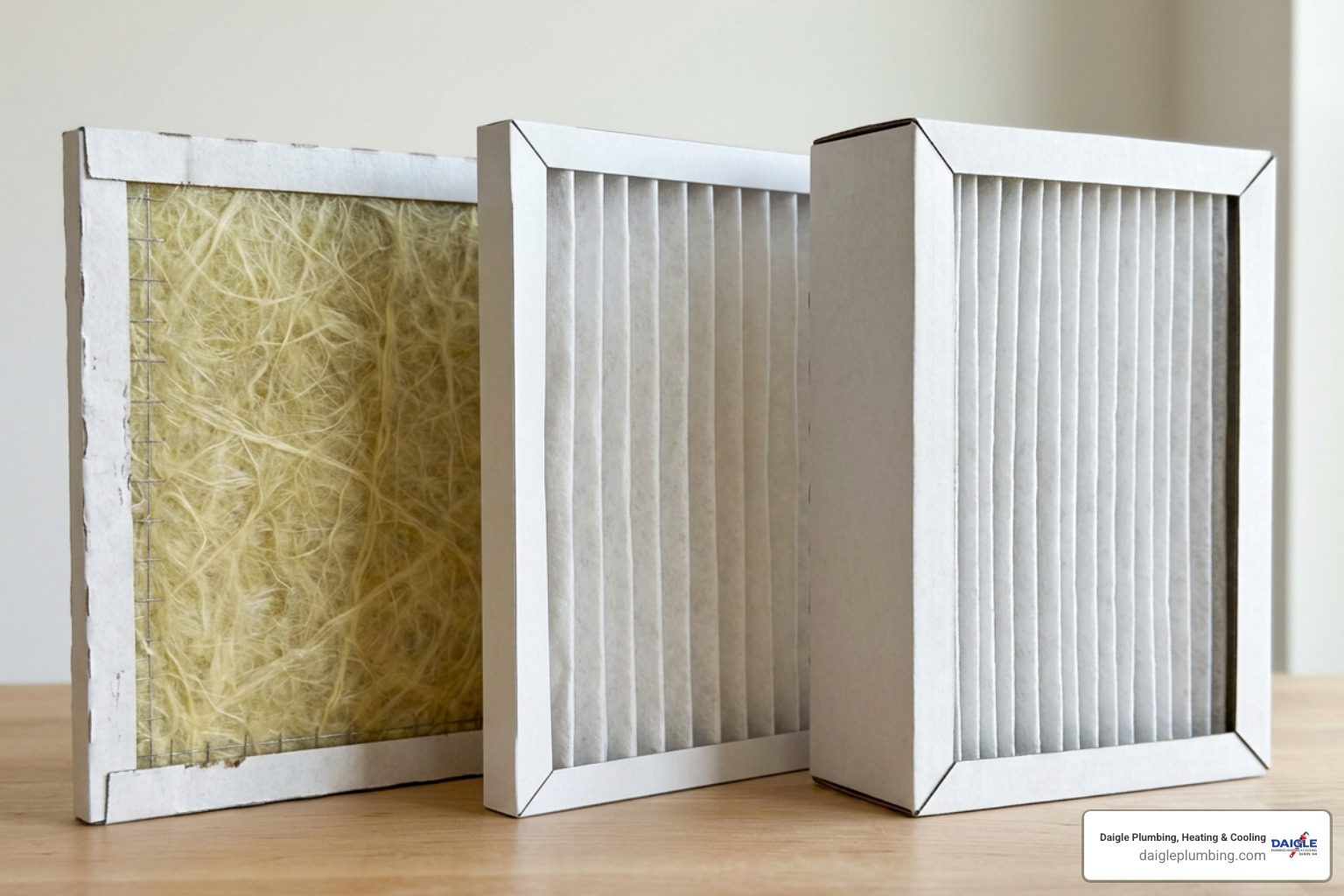
- Fiberglass flat-panel filters: These standard 1-inch disposable filters use loose spun fiberglass fibers. They capture large lint and dust particles to protect mechanical equipment, but they catch very few microscopic allergens. Because of their minimal surface area, they require replacement every 30 days.
- Pleated media filters: Constructed from polyester or cotton blends arranged in accordion-style folds, pleated filters dramatically increase surface area. This design captures microscopic particles like pet dander and mold spores while allowing steady airflow.
- Electrostatic filters: Available in disposable or washable formats, these filters use self-charging static electricity to attract and hold magnetic dust particles.
- High-efficiency particulate air (HEPA) filters: HEPA filters trap 99.97% of particles down to 0.3 microns. However, standalone residential furnace cabinets rarely support true HEPA filters directly because the dense material creates excessive airflow resistance unless paired with a dedicated bypass air purification system.
Comparing 1-Inch vs 4-Inch Media Filters
When comparing standard 1-inch filters to deep 4-inch or 5-inch media filters, the primary difference comes down to physical surface area. A 1-inch pleated filter laid flat provides roughly 4 to 5 square feet of surface area. A deep 4-inch pleated media filter packs between 20 and 35 square feet of filtering material into the same cabinet opening thanks to deep, accordion-like pleats.
More surface area means a 4-inch filter holds significantly more dust before air resistance begins to rise. A standard 1-inch filter reaches maximum dirt-holding capacity in 1 to 3 months, while a 4-inch media filter operates efficiently for 6 to 12 months. Deep media filters also create less static pressure drop across your ductwork, allowing your system to maintain optimal airflow while delivering superior filtration. Converting a standard 1-inch filter slot into a 4-inch media cabinet requires a simple sheet-metal modification, making it one of the most cost-effective upgrades for whole-home comfort.
Selecting the Right MERV Rating for Residential Systems
MERV stands for Minimum Efficiency Reporting Value, rated on a scale from 1 to 16 for standard residential systems. A higher MERV rating indicates a tighter filter weave capable of capturing smaller airborne particles. However, higher is not always better for every heating system.
Older heating systems equipped with single-speed Permanent Split Capacitor (PSC) blower motors cannot adjust their speed when airflow encounters resistance. Placing a high-resistance MERV 13 filter on a system designed for lower resistance creates static pressure issues that can overheat the furnace. In contrast, modern systems equipped with variable-speed Electronically Commutated Motors (ECM) adjust speed to maintain steady airflow through denser filter materials.
| MERV Rating | Typical Particle Capture Range | Best Suited For | Expected Pressure Drop |
|---|---|---|---|
| MERV 1–4 | > 10.0 microns (Lint, carpet fibers, large dust) | Basic equipment protection only; budget disposable filters | Very Low |
| MERV 6–8 | 3.0 to 10.0 microns (Pollen, dust mites, mold spores) | Standard residential homes; ideal for PSC blower motors | Low to Moderate |
| MERV 11 | 1.0 to 3.0 microns (Pet dander, fine dust, auto emissions) | Homes with pets, mild allergies, or active families | Moderate |
| MERV 13 | 0.3 to 1.0 microns (Bacteria, smoke, droplet nuclei) | Allergy sufferers; requires ECM motors or deep media cabinets | Moderate to High |
For most standard residential systems with 1-inch slots, a MERV 8 to MERV 11 filter provides the ideal balance between dust capture and safe airflow.
Your Complete Furnace Filter Replacement Schedule by Filter Type
Establishing a reliable replacement routine keeps your system operating smoothly. Standard recommendations provide a strong baseline, but real-world home habits determine your exact replacement needs.
To maintain heating reliability throughout the year, homeowners in Derry, NH, and surrounding communities pair DIY filter maintenance with professional maintenance plans to ensure total system health.
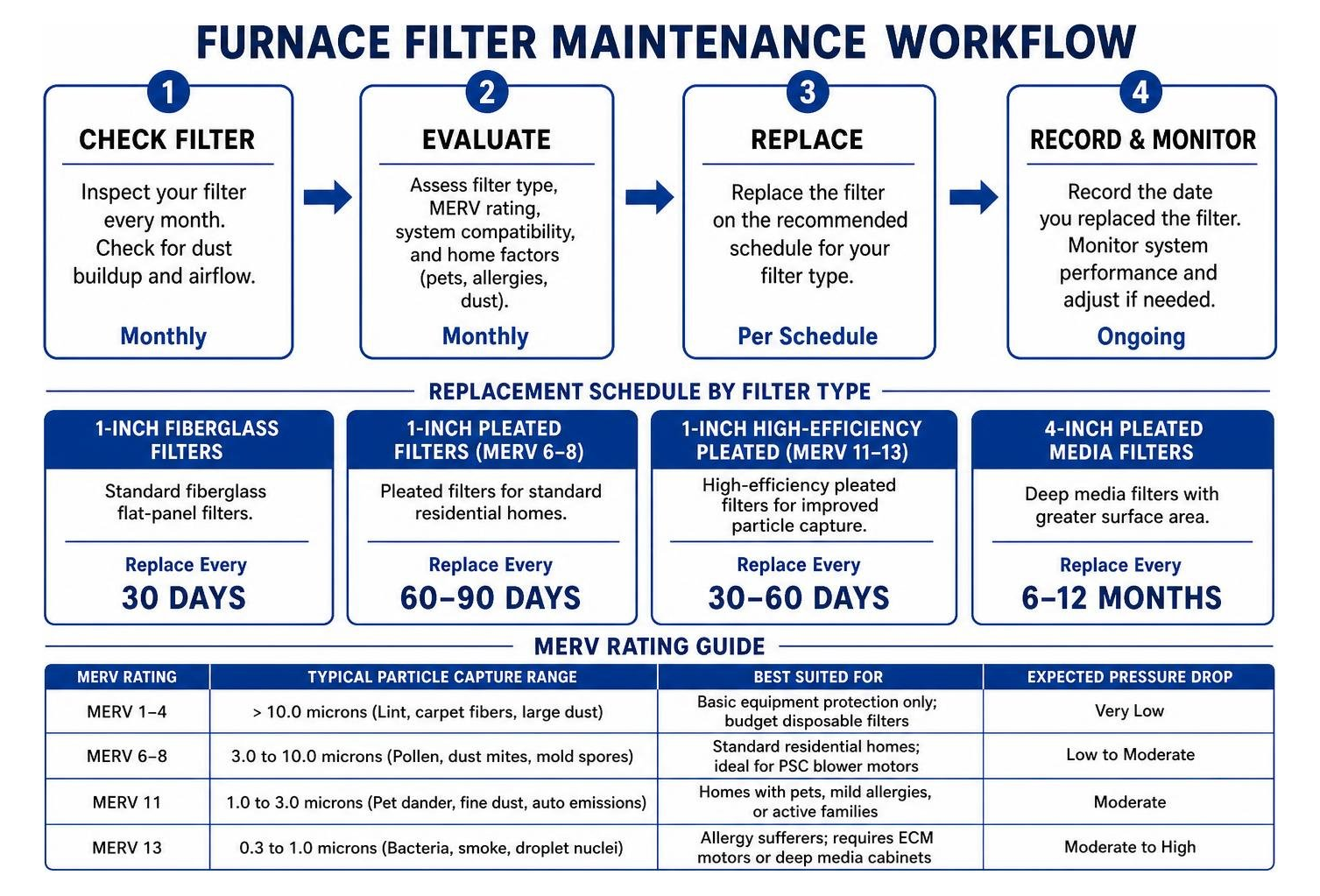
- 1-inch fiberglass filters: Replace every 30 days.
- 1-inch pleated filters (MERV 6–8): Replace every 60 to 90 days.
- 1-inch high-efficiency pleated filters (MERV 11–13): Replace every 30 to 60 days due to faster dust loading.
- 2-inch pleated filters: Replace every 90 to 120 days.
- 4-inch to 5-inch media filters: Replace every 6 to 12 months.
Customizing Your Furnace Filter Replacement Schedule for Pets and Allergies
Household occupants directly influence how fast an air filter fills with debris. Pets shed fur, hair, and microscopic dander that load filter fibers far quicker than standard household dust.
- Single dog or cat: Increases filter loading by roughly 25% to 30%. A 90-day pleated filter should be changed every 60 days.
- Multiple pets or heavy shedding breeds: Homes with multiple large pets experience 40% to 50% faster filter loading. A standard 1-inch filter may need replacement every 21 to 30 days during peak shedding seasons.
- Allergy and asthma sufferers: To keep airborne irritants low, replace filters every 30 to 45 days regardless of visual appearance.
Seasonal Adjustments to Your Furnace Filter Replacement Schedule
Your filter’s actual operating hours matter much more than the calendar days elapsed. During mild spring and autumn months when heating and AC systems cycle infrequently, filters collect debris slowly. During peak winter deep freezes or high summer humidity, equipment runs 10 to 16 hours daily.
Particulate matter remains suspended in dry indoor winter air, accelerating dust capture. Inspect filters twice a month during peak heating and cooling seasons, and pair these checks with an annual furnace inspection before winter arrives in Derry, NH.
Warning Signs and the Real Cost of a Neglected Filter
A clogged filter restricts airflow throughout your ductwork, forcing the blower motor to work against heavy resistance. The U.S. Department of Energy estimates that replacing a dirty filter with a clean one reduces HVAC energy consumption by 5% to 15%. When air cannot flow freely across heat exchangers or cooling coils, your comfort drops and utility bills rise. Regular seasonal tune-ups play a major role in extending equipment lifespan and avoiding unnecessary wear.
Performance Symptoms of Restrictive Airflow
Look for these everyday warning signs that indicate your furnace filter is overdue for a swap:
- Weak airflow at vents: Rooms farthest from the central air handler feel noticeably cooler or warmer than the rest of the house.
- Dust build-up near registers: A gray film forms on supply grilles and furniture shortly after cleaning.
- Whistling or humming sounds: Restricted return ducts create whistling sounds as the blower struggles to draw air.
- Short cycling: The furnace ignites, runs for 2 to 3 minutes, shuts off abruptly, and restarts repeatedly.
- Burning or overheating odors: Reduced airflow traps heat inside the cabinet, producing a distinct hot metallic smell.
Perform the simple visual light test: hold your filter up toward a light bulb or bright window. If light cannot pass through the pleats, the filter is completely loaded and needs replacement.
Mechanical Risks and Expensive Breakdowns
Operating your heating system with a dirty filter can trigger severe mechanical failures:
- Blower motor burnout: Restricting return air forces the blower motor to draw higher electrical current, generating extreme internal heat. A neglected filter can shorten motor lifespan by up to 50%.
- Heat exchanger cracking: Without adequate cooling airflow, heat exchanger temperatures rise rapidly, tripping safety limit switches. Over time, repeated thermal expansion causes metal stress cracks, risking carbon monoxide release into living spaces.
- Evaporator coil freeze-ups: During summer AC operation or dual-fuel heat pump cycles, restricted airflow causes coil temperatures to drop below 32 degrees Fahrenheit. Ice builds across the coil, causing refrigerant floodback that can destroy the compressor.
If your heating system begins short cycling or shutting down unexpectedly, Daigle Plumbing, Heating & Cooling can provide prompt furnace repair in Derry, NH to protect your heating equipment.
How to Correctly Measure, Replace, and Maintain Furnace Filters
Replacing a furnace filter is a simple DIY task when done correctly. Start by locating your filter cabinet, typically positioned in the return air duct adjacent to the furnace blower compartment or behind a central return wall grille.
- Turn off system power: Switch the thermostat to OFF or flip the dedicated furnace service switch on the side of the unit to ensure the blower does not activate during replacement.
- Remove the old filter: Slide out the dirty filter carefully to prevent loose dust and pet dander from falling into the blower cabinet.
- Check the sizing: Look at the outer frame for printed dimensions. Note the difference between nominal dimensions (the rounded label size, such as 16x25x1) and actual dimensions (the true physical measurement, such as 15.5 x 24.5 x 0.75 inches). If purchasing a new brand, measure the slot opening to avoid air bypass gaps.
- Identify airflow direction: Locate the directional arrow printed on the new filter frame. The arrow must point toward the furnace blower unit and away from the return air ductwork.
- Slide in the new filter: Ensure a snug fit without crushing the pleated media or bending the cardboard frame.
- Secure access and restore power: Close the access panel firmly and restore electrical power at the switch and thermostat.
Avoid common installation mistakes: never stack two thin 1-inch filters together to fit a wider slot, never force an oversized filter into a small cabinet, and never operate your system without a filter in place.
Washable vs Disposable Filters: Cleaning and Maintenance Protocols
Washable electrostatic filters feature aluminum or rigid plastic frames designed for periodic cleaning. While they eliminate recurring filter purchases, they demand strict maintenance.
Rinse washable filters outdoors once a month using a low-pressure garden hose, spraying in the opposite direction of normal airflow to push trapped dirt out. Never scrub the media with stiff brushes or use harsh chemical detergents that degrade the electrostatic fibers. Most importantly, allow the filter to dry completely in a clean area for 12 to 24 hours before reinstalling. Reinstalling a damp filter introduces moisture directly into your duct system, creating an environment for mold and mildew growth. For most busy households, disposable pleated filters provide more reliable filtration without the risk of moisture issues.
Frequently Asked Questions About Furnace Filters
What happens if I install a furnace filter backwards?
Installing a filter backward places the reinforced wire backing on the wrong side. Air pushes against unsupported filter media, which can cause the frame to bend, collapse into the blower wheel, or allow unfiltered air to bypass around the edges. Backward filters also create higher airflow resistance, reducing heating efficiency and increasing blower motor strain.
Can I run my heating system temporarily without a filter?
Running your furnace without a filter should be avoided. Without filtration, return air pulls dust, hair, and debris directly across the spinning blower wheel and into the delicate heat exchanger or AC evaporator coil. Operating without a filter for even a few days can coat components with grime, reducing efficiency and requiring professional cleaning.
How do I know if a high-MERV filter is damaging my system?
Signs of excessive filter resistance include a blower motor that sounds louder than usual, whistling air at return vents, rooms taking longer to reach set temperatures, and the furnace shutting down on high-temperature limit switches. If you notice these symptoms after installing a high-MERV filter, switch back to a MERV 8 pleated filter to verify whether airflow returns to normal.
Conclusion
Following a consistent furnace filter replacement schedule protects your equipment, lowers monthly energy costs, and keeps indoor air clean for your family. By matching filter thickness and MERV ratings to your home’s needs and adjusting for pets, seasons, and runtime, you can prevent major heating breakdowns.
At Daigle Plumbing, Heating & Cooling, our family-owned team brings over 40 years of local heating, cooling, and plumbing expertise to homeowners across Derry, Manchester, Nashua, and neighboring communities. If your system continues to short-cycle, makes unusual noises, or struggles to maintain comfortable temperatures even after a fresh filter change, contact our professional HVAC technicians for prompt, professional service.