Understanding Mini Split Air Conditioner and Heating Systems
#
If you’re comparing mini split air conditioner and heating systems to find the best option for your home, here’s the short answer:
The best mini split systems for most homeowners in 2026:
| System Type | Best For | Estimated Cost (Unit + Install) |
|---|---|---|
| Single-zone professional (12,000–18,000 BTU) | One room or addition | $1,500–$4,000 |
| Multi-zone professional (2–4 zones) | Whole-home zoning | $4,000–$10,500 |
| DIY single-zone (12,000–18,000 BTU) | Budget installs with basic skills | $800–$2,500 |
| Hyper-heat system | Cold climates (below 0°F) | $2,500–$6,000+ |
Mini splits beat central air and window units on efficiency, flexibility, and long-term savings, but only when you choose the right size and get a proper installation.
Heating and cooling bills are one of the biggest monthly expenses for homeowners in Derry, NH, and most people are overpaying without knowing it. Central air systems lose roughly 30% of their energy through leaky ducts, according to the U.S. Department of Energy. Window units are cheap upfront but inefficient and seasonal. Mini splits solve both problems at once.
They cool in summer, heat in winter, and let you control the temperature room by room without ductwork. Modern systems can cut monthly utility costs by 30% to 50% compared to portable or window units, and high-quality models last 15 to 20 years with proper maintenance.
But not every mini split delivers on that promise. The wrong size, a rushed DIY install, or a low-efficiency unit can wipe out those savings fast.
That’s exactly what this guide is here to help you avoid.
The team at Daigle Plumbing, Heating & Cooling brings hands-on HVAC service, sales, and installation experience to help New Hampshire homeowners find the right mini split air conditioner and heating solutions for their specific homes and climate. In this guide, we will walk you through the top-rated systems, what they actually cost, and how to pick the right one without second-guessing yourself.
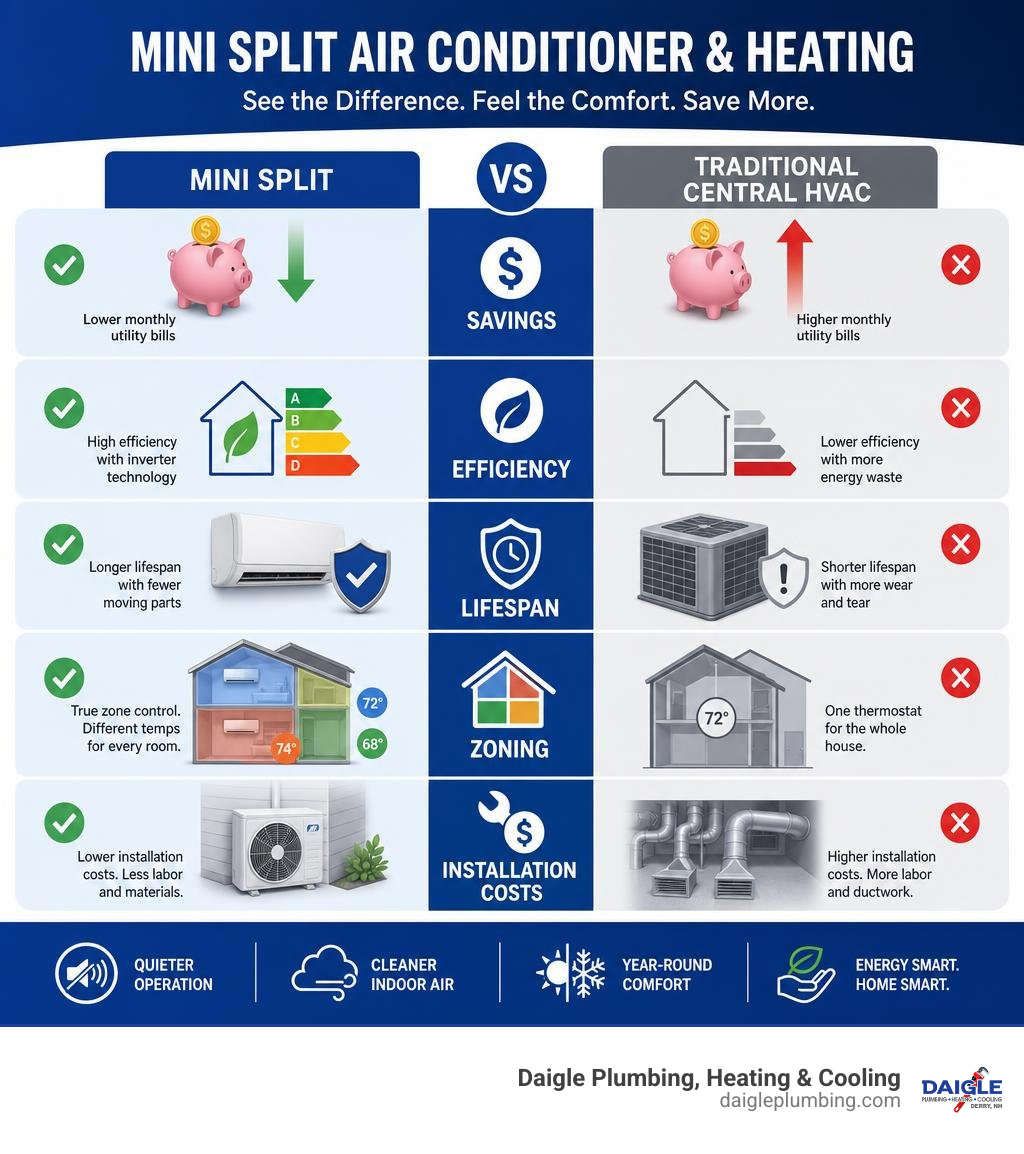
At its core, a mini split is a ductless heat pump system. Traditional heating systems create heat by burning fossil fuels or running electricity through high-resistance coils. Air conditioners cool your home by capturing indoor heat and dumping it outside.
A mini split heat pump does both, but instead of creating heat, it simply moves it. In the summer, it absorbs heat from your rooms and pumps it outdoors. In the winter, it reverses the process, extracting heat from the outdoor air (even in freezing New Hampshire winters) and bringing it inside.
If you are comparing ductless comfort with a conventional setup, understanding what a ductless HVAC system is and how it works can make it easier to see why mini-splits are so efficient in additions, older homes, and rooms that never stay comfortable.
The secret to their high efficiency is inverter technology. Traditional HVAC compressors are either 100% on or 100% off. When your thermostat calls for cooling, the system blasts on at full power, cools the room, and shuts off. This constant cycling consumes massive amounts of energy and wears out mechanical parts.
In contrast, a mini split’s inverter compressor acts like a dimmer switch. It dynamically adjusts its speed to match the exact temperature demand of the room. Once the room reaches the target temperature, the compressor runs at an ultra-low, whisper-quiet speed to maintain it. This prevents energy spikes and keeps your home at a perfectly consistent temperature.
Compared with window AC units, mini-splits offer a more permanent and efficient way to condition a room. A closer look at mini split energy efficiency versus window units shows why homeowners often prefer ductless systems for quieter operation, better security, and fewer air leaks around the opening.
How Does a Mini Split Air Conditioner and Heating Unit Work?
A ductless mini split system consists of two main physical components: an outdoor condenser unit and one or more indoor air handlers.
These two components are connected through a small, three-inch hole in your wall by a line set containing:
- Copper tubing for refrigerant
- A condensate drain line to carry away moisture
- Power and control wiring to sync the indoor and outdoor units
The indoor air handler contains a fan and a cooling/heating coil. As indoor air passes over the coil, the refrigerant absorbs or releases heat. This design is incredibly flexible, allowing you to mount air handlers on walls, flush with the ceiling, or near the floor.
Key Benefits of Going Ductless
Why are so many homeowners in towns like Salem, NH, and Manchester, NH, making the switch? Here are the primary advantages:
- Zero Duct Loss: The Department of Energy estimates that energy losses through ducts account for roughly 30% of a central air system’s energy consumption. By delivering conditioned air directly to the room, mini splits eliminate this waste entirely.
- True Zone Control: Central HVAC systems rely on a single thermostat, meaning you often have to freeze the downstairs just to make the upstairs bedrooms livable. Mini splits allow you to set different temperatures in every room. If a guest room or basement is unoccupied, you can turn that unit off entirely to save money.
- Incredible Energy Savings: Moving heat requires far less electricity than creating it. By switching from baseboard heating or window ACs to a mini split heat pump, you can save 30% to 50% on your monthly utility costs.
- Improved Indoor Air Quality: Traditional ductwork accumulates dust, pet dander, and mold over time, blowing those allergens throughout your home. Mini splits feature multi-stage, washable filtration systems in each room, keeping your indoor air clean.
For homeowners deciding whether ductless is the right fit, the pros and cons of mini-split systems help clarify where these systems shine and where careful sizing, placement, or backup heat may still matter.
Choosing the Best Mini Split Air Conditioner and Heating System
Selecting the perfect system requires understanding a few key technical specifications, starting with efficiency ratings.
When shopping, you will see two main efficiency metrics:
- SEER2 (Seasonal Energy Efficiency Ratio 2): This measures cooling efficiency over a typical season. The federal minimum standard is 14 SEER2, but high-efficiency mini splits routinely range from 20 to 25 SEER2. A 20 SEER2 system uses roughly half the energy of an older 10 SEER system.
- HSPF2 (Heating Seasonal Performance Factor 2): This measures heating efficiency. Look for a rating of 9.0 HSPF2 or higher for optimal winter performance.
If your current HVAC system cannot keep every room comfortable, a ductless upgrade may be a better fit than replacing everything at once. Daigle Plumbing, Heating & Cooling installs Mitsubishi ductless systems for homeowners who want targeted heating and cooling without adding ductwork.
A mini split can also support or replace other heating equipment when the system is designed correctly. If you are weighing ductless heat pumps against your existing furnace, boiler, or central air setup, the team’s heat pump repair and installation experience can help you choose a practical path for year-round comfort.
Sizing Your Mini Split Air Conditioner and Heating System (BTU Guide)
Getting the right size is critical. An undersized unit will run constantly, driving up your electric bill and wearing out the compressor. An oversized unit will cool the room so quickly that it doesn’t have time to properly dehumidify the air, leaving your home feeling cold and clammy.
As a general rule of thumb, you need about 20 BTUs of capacity per square foot of living space. However, you must adjust this based on your room’s characteristics:
- High Ceilings: If your ceilings are over 8 feet, increase your BTU calculation by 10%.
- Sunlight: If the room is heavily shaded, reduce capacity by 10%. If it gets direct, heavy sunlight (such as a south-facing loft), increase it by 10%.
- Location: If the room is located directly below a fully insulated, conditioned space, you can apply a 0.7 multiplier to reduce the required BTUs.
Here is a quick reference table to help you match your space with the right capacity:
| Room Size (Sq. Ft.) | Required BTU Capacity | Common Single-Zone System Example |
|---|---|---|
| 150 to 350 | 9,000 BTU (0.75 Ton) | Standard Bedroom / Small Office |
| 350 to 500 | 12,000 BTU (1.0 Ton) | DIY 12,000 BTU 1-Ton 1-Zone 22 SEER Ductless Mini Split AC and Heat Pump |
| 500 to 750 | 18,000 BTU (1.5 Ton) | DIY 18,000 BTU 1.5-Ton 1-Zone 22 SEER Ductless Mini Split AC and Heat Pump |
| 750 to 1,000 | 24,000 BTU (2.0 Tons) | 24,000 BTU 5th Gen Mini Split System |
| 1,000 to 1,500 | 36,000 BTU (3.0 Tons) | Large Open-Concept Living Area |
Single-Zone vs. Multi-Zone Configurations
A single-zone system connects one outdoor condenser to one indoor air handler. This is perfect for home additions, sunrooms, detached garages, or resolving a single “hot spot” in your home.
A multi-zone system connects one outdoor condenser to multiple indoor air handlers (typically 2 to 5 zones). This allows you to heat and cool your entire home with a single outdoor footprint.
When configuring a multi-zone system, the outdoor condenser’s capacity is shared among the indoor units. Interestingly, modern inverter technology allows multi-zone condensers to support a total indoor air handler capacity of up to 1.25 times the condenser’s nominal rating. This works because you rarely run all indoor units at maximum capacity at the exact same time.
For whole-home comfort, a multi-zone configuration can offer incredible flexibility. These systems allow you to heat or cool several separate rooms independently using highly efficient variable-speed technology.
A multi-zone setup is also one of the smartest ways to handle seasonal shifts. In New Hampshire homes where spring days swing from chilly mornings to warm afternoons, ductless mini-split installation helps manage temperature swings by giving each area of the home its own comfort control.
Top-Rated Professional Mini Split Systems for 2026
While retail DIY brands have grown in popularity for budget-conscious homeowners, professional-grade HVAC brands remain the gold standard for performance, longevity, and cold-weather reliability.
Professional systems are manufactured with heavier-gauge metals, more advanced electronics, and superior corrosion-resistant coatings (like Gold Fin technology). Furthermore, professional brands are currently leading the transition to R-454B, a next-generation refrigerant designed to comply with 2026 environmental standards by offering a much lower Global Warming Potential (GWP) than older R-410A systems.
Industry-Leading High-Efficiency Systems
When it comes to professional mini splits, Mitsubishi Electric is an industry leader. Some systems are engineered to operate at decibel levels as low as 19 dBA, which is quieter than a human whisper.
Unlike retail brands that may struggle to provide replacement parts down the road, choosing a premium brand helps ensure access to long-term support. If you are ready to make a serious upgrade to your home comfort, a Mitsubishi ductless heating and cooling system can offer strong cold-climate performance, comfort control, and reliability.
Advanced Multi-Zone Solutions
For larger homes in Merrimack, NH, or Bedford, NH, professional multi-zone systems provide seamless climate control. These systems use advanced smart sensors to monitor temperature and humidity. Some high-end remotes even feature “Follow Me” technology, which tracks the temperature directly around the remote control rather than at the wall unit, ensuring localized comfort exactly where you are sitting.
Hyper-Heating Technology for Cold Climates
In New England, standard heat pumps traditionally struggled once temperatures dropped below freezing. That is no longer the case.
Modern hyper-heating systems are designed specifically for cold climates. These units can provide 100% heating capacity at outdoor temperatures as low as 5°F and continue to extract heat efficiently down to -13°F or -15°F. This eliminates the need for expensive fossil-fuel backup systems, keeping your home warm and cozy through the toughest New Hampshire blizzards.
DIY vs. Professional Mini Split Installation
With the rise of “YouTube University,” many homeowners wonder if they can install a mini split themselves to save on labor costs. While DIY kits like the MRCOOL DIY series exist, they come with significant trade-offs that every homeowner must carefully consider.
Here is a realistic look at the physical and legal challenges of a DIY installation:
- The “Pre-Charged” Trap: DIY units use pre-charged copper line sets with quick-connect fittings. While this avoids the need for a vacuum pump, it means you cannot cut the lines to length. If you only need 15 feet of line but your kit comes with 25 feet, you are forced to coil the bulky, excess copper tubing behind your outdoor unit.
- Manual Discrepancies: DIY instruction manuals are notoriously outdated. Homeowners frequently report drilling a 2.5-inch hole through their home’s exterior as instructed, only to find the actual wall sleeve is 3.5 inches, forcing them to enlarge the hole without a pilot.
- Electrical Hazards: Mini splits are high-voltage appliances. A standard 18,000 BTU unit requires a dedicated 208/230V double-pole circuit breaker and 12-gauge wiring. Running this wire from your main electrical panel to an outdoor disconnect switch requires a licensed electrician to ensure code compliance and safety.
- Warranty Risks: This is the biggest catch. Almost all HVAC manufacturers will completely void your warranty if the system is not installed or signed off by a licensed HVAC professional. If a control board or compressor fails two years down the road, a self-installed DIYer will have to pay 100% of the replacement costs out of pocket.
- Specialized Tools: Professional systems require specialized tools to physically vacuum the refrigerant lines, clear out moisture, pressure-test the lines with nitrogen to prevent leaks, and handle EPA-regulated refrigerants.
For the vast majority of homeowners, hiring a professional team saves money in the long run by preventing refrigerant leaks, ensuring peak operating efficiency, and preserving a robust manufacturer warranty.
Frequently Asked Questions about Mini Splits
If you are still weighing your options, here are the answers to the most common questions we hear from homeowners in Windham, NH, Hooksett, NH, and surrounding areas.
How much does a mini split system cost to install?
A single-zone professional installation typically ranges from $1,500 to $4,000, depending on the BTU capacity and the complexity of the electrical run. A multi-zone system for an entire home generally ranges from $4,000 to $10,500.
While this upfront cost is higher than buying window units, you can offset this investment through:
- NHSaves Utility Rebates: New Hampshire homeowners can qualify for significant rebates on high-efficiency heat pumps.
- Federal Tax Credits: Under the Inflation Reduction Act, you may qualify for tax credits up to $2,000 for installing qualified heat pumps.
- Financing Options: We offer flexible financing plans to help make your home comfort upgrade affordable.
Do mini splits work effectively in extreme cold weather?
Yes, provided you choose a model equipped with hyper-heat or cold-climate technology. These systems are specifically engineered to handle sub-zero New England winters.
How long do mini splits last and what maintenance is required?
A high-quality, professionally installed mini split system will last between 15 and 20 years with proper maintenance.
To ensure your system reaches its maximum lifespan, you should:
- Clean the Air Filters: Slide out the washable filters in your indoor air handlers and rinse them under warm water every 2 to 4 weeks. This maintains optimal airflow and prevents dust buildup on the motor.
- Keep the Outdoor Unit Clear: Ensure leaves, snow, and weeds do not block the airflow around your outdoor condenser.
- Schedule Annual Maintenance: Have a professional technician perform a deep coil cleaning and electrical check once a year.
For a complete checklist, read our ductless AC maintenance tune-up guide. If you do run into any performance dips, our troubleshooting guides on mini split AC problems and solutions and mini split AC not cooling troubleshooting will help you get back on track.
Conclusion
Investing in a mini split air conditioner and heating system is one of the smartest ways to lower your energy bills, improve your indoor air quality, and bring precise, zoned comfort to your home. Whether you are looking to heat and cool a new home addition in Hudson, NH, or zone your entire home in Londonderry, NH, getting the right system and a professional installation is the key to unlocking those 30% to 50% monthly savings.
At Daigle Plumbing, Heating & Cooling, we have been serving Derry, NH, and the surrounding communities for over 40 years. As a family-owned business, we back our work with licensed and insured experts, a satisfaction guarantee, and flexible financing options.
If you are ready to find the perfect ductless system for your home, contact our professional mini-split technicians. We’ll help you design a system that keeps your family comfortable all year long while putting money back in your pocket.