What to Do When Your AC Is Not Cooling Your House
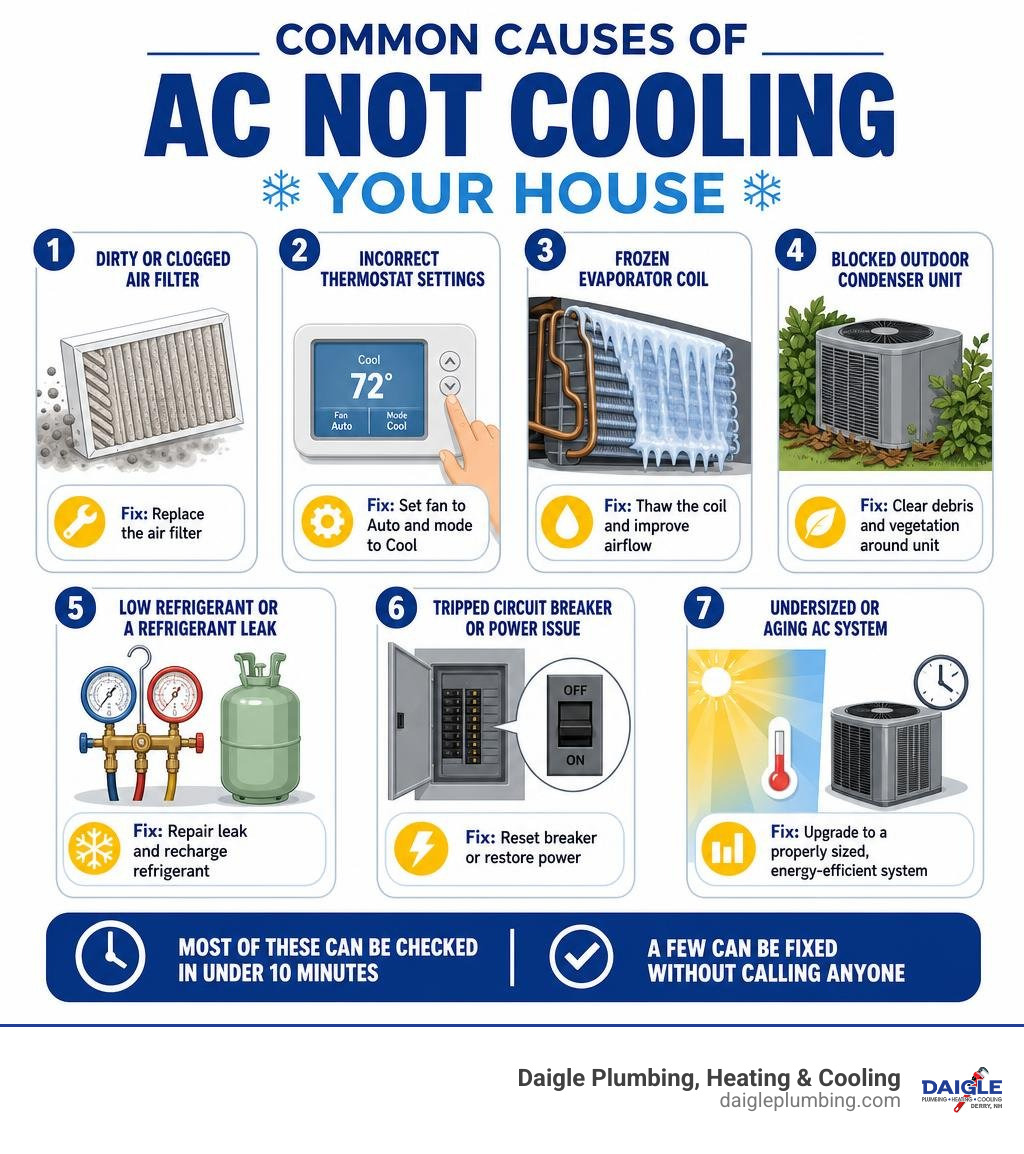
If your AC is not cooling your house, here are the most common reasons and what to check first:
- Dirty or clogged air filter: restricts airflow and is the #1 cause of cooling failure
- Incorrect thermostat settings: fan set to “On” instead of “Auto,” or wrong mode
- Frozen evaporator coil: caused by poor airflow or low refrigerant
- Blocked outdoor condenser unit: debris prevents heat from escaping
- Low refrigerant or a refrigerant leak: system can’t absorb heat properly
- Tripped circuit breaker or power issue: unit won’t run at all
- Undersized or aging AC system: can’t keep up with summer heat demand
Most of these can be checked in under 10 minutes, and a few can be fixed without calling anyone.
It’s a frustrating feeling: the AC is humming, the fan is blowing, but your home just won’t cool down. You check the thermostat, it looks fine, and yet the house keeps getting warmer. If this sounds familiar, you’re not alone. AC cooling problems are one of the most common homeowner complaints during New Hampshire summers, and the good news is that many causes are straightforward to diagnose once you know what to look for.
This guide walks you through everything step by step, from quick DIY checks you can do right now to knowing when it’s time to call a professional.
At Daigle Plumbing, Heating & Cooling, our licensed HVAC team has seen nearly every version of the AC not cooling house problem there is. Our goal here is to help you cut through the confusion and find the real fix, fast.
Common Reasons for an AC Not Cooling House
When your air conditioner runs but fails to cool your home, it usually comes down to one of two physical bottlenecks: restricted airflow or a breakdown in the heat transfer process. Your AC doesn’t actually “create” cold air; it absorbs heat from inside your home and dumps it outside. Anything that blocks this loop will leave you sweating.
To put things in perspective, let’s look at what actually triggers most cooling failures. According to industry service call data, a simple dirty air filter is the single most frequent reason an air conditioner stops cooling. In fact, filter and thermostat setting corrections resolve up to 45% of all “AC not cooling” calls.
Meanwhile, physical system leaks are also incredibly common. Typical homes lose 20% to 30% of their conditioned air through leaky ductwork before it even reaches the living spaces. When the problem lies within the cooling equipment itself, refrigerant leaks or low refrigerant levels account for 15% to 20% of “running but not cooling” cases, while frozen evaporator coils make up another 10% to 15%.
Understanding these probabilities can help you narrow down the culprit. If your symptoms match a system that runs but still will not cool, our breakdown of common reasons your AC is not cooling the house properly explains how airflow problems, thermostat errors, frozen coils, and refrigerant issues usually show up in a home.
Step-by-Step Guide to Troubleshooting an AC Not Cooling House
Before you pick up the phone to schedule a service call, run through this quick, 5-minute DIY diagnostic checklist. It could save you a diagnostic fee and get your home cool again immediately.
- Step 1: Check the Airflow. Go to your supply registers, which are the vents blowing air into your rooms. Is there air coming out? If so, does it feel lukewarm or cold? If there is barely any air moving, you have an airflow restriction.
- Step 2: Inspect the Thermostat. Ensure the thermostat is set to “Cool” and the temperature setting is at least 3 to 5 degrees below the current room temperature.
- Step 3: Check the Outdoor Condenser. Walk outside and look at your outdoor unit. Is the fan spinning? Is the area surrounding the unit free of weeds, leaves, and debris? Your outdoor unit needs at least two feet of clear space on all sides to dump heat efficiently.
- Step 4: Inspect the Indoor Air Handler. Check the drain pan underneath your indoor unit. Is it filled with water? If your condensate drain line is clogged, a safety float switch will shut down your system to prevent water damage.
For homeowners in southern New Hampshire, a professional AC repair service in Derry, NH can diagnose the issue safely when these basic checks point to an electrical problem, refrigerant leak, failed capacitor, or another repair that should not be handled as a DIY fix.
Why Your AC Not Cooling House Might Be a Thermostat Issue
Sometimes, the issue isn’t your air conditioner at all. It’s the brain directing it. Thermostat issues account for roughly 8% of summer service calls.
The first thing to check is the fan setting. If your thermostat fan is set to “ON” instead of “AUTO,” the indoor fan will run continuously, even when the outdoor compressor is turned off. This means the system will blow unconditioned, room-temperature air through your vents between cooling cycles, making your home feel warm and humid. Always keep the fan set to “AUTO” so it only blows when the system is actively cooling.
Other common thermostat culprits include:
- Dead Batteries: If your thermostat display is blank or dim, replace the batteries immediately.
- Poor Placement: If your thermostat is installed near a sunny window, a drafty door, or a heat-producing appliance, it will read the wrong temperature and cycle your system incorrectly.
- Calibration Issues: Older thermostats can lose calibration over time, meaning the temperature they display doesn’t match the actual temperature of the room.
If you are experiencing uneven temperatures, such as a hot upstairs and a cold downstairs, the problem may involve duct layout, airflow balance, insulation, or equipment sizing. Our article on why your AC is not cooling downstairs walks through those room-by-room cooling issues in more detail.
How to Check and Replace Your Air Filter
Because a dirty air filter is the most common cause of cooling failure, checking it should be your absolute first step. When an air filter becomes clogged with dust, pet dander, and hair, it restricts the volume of air flowing across your indoor evaporator coil.
Without enough warm air passing over it, the evaporator coil gets too cold, causing the moisture on the coil to freeze solid. Once ice forms, it completely blocks heat transfer, and your system will start blowing warm air.
To check your filter, turn off your HVAC system at the thermostat, slide the filter out, and hold it up to a light source. If light cannot pass through the filter, it is completely clogged and must be replaced.
During peak cooling seasons in southern New Hampshire, we recommend replacing basic 1-inch pleated filters every 30 to 90 days. If you have pets or allergy sufferers in your home, check it monthly. Regular filter changes are also one of the simplest ways to reduce preventable strain between visits from an AC tune-up technician in Derry, NH.
What to Do When the AC Runs But Won’t Lower the Temperature
If your air conditioner is running constantly but your home’s temperature refuses to drop, your system is struggling to reject heat.
A great way to test your system’s basic performance is the temperature split test. You can do this at home with a simple digital thermometer:
- Measure the temperature of the air entering your return grille, where the air filter is located.
- Measure the temperature of the air blowing out of your closest supply register.
- Subtract the supply temperature from the return temperature.
A properly functioning central air conditioning system should have a temperature split of 15 to 20 degrees Fahrenheit. If the difference is less than 15 degrees, your system is not absorbing enough heat. This is a clear sign of a mechanical issue, such as dirty coils, a failing compressor, or low refrigerant.
High utility bills can be another clue that the system is losing efficiency while it struggles to cool the home. If your AC is running longer than usual and your energy costs keep rising, our article on poor cooling and high utility bills explains how hidden cooling problems can show up on your monthly bill.
Dealing with a Frozen Evaporator Coil
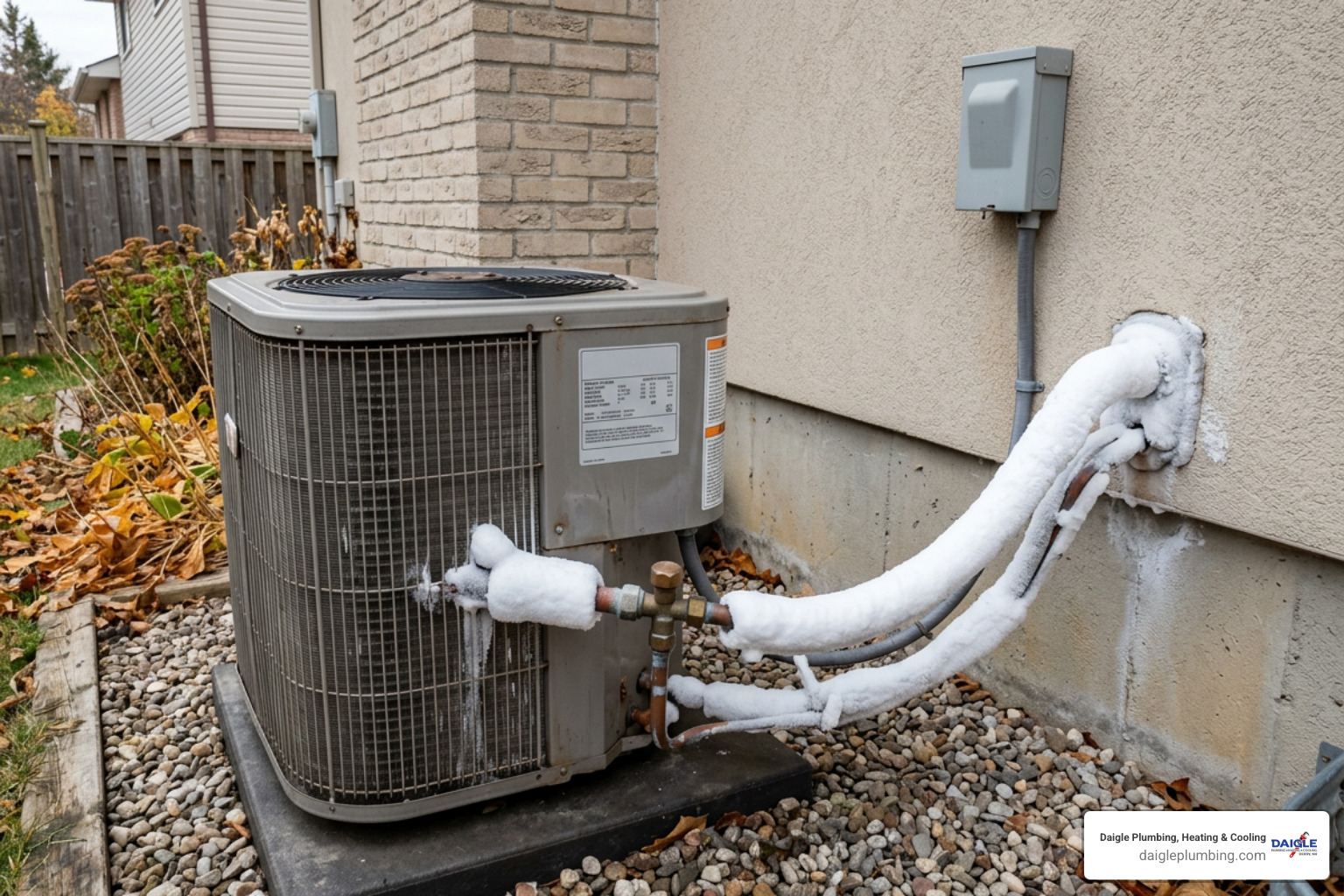
If you look at your indoor air handler or the copper refrigerant lines running outside and see ice buildup, your evaporator coil is frozen.
When ice forms, it acts as an insulator, stopping the refrigerant from absorbing heat from your indoor air. This leads to a self-reinforcing cycle: the restricted airflow makes the coil colder, which creates more ice, which blocks even more airflow.
How to fix a frozen evaporator coil:
- Turn off the cooling immediately. Running the system with a frozen coil can cause permanent compressor failure, which can be a very expensive repair.
- Switch the fan to “ON.” Keep the thermostat set to “Off” for cooling, but turn the fan setting to “On.” This forces warm indoor air over the ice, melting it gradually.
- Expect a 4 to 6-hour thaw. Do not try to scrape the ice off the coils with a screwdriver or tool, as you can easily puncture the copper lines.
- Replace the air filter. Once the system is completely thawed, check your filter. If it was dirty, replacing it may solve the problem entirely.
If the ice returns after you’ve replaced the filter and restored airflow, you may have a refrigerant leak or another mechanical issue. Our article on why your air conditioner is freezing up explains why ice can come back even after the filter has been changed.
Signs of a Refrigerant Leak
A common misconception is that air conditioners “consume” refrigerant over time. In reality, your AC system is a sealed loop. The refrigerant simply cycles back and forth between liquid and gas states to transfer heat. If your system is low on refrigerant, it means you have a leak.
Adding more refrigerant without fixing the leak is a temporary, expensive, and environmentally harmful mistake. Signs that your AC has a refrigerant leak include:
- A gradual loss of cooling capacity over several weeks.
- Hissing or bubbling noises coming from the indoor air handler or outdoor lines.
- Ice forming on the evaporator coil or the outdoor brass valves.
- Unusually high utility bills because the system has to run constantly to meet demand.
If you suspect a leak, you must call a licensed professional. Federal EPA regulations require certified technicians to handle and repair refrigerant systems.
What to Check When Your AC Won’t Turn On At All
If your system is completely silent and won’t turn on, you are dealing with a power or safety control issue rather than a refrigerant problem.
| Symptom | Probable Cause | Homeowner Action |
|---|---|---|
| Blank thermostat screen | Dead batteries | Replace batteries |
| Outdoor unit silent, indoor running | Tripped outdoor breaker / Failed capacitor | Check main panel breaker once |
| Entire system completely silent | Tripped main breaker / Tripped float switch | Check main panel and indoor drain pan |
| System clicks but won’t start | Failed start capacitor | Call a professional HVAC technician |
If you find yourself in this situation, check these three main power points:
- The Circuit Breaker: Go to your home’s main electrical panel. Look for the breakers labeled “AC” or “HVAC.” If a breaker is tripped, switch it completely to the “Off” position first, then flip it back to “On.” Warning: If the breaker trips again immediately, do not reset it a second time. This indicates a serious electrical short or a failing compressor, and resetting it again can cause an electrical fire.
- The Outdoor Disconnect Box: Located on the exterior wall near your outdoor unit, this box contains a pull-out switch or circuit breaker. Ensure it hasn’t been accidentally bumped or turned off.
- The Condensate Float Switch: Check the drain pan under your indoor unit. If the drain line is clogged with algae or debris, the water will back up, lifting the safety float switch and cutting all power to the system to prevent a household flood.
How to Safely Reset Your Central AC System
If your system has experienced a minor electrical glitch or power surge, performing a hard reset can reboot the internal control boards and restore operation.
How to safely reset your central AC:
- Turn your thermostat completely to the “Off” position.
- Go to your main electrical panel and locate the AC circuit breaker.
- Flip the breaker to the “Off” position.
- Wait at least 5 full minutes. This allows any residual electrical charge to dissipate from the system’s capacitors and control boards.
- Flip the breaker back to the “On” position.
- Turn your thermostat back to “Cool” and set the temperature below the room temperature.
Many modern systems have built-in time delays, so it may take up to 5 minutes after resetting for the outdoor unit to kick on. If the system does not restart or trips the breaker again, stop there and schedule professional service rather than continuing to reset the equipment.
DIY vs. Professional HVAC Repair: When to Call a Pro
While cleaning a condenser coil or replacing an air filter are excellent DIY projects, some repairs carry significant safety risks and require specialized tools.
Electrical components, such as capacitors and contactors, are common failure points. In fact, capacitor failure accounts for 25% to 30% of summer emergency AC calls in New Hampshire. Capacitors store high-voltage electricity even when the power is turned off. Attempting to replace one without the proper tools and safety training can result in severe electrical shock.
Similarly, diagnosing a failed compressor or repairing a refrigerant leak requires specialized manifold gauges, vacuum pumps, and EPA certification. If your basic troubleshooting steps don’t bring back the cold air, it is always safest to call a professional.
Signs Your AC Needs Professional Repair or Replacement
How do you know if your air conditioner simply needs a quick fix or if it’s time to start planning for a new system?
Consider these key factors:
- System Age: Most central air conditioners have an operational lifespan of 10 to 12 years. If your system is approaching 15 years of age and experiences a major component failure, replacing it is often more cost-effective than repairing it.
- Frequent Repairs: If you’ve had to call an HVAC technician multiple times over the last two summers, those repair costs can quickly add up to the price of a modern, high-efficiency replacement.
- Compressor Failure: The compressor is the heart of your AC system. If it fails, the repair is incredibly labor-intensive and expensive. On an older, out-of-warranty system, a failed compressor almost always warrants a full system replacement.
Preventive Maintenance Steps to Avoid Cooling Issues
The best way to handle an AC emergency is to prevent it from happening in the first place. Regular, proactive maintenance keeps your system running efficiently, lowers your monthly energy bills, and helps prevent unexpected breakdowns during the hottest weeks of the summer.
- Schedule an Annual Tune-Up: Have a licensed technician inspect your electrical connections, measure refrigerant levels, test capacitors, and clean the internal components every spring.
- Keep Coils Clean: Gently rinse your outdoor condenser coils with a garden hose once a year to remove pollen, dust, and grass clippings.
- Flush Your Condensate Drain: Pour a cup of vinegar or warm water down your indoor condensate drain line once a month during the summer to prevent algae buildup and clogs.
Frequently Asked Questions about AC Cooling Problems
Why is my AC running but not blowing cold air?
If your system is running but blowing warm or lukewarm air, it is usually caused by an airflow restriction, like a clogged air filter or blocked return vents, a dirty outdoor condenser coil that cannot release heat, or a refrigerant leak. Run through the basic DIY checks to narrow down the cause.
Should I turn off my AC if it is running but not cooling?
Yes, absolutely. If your system is running constantly without lowering the temperature, it puts immense strain on the compressor. This can lead to overheating, permanent motor damage, or a frozen evaporator coil, turning a simple repair into an expensive replacement.
Does cleaning the AC filter make the air colder?
While cleaning or replacing a dirty filter does not physically change the temperature of the refrigerant inside the coils, it dramatically increases the volume of air passing through the system. This improves heat absorption and dehumidification, making the air coming out of your vents feel significantly crisper and cooler.
Conclusion
When your air conditioner stops cooling, it doesn’t take long for your home to feel uncomfortable. Fortunately, by checking your air filter, verifying your thermostat settings, and inspecting your outdoor unit, you can solve many common cooling issues yourself.
But when DIY troubleshooting isn’t enough, our team at Daigle Plumbing, Heating & Cooling is here to help. As a family-owned business with over 40 years of experience serving Derry, Salem, Manchester, Nashua, Auburn, Hampstead, Merrimack, Bedford, Windham, Hooksett, Hudson, and Londonderry, New Hampshire, we pride ourselves on delivering expert, reliable service. We offer fully licensed and insured technicians, a 100% satisfaction guarantee, convenient financing options, and seasonal specials to keep your home comfortable year-round.
Don’t spend the summer sweating in a warm house. Contact our professional AC technicians today, and we’ll get your home cool and comfortable again in no time!