Why Every Well Owner Needs a Seasonal Well Pump Maintenance Plan
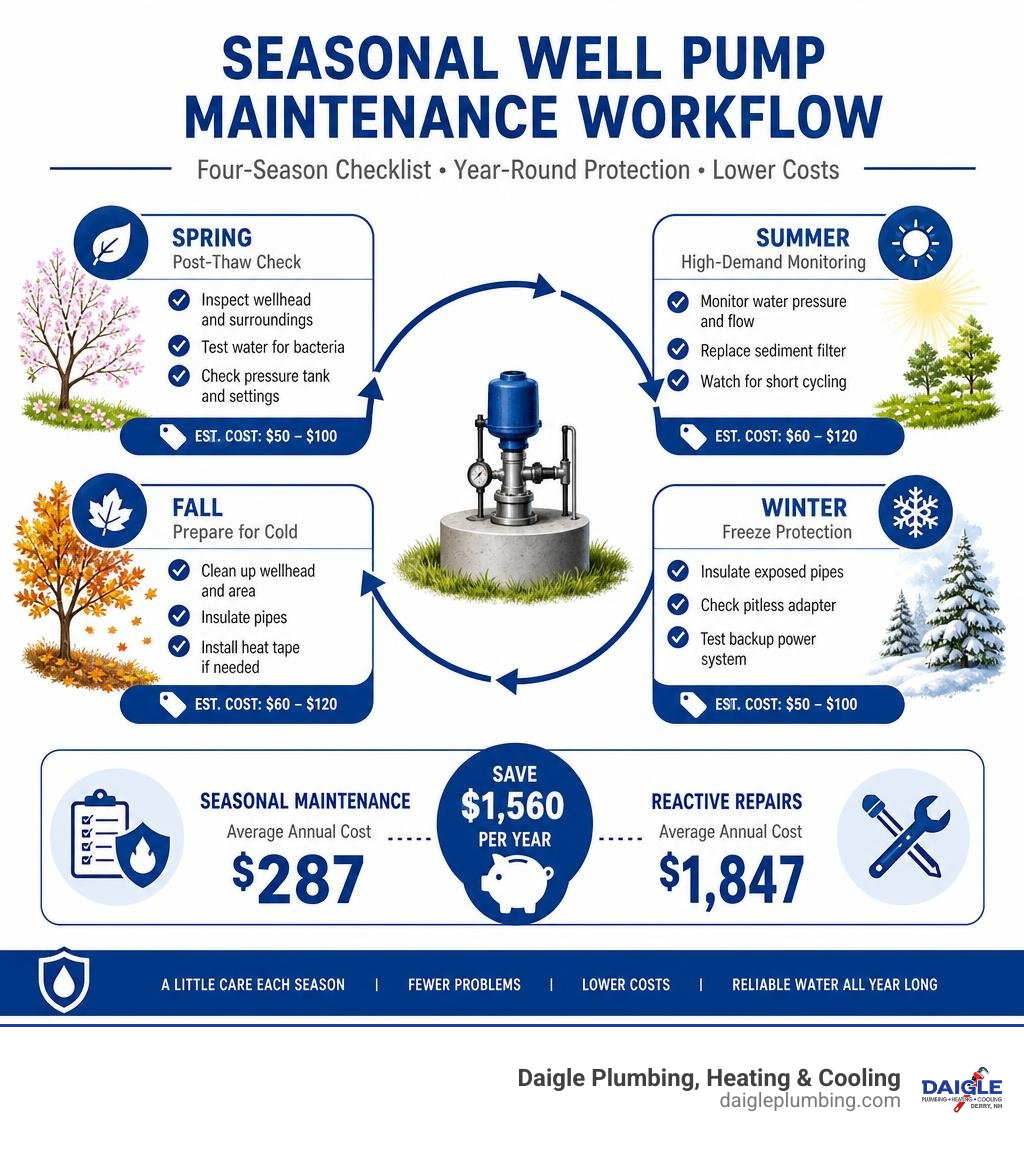
Seasonal well pump maintenance is the practice of inspecting, testing, and servicing your private well system four times a year, once each season, to catch small problems before they become expensive emergencies. Here’s what it covers at a glance:
| Season | Primary Focus |
|---|---|
| Spring | Post-thaw inspection, bacteria water testing, pressure tank check |
| Summer | High-demand monitoring, sediment filter replacement, short cycling watch |
| Fall | Wellhead cleanup, pipe insulation, heat tape installation |
| Winter | Freeze protection, pitless adapter check, generator testing |
About 43 million Americans rely on private wells for their drinking water, and unlike municipal water systems, the full responsibility for maintenance falls on the homeowner. That means no reminders, no inspections, and no safety net unless you build one yourself.
Most well pump problems don’t appear overnight. They build slowly, showing warning signs like fluctuating water pressure, sputtering faucets, or a climbing electric bill. Understanding common well problems and solutions helps catch those signals early, before your water stops flowing on a cold January night.
At Daigle Plumbing, Heating & Cooling, our team of experienced technicians has seen how a simple seasonal well pump maintenance routine is the single biggest factor separating a long-lasting pump from one that fails too soon. In the sections below, we will walk you through exactly what to do each season, what to watch for, and when to call a professional.
Why Preventive Well Pump Care Saves Money
Taking care of your well system is very much like changing the oil in your vehicle. A small, predictable investment in upkeep prevents a complete engine breakdown down the road. For homeowners in Derry, NH, and nearby communities like Londonderry, Windham, and Hudson, taking care of your well system prevents sudden water shutoffs during freezing winters or scorching summer months.
Preventive care matters because small issues inside a well system tend to compound. A clogged pre-filter can reduce flow, a poorly charged pressure tank can force the pump to cycle too often, and dirty pressure switch contacts can keep the motor from starting or stopping reliably. Finding those problems during a seasonal check is far easier than discovering them after the household has no running water.
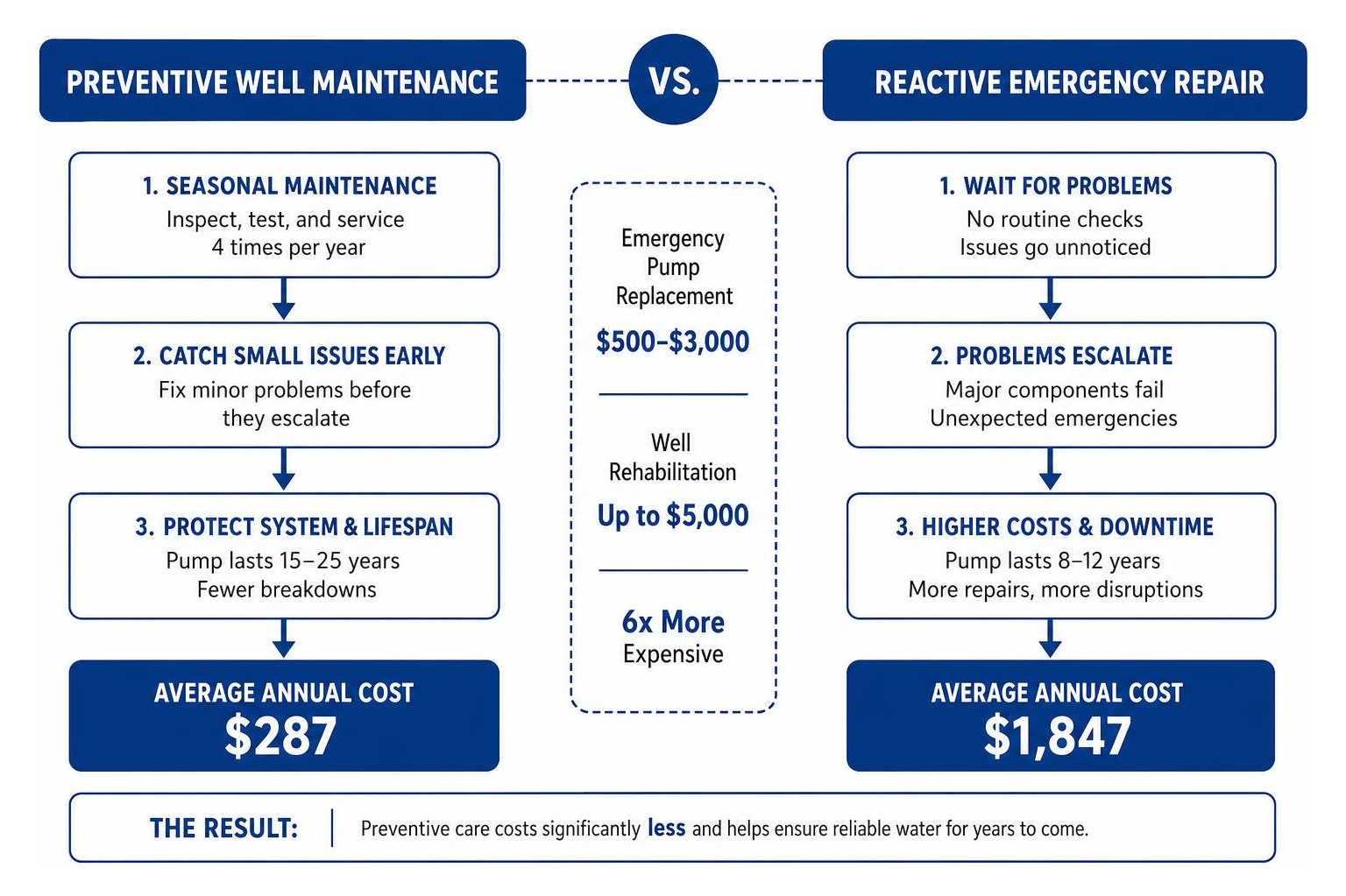
When you maintain proper pre-charge pressure in your storage tank, replace clogged pre-filters, and keep your pressure switch clean, you drastically reduce mechanical strain on the submersible motor deep inside the casing. A well pump operating under ideal conditions can last far longer than one exposed to constant short cycling and electrical resistance. Similarly, a pressure tank lasts longer when the air charge is checked and adjusted before the bladder is overworked.
| Service or Component Task | Preventive Maintenance Focus | Risk Reduced |
|---|---|---|
| Professional system inspection | Electrical, pressure, tank, and pump performance review | Unexpected pump failure |
| Lab water quality testing | Bacteria, nitrates, pH, and local contaminant screening | Unsafe drinking water |
| Pressure tank pre-charge adjustment | Correct air pressure and bladder function | Premature pressure tank wear |
| Winterization and pipe insulation | Exposed piping, pump house, and utility room protection | Frozen lines and burst plumbing |
Applying simple well pump maintenance tips keeps your system running reliably year-round by helping you spot pressure changes, short cycling, and water-quality concerns before they become emergencies.
For issues that go beyond a homeowner checklist, professional plumbing services protect the full household water system, from pressure controls and supply lines to filtration and fixture performance.
Complete Seasonal Well Pump Maintenance Checklist for Year-Round Care
Every season brings a distinct set of environmental pressures to private water systems in New Hampshire. From frozen ground in Manchester and Hooksett to spring mud season and heavy summer groundwater usage in Bedford and Merrimack, adapting your routine to the local weather keeps your water clean and your equipment protected.
Spring Seasonal Well Pump Maintenance: Post-Winter Recovery
Spring is the season of thaw and heavy rainfall. As snowmelt saturates the ground, deep frost thaws, causing ground movement that can shift well casings or unseat sanitary caps.
- Inspect casing and cap: Check the visible pipe extending above ground. Ensure the casing extends at least 12 inches above the soil line and is completely free of hairline cracks. Verify that the sanitary well cap is tightly bolted with an intact EPDM rubber gasket.
- Assess surface runoff: Ensure the surrounding ground slopes downward away from the casing in all directions. Standing water around the well casing can seep down the outside of the pipe and contaminate your drinking water supply.
- Clean vent screens: The small air vent on the well cap allows air pressure inside the casing to equalize as water is pumped out. Inspect this vent screen and clear away spider webs, debris, or insect nests.
- Schedule annual water testing: Spring is the absolute best time for annual water quality testing. Snowmelt and spring runoff carry surface contaminants into shallow aquifers. Send a sample to an EPA-certified laboratory to test for total coliform bacteria, E. coli, nitrates, pH, and local heavy metals.
Summer Seasonal Well Pump Maintenance: High Demand Management
Summer introduces peak water demand. Between lawn irrigation, garden watering, filling swimming pools, and extra laundry, your pump works harder during June, July, and August than at any other time of year.
- Monitor water table drawdown: Extended dry spells lower the water table. If your pump takes noticeably longer to build pressure or if water looks slightly cloudy, your well level may be dropping. Stagger heavy water activities like laundry and pool filling to allow the well aquifer time to recover.
- Watch for short cycling: Rapid clicking from the pressure switch or the pump turning on and off every few seconds while a faucet runs indicates short cycling. Identifying and resolving well pump short cycling protects electrical components from premature burnouts.
- Replace sediment filters: High water consumption draws more fine sand and silt through the system. Inspect pre-filter cartridges monthly and replace them whenever you notice a visible drop in household water pressure.
Fall Seasonal Well Pump Maintenance: Pre-Winter Prep
Fall is your window of opportunity to prepare outdoor components before freezing weather arrives across Southern New Hampshire.
- Clear the wellhead clearance zone: Clear away fallen leaves, brush, weeds, and heavy mulch from around the wellhead. Establish a clean clearance zone free of debris. Never store fertilizers, pesticides, paints, or winter road salt near your wellhead.
- Grade the surrounding soil: If summer rain created depressions around the casing, pack clean clay or dense topsoil around the base so surface water drains away from the pipe.
- Install pipe insulation and heat tape: Inspect all exposed water lines inside unheated pump houses, basements, or crawl spaces. Apply self-regulating heat tape along exposed metal or plastic pipes, then slip foam pipe insulation sleeves over them. Always choose self-regulating heat tape, as constant-wattage tape can overheat and poses a severe fire hazard.
- Disconnect hose bibbs: Remove all garden hoses from outdoor spigots. Leaving a hose attached during a freeze traps water inside the spigot body, causing the pipe inside the wall to rupture.
Winter Seasonal Well Pump Maintenance: Freeze Damage Prevention
New Hampshire winters bring prolonged sub-zero cold. When water freezes, it expands with enough force to split pump bodies, crack concrete pads, and damage brass valves.
- Verify pitless adapter depth: Ensure your well’s pitless adapter, the underground connection where the well pipe turns horizontally toward your house, is set safely below the regional frost line.
- Maintain utility room heat: Keep your pressure tank room, utility space, or pump house heated enough to prevent freezing. If the space is semi-conditioned, install a small thermostatic space heater or an insulated pressure tank blanket.
- Implement a faucet dripping protocol: During severe cold snaps, let a cold water faucet farthest from the pressure tank drip at a slow rate. Moving water takes much longer to freeze inside buried supply pipes.
- Test backup power equipment: Power outages during winter storms leave your pump useless unless you have a backup generator. Test your generator monthly under load to ensure it can handle the heavy starting surge wattage required by your pump motor.
DIY Inspection Tasks: Pressure Tank, Pressure Switch, and Wellhead
While servicing deep submersible pumps requires specialized hoist trucks and licensed equipment, homeowners can easily perform basic mechanical checks on the indoor control assembly. Always shut off electrical power at the main circuit breaker panel before opening control covers or servicing mechanical valves!
Checking Pressure Tank Pre-Charge and Bladder Health
Your pressure tank acts as a buffer. It stores pressurized water so your pump motor doesn’t have to turn on every time someone turns on a kitchen faucet or flushes a toilet. Over time, air slowly escapes through the tank valve, forcing the pump to turn on far too often.
To test air pre-charge properly:
- Turn off power to the well pump at the circuit breaker panel.
- Open the lowest faucet in your home, or the drain valve at the base of the tank, and let water run until the tank is completely empty and system pressure reads 0 psi.
- Remove the protective plastic cap from the Schrader valve located on top of the pressure tank.
- Press a standard tire pressure gauge firmly onto the valve stem to read the air pressure.
- Compare the air reading to your pressure switch cut-in setting. The air pressure must be set exactly 2 psi below the cut-in setting.
- For a standard 30/50 psi switch, which turns on at 30 and off at 50, set tank air to 28 psi.
- For a 40/60 psi switch, set tank air to 38 psi.
If water squirts out of the Schrader valve when you press the tire gauge, the internal rubber diaphragm or bladder inside the tank has ruptured. Recognizing waterlogged pressure tank troubleshooting and fixes helps prevent total system loss and internal tank corrosion.
You can also use a simple physical test: tap the side of a steel pressure tank with a metal ring or key. The top half, filled with compressed air, should produce a clear, hollow ring, while the bottom half, filled with water, should produce a dull thud. If the entire tank sounds dull and heavy from top to bottom, it is completely waterlogged and requires immediate service.
Inspecting Pressure Switch and Wellhead Controls
The pressure switch is the brain of your well system. It senses water pressure inside the manifold line and signals the pump motor when to start and stop.
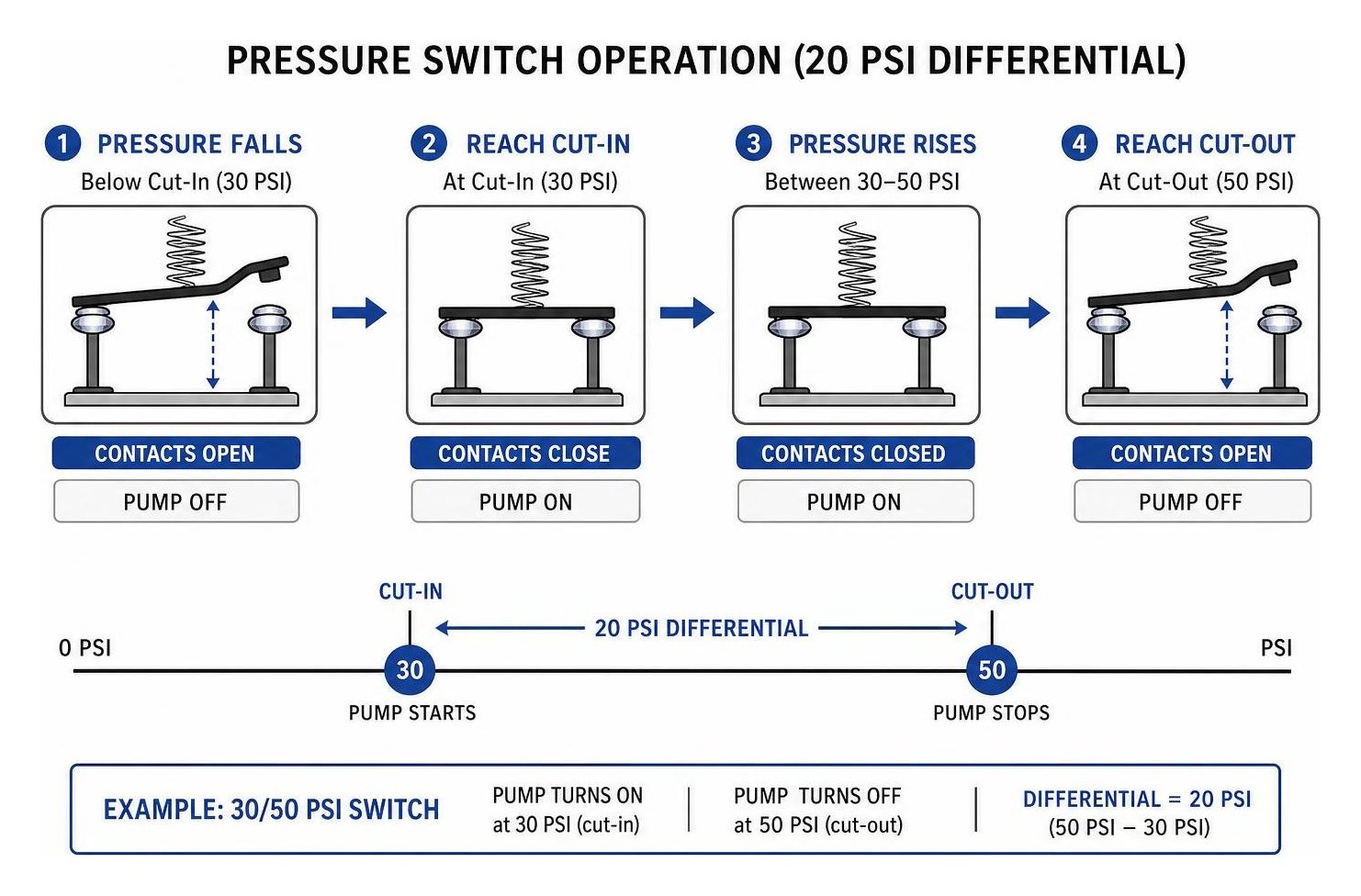
With power safely switched off at the breaker box, unthread the plastic cover nut and lift off the gray cover. Examine the four silver contact points inside.
Look for electrical pitting, black charring, or burn marks across the contacts. Humidity, high electrical loads, and small insects like ants or spiders, which are attracted to electrical warmth, often get trapped between the contacts, preventing electrical current from reaching the motor. Clean dirty contacts gently using fine 400-grit sandpaper or electrical contact cleaner spray.
Check that the switch maintains a standard 20 psi operating range between its cut-in and cut-out points. If your pressure gauge bounces erratically or fails to shut off at the upper limit, learning how to adjust well pump pressure switch springs restores steady operation.
Signs Your Well System Needs Immediate Professional Service
Not every well issue can be addressed with routine DIY care. Some warning signs indicate mechanical wear or electrical component failure that requires licensed intervention before total system breakdown occurs.
Watch out for these clear warning signs:
- Sputtering faucets: Pockets of air blasting out of fixtures signal a leak in the drop pipe inside the well casing, a failing check valve, or a dangerously low water table drawing air into the pump intake.
- Discolored, cloudy, or sandy water: Silt or grit appearing in sink basins indicates that your pump is sitting too close to the bottom of the well shaft, or that well screen slot openings are deteriorating.
- Sudden electric bill surges: A noticeable jump in monthly power bills often means your pump motor is running continuously due to a stuck pressure switch, a damaged check valve, or a torn pressure tank bladder.
- Rapid pressure switch clicking: Hearing your electrical switch click on and off every few seconds while running a bathroom faucet is a clear warning sign of a waterlogged pressure tank.
- Complete water shutdown: Sudden total loss of pressure requires professional electrical testing across control boxes, capacitors, and motor windings.
When you call Daigle Plumbing, Heating & Cooling for a comprehensive inspection, our technicians perform extensive diagnostics beyond standard surface checks. We measure motor amp draw against manufacturer nameplate ratings, test electrical insulation resistance down the well casing, perform a dynamic drawdown test to gauge recovery yield, and evaluate sanitary casing integrity.
Recognizing critical well pump repair signs helps homeowners address severe symptoms before complete breakdown. For reliable, long-term system performance, schedule our expert team for well pump repair services in Derry, NH to keep your family’s water flowing cleanly year after year.
Frequently Asked Questions About Well Pump Maintenance
How often should well pump maintenance be performed?
Homeowners should perform basic visual checks and pressure tank tests every three months, or seasonally. Complete certified laboratory water quality testing should be conducted once a year in spring. A comprehensive professional mechanical inspection should be scheduled more often as the system ages or whenever pressure, water quality, or pump performance changes.
What is the typical lifespan of a well pump and how can it be extended?
A quality submersible well pump can last for many years, especially with proper seasonal care. Jet pumps located above ground may have a shorter service life because more components are exposed to temperature swings and moisture. The single most effective way to extend lifespan is to prevent short cycling by checking pressure tank air pressure twice a year and replacing clogged sediment filters promptly.
How do seasonal weather changes affect well pump performance?
Winter freezing weather expands trapped water, bursting exposed pipes and damaging pressure switches. Spring snowmelt introduces surface runoff, raising bacterial contamination risks. Summer heat waves lower regional water tables, causing pumps to run longer to meet demand, while winter dry spells can increase mineral concentration as bedrock contact time increases.
Conclusion
Taking care of your private water well doesn’t have to cost a fortune or require endless weekend hours. By establishing a basic, season-by-season routine, checking tank pre-charge air, insulating exposed plumbing, replacing sediment filters, and running annual lab water tests, you preserve pristine drinking water quality while protecting your wallet against emergency repair bills.
When complex electrical issues arise, or when your system requires deep diagnostic testing, our experienced team at Daigle Plumbing, Heating & Cooling is ready to help. Family-owned and proudly serving Derry, NH and surrounding communities for over 40 years, we back all our work with licensed experts and a 100% satisfaction guarantee. Contact our professional well pump technicians to keep your home’s water system in peak condition for years to come!