Why AC Service and Installation Matters More Than You Think
AC service and installation is one of the most important investments a homeowner can make, especially when New Hampshire summers push temperatures high enough to make a broken AC feel like an emergency.
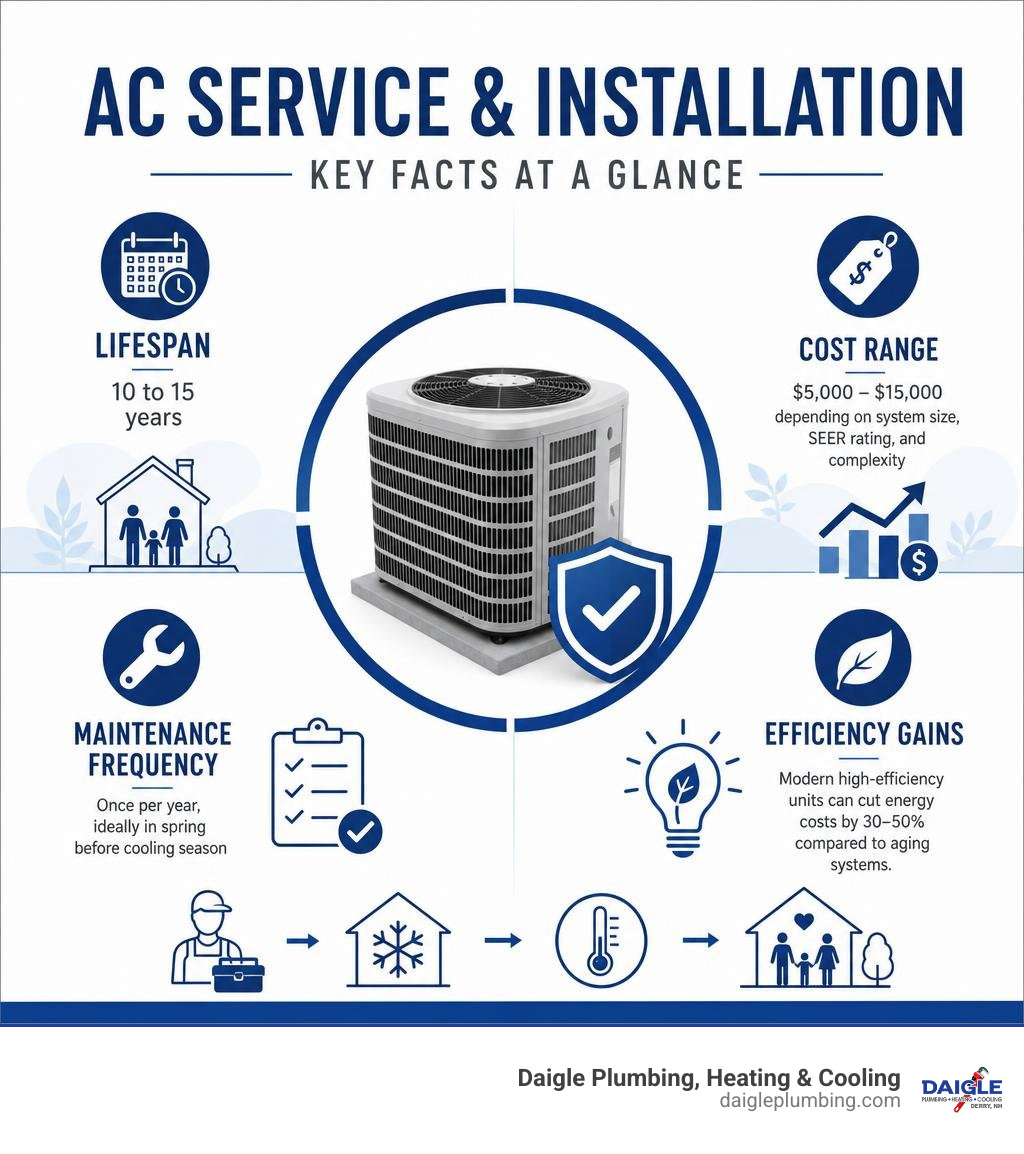
Here’s a quick overview of what you need to know:
| Topic | Quick Answer |
|---|---|
| When to repair | Strange noises, weak airflow, warm air, rising energy bills |
| When to replace | System is 10-15 years old or repairs exceed 40-50% of replacement cost |
| How long installation takes | Most jobs are done in 6-10 hours (one day) |
| Typical cost range | $5,000-$15,000 depending on system size, SEER rating, and complexity |
| How often to maintain | Once per year, ideally in spring before cooling season |
| Why hire a pro | Licensing, warranty protection, proper sizing, and safety code compliance |
Most air conditioners last 10 to 15 years when properly maintained. Modern high-efficiency units can cut energy costs by 30-50% compared to aging systems. Getting the service and installation right, from sizing to startup, is what separates a system that works great for 15 years from one that causes headaches every summer.
At Daigle Plumbing, Heating & Cooling, our licensed HVAC team has worked across every level of AC service and installation, from hands-on diagnostics to full cooling system replacements. In this guide, we’ll walk you through what homeowners need to know to make smart, confident decisions about their home’s cooling system.
Knowing When to Repair, Maintain, or Replace Your System
It is a common scenario: mid-July arrives, the humidity in Southern New Hampshire rises to stifling levels, and your air conditioner starts making a sound like a blender full of rocks. You find yourself staring at the thermostat, wondering if you need a quick repair, a routine tune-up, or a completely new system.
When navigating AC service and installation, knowing where your current unit stands in its lifecycle is key to saving money and avoiding sleepless, sweaty nights.
In our region, which covers everything from Derry and Londonderry to Salem and Nashua, our cooling systems face unique challenges. We experience damp, pollen-heavy springs, high summer humidity, and long winters where the outdoor condenser sits idle under heavy snow. This seasonal swing puts a lot of stress on mechanical parts.
If your system is approaching the 10-to-15-year mark, its efficiency has likely declined significantly compared to modern models. When you combine age with rising energy bills and declining cooling performance, replacement often becomes more cost-effective than pouring money into endless repairs.
Recognizing the Warning Signs of AC Failure
Before your air conditioner completely breaks down on the hottest day of the year, it will usually drop a few hints that it is struggling. Learning to read these warning signs can save you from a full-blown cooling emergency:
- Weak Airflow: If you place your hand near a supply register and feel only a gentle whisper of air, your blower motor might be failing, or you could have severe ductwork blockages.
- Warm Air: If the air coming out of your vents feels lukewarm even when the thermostat is set to “cool,” you could be dealing with a failed compressor or a refrigerant leak.
- Strange Noises: Squealing, grinding, scraping, or loud rattling noises are never normal. They usually point to slipped belts, failing bearings, or loose internal components.
- Frequent Cycling: An air conditioner that turns on and off every few minutes (known as short-cycling) is working twice as hard as it should. This is often caused by an oversized unit, a failing thermostat, or restricted airflow.
When these signs are ignored, a minor issue can quickly escalate into a complete system breakdown. If you find yourself in this situation, our AC repair in Derry, NH team can diagnose the problem, explain your options, and restore reliable cooling before a small issue becomes a larger one.
The Golden Rules of Preventive Maintenance
The easiest way to avoid emergency repair calls is to treat your air conditioner like your car. You wouldn’t drive a vehicle for 50,000 miles without an oil change, yet many homeowners expect their AC to run for a decade without a single check-up.
To maximize your system’s efficiency and lifespan, we recommend scheduling a professional tune-up once a year, ideally in the spring before the summer heat hits. Regular maintenance keeps your system running at peak performance, lowers your monthly utility bills, and helps catch small component wear before it turns into an expensive breakdown.
If you are wondering how to time this correctly, a spring appointment is usually best because it gives technicians time to clean coils, test refrigerant performance, and catch worn parts before peak demand. Homeowners who want to plan ahead can use our advice on when to schedule an AC maintenance service to choose the right time of year, then keep the system efficient by following the right AC unit cleaning schedule for coils, filters, and outdoor components.
Demystifying the AC Service and Installation Process
If maintenance and repairs are no longer enough to keep your home comfortable, it is time to look at a new AC service and installation. Investing in a new cooling system can feel overwhelming because of the technical jargon involved. However, understanding a few basic concepts will help you choose the perfect system for your home.
When selecting a new air conditioner, you will want to look at the SEER2 (Seasonal Energy Efficiency Ratio 2) rating. This rating measures how much cooling the system delivers per watt of electricity used.
While older systems in New Hampshire homes might have SEER ratings as low as 10 or 12, modern units start at a minimum of 14 to 15 SEER2, with high-efficiency models reaching well into the 20s. Upgrading to a modern, high-efficiency system can reduce your cooling-related energy costs by 30% to 50%.
Additionally, modern systems offer advanced features like variable-speed motors and two-stage compressors. Unlike traditional single-stage systems that run at either 100% capacity or 0%, variable-speed systems adjust their output dynamically to match the precise cooling needs of your home. This results in incredibly consistent indoor temperatures, superior humidity control, and whisper-quiet operation.
Sizing Your System with Precision
One of the most common mistakes in the HVAC industry is sizing a system based solely on a home’s square footage. This “rule of thumb” approach often leads to systems that are either too small or too large, both of which cause major comfort and mechanical issues:
- An Oversized System: A system that is too large will cool your home incredibly fast and then shut off. Because it runs in short bursts (short-cycling), it never stays on long enough to pull humidity out of the air, leaving your home feeling cold and clammy. This constant starting and stopping also places immense wear on the compressor, shortening its lifespan.
- An Undersized System: A unit that is too small will run continuously, struggling to reach your target temperature on hot days. This leads to high energy bills and premature system failure from overwork.
To prevent these issues, our team always performs a detailed Manual J Load Calculation. This calculation takes into account your home’s total square footage, ceiling heights, insulation levels, window types, local climate demands, and sun exposure.
By taking these factors into account, we ensure your new system is sized for comfort, efficiency, and long-term performance. If replacement is the right next step, our AC installation in Derry, NH service helps homeowners choose equipment that fits the home’s layout, cooling load, and budget.
What to Expect During Your AC Service and Installation Day
A standard residential AC installation is a highly coordinated process that can typically be completed in a single day (usually taking between 6 and 10 hours). Here is what the typical installation day looks like:
- Site Preparation: Our technicians arrive, lay down protective drop cloths to safeguard your flooring, and carefully shut off the electrical power to your existing HVAC system.
- Old Equipment Removal: We safely pump out and reclaim the old refrigerant in compliance with EPA guidelines, disconnect the electrical lines, and remove the old indoor evaporator coil and outdoor condenser unit.
- Ductwork Inspection and Modification: We inspect your existing ductwork to ensure it can handle the airflow of the new system, making any necessary minor adjustments or repairs.
- New Equipment Placement: We install the new indoor evaporator coil, place the new outdoor condenser on a level, vibration-absorbing pad, and run new copper refrigerant lines between them.
- Electrical and Control Wiring: We connect the high-voltage power lines, install a new outdoor electrical disconnect box for safety, and connect the low-voltage control wiring to your thermostat.
- System Evacuation and Testing: We use a specialized vacuum pump to remove air and moisture from the refrigerant lines, test the system for leaks, and release the precise factory refrigerant charge.
- Commissioning and Walkthrough: We turn the system on, measure airflow and temperature drops, make sure the system operates perfectly, and walk you through how to use your new thermostat.
We handle everything from start to finish, including acquiring local municipal permits and arranging final inspections. During installation, our technicians also explain how the system was sized, what maintenance it will need, and how to get the best efficiency from your thermostat settings.
Navigating Costs, Warranties, and Reputable Contractors
Investing in your home’s cooling system is a major financial decision. To make the best choice, you need to understand the value of professional installation, the typical costs involved, and how to protect your investment with warranties and maintenance plans.
Why Professional AC Service and Installation Beats DIY
With the rise of online tutorials, some homeowners are tempted to attempt a DIY air conditioner installation or hire an unlicensed handyman. However, HVAC installation is not a standard weekend project. It requires specialized knowledge of high-voltage electricity, plumbing, sheet metal fabrication, and chemistry.
First and foremost, handling chemical refrigerants requires an EPA Section 608 Certification. It is illegal for unlicensed individuals to purchase or handle these substances due to their environmental impact.
Additionally, improper electrical wiring poses severe fire and shock hazards, while poorly sealed ductwork or incorrect refrigerant charges will cause your brand-new system to run inefficiently or fail prematurely.
Perhaps the most important reason to choose a professional is warranty protection. Almost all major HVAC manufacturers (such as Carrier, Trane, and Lennox) explicitly state in their warranty terms that their parts warranty is only valid if the system is installed by a licensed HVAC professional.
If a DIY installation goes wrong, you will be entirely on the hook for the cost of replacement parts and repairs. When you choose an experienced team, you protect your warranty and ensure your system complies with all local building and safety codes.
If your current system is acting up but isn’t quite ready for replacement, the right repair can extend its service life while you plan for a future upgrade.
Understanding the Financials: Costs, Financing, and Avoiding Scams
To help you budget effectively, here is a breakdown of the average costs for AC service and installation in the Southern New Hampshire region:
| Service Type | Average Cost Range | What is Typically Included |
|---|---|---|
| Professional AC Tune-Up | $120 – $250 | Complete system inspection, coil cleaning, electrical checks, and performance testing. |
| Minor AC Repairs | $150 – $450 | Replacing capacitors, contactors, fan blades, or fixing minor electrical issues. |
| Major AC Repairs | $600 – $2,000+ | Replacing blower motors, repairing refrigerant leaks, or replacing outdoor fan motors. |
| Full System Replacement | $5,000 – $15,000+ | New indoor/outdoor units, copper line sets, electrical disconnects, permits, and labor. |
To make new installations more manageable, we offer flexible financing options with approved credit, allowing you to pay for your system over time through comfortable monthly payments. Keeping up with maintenance can also help control operating costs because clean coils, unrestricted airflow, and accurate refrigerant performance all affect efficiency. For homeowners comparing the value of maintenance against utility costs, our breakdown of how AC service lowers energy bills explains why routine care is often less expensive than waiting for a breakdown.
When looking for a contractor, always verify that they are fully licensed and insured in New Hampshire. Avoid contractors who give you a firm quote over the phone without visiting your home, as it is impossible to accurately size or price a system without seeing the physical space.
Watch out for incredibly low bids, which often indicate that the contractor is cutting corners, using unlicensed labor, or planning to hit you with hidden fees later.
Frequently Asked Questions About AC Service and Installation
How long does a typical air conditioner last?
On average, a well-maintained residential air conditioner will last between 10 and 15 years. In our Southern New Hampshire climate, systems that are neglected or forced to work through dirty filters and clogged coils may fail closer to the 8-to-10-year mark.
Conversely, scheduling annual professional tune-ups can extend your system’s life to 15 years or more. Preventive maintenance helps catch failing capacitors, dirty coils, weak airflow, and refrigerant issues before they turn into expensive emergency repairs.
What is included in a professional AC tune-up?
A professional tune-up is much more than a quick visual check. It involves a comprehensive inspection and cleaning process to ensure every component of your system is operating safely and efficiently.
During a visit, technicians typically verify electrical connections, clean coils, check refrigerant levels, inspect condensate drainage, test safety controls, and confirm that the system is delivering proper airflow and temperature drop.
How can I make sure my air conditioner is ready for summer?
Before the hot weather arrives, there are a few simple steps you can take to prepare your system:
- Change the Air Filter: Replace your return air filter every 1 to 3 months to ensure proper airflow.
- Clear the Outdoor Unit: Remove any leaves, twigs, grass clippings, or weeds within two feet of your outdoor condenser unit to allow proper heat dissipation.
- Test the System Early: Turn your AC on for a brief test run on a mild day in late spring to ensure it is blowing cold air before you actually need it.
A professional spring inspection is also a good way to confirm that refrigerant levels, electrical components, and airflow are ready before the first major heatwave.
Regional Resources and Alternative Options
If you are looking for local rebates or alternative cooling options across Southern New Hampshire, here are several trusted resources to explore:
- Energy Efficiency Rebates: Before installing a new system, check out NHSaves for utility rebates and incentives on high-efficiency cooling systems in New Hampshire.
- Ductless Cooling Solutions: If your home doesn’t have existing ductwork, ductless mini-split systems offer an efficient alternative for targeted cooling in specific rooms.
- Local Municipal Guidelines: For residents in Manchester, Nashua, or Derry, always check your local town or city hall website for building permit requirements before starting any major HVAC installation.
Conclusion
Keeping your home cool and comfortable during the humid New Hampshire summers doesn’t have to be a stressful experience. By recognizing the warning signs of system wear early, scheduling regular preventive maintenance, and working with licensed professionals when it is time for a new installation, you can enjoy reliable, energy-efficient cooling for years to come.
At Daigle Plumbing, Heating & Cooling, we have been serving our neighbors in Derry, NH, and the surrounding communities for over 40 years. As a family-owned business, we are committed to providing transparent pricing, expert workmanship, and a 100% satisfaction guarantee.
Whether you need a quick repair, an annual tune-up, or a brand-new high-efficiency system installation, we are here to help. Don’t wait for your air conditioner to break down in the middle of a heatwave. Contact our professional AC service and installation technicians to get the right cooling solution for your home.