When Your AC Coil Is Leaking, Here’s What to Do First
AC coil leak repair is one of the most common and most misunderstood HVAC problems homeowners face. If you need a quick answer, here it is:
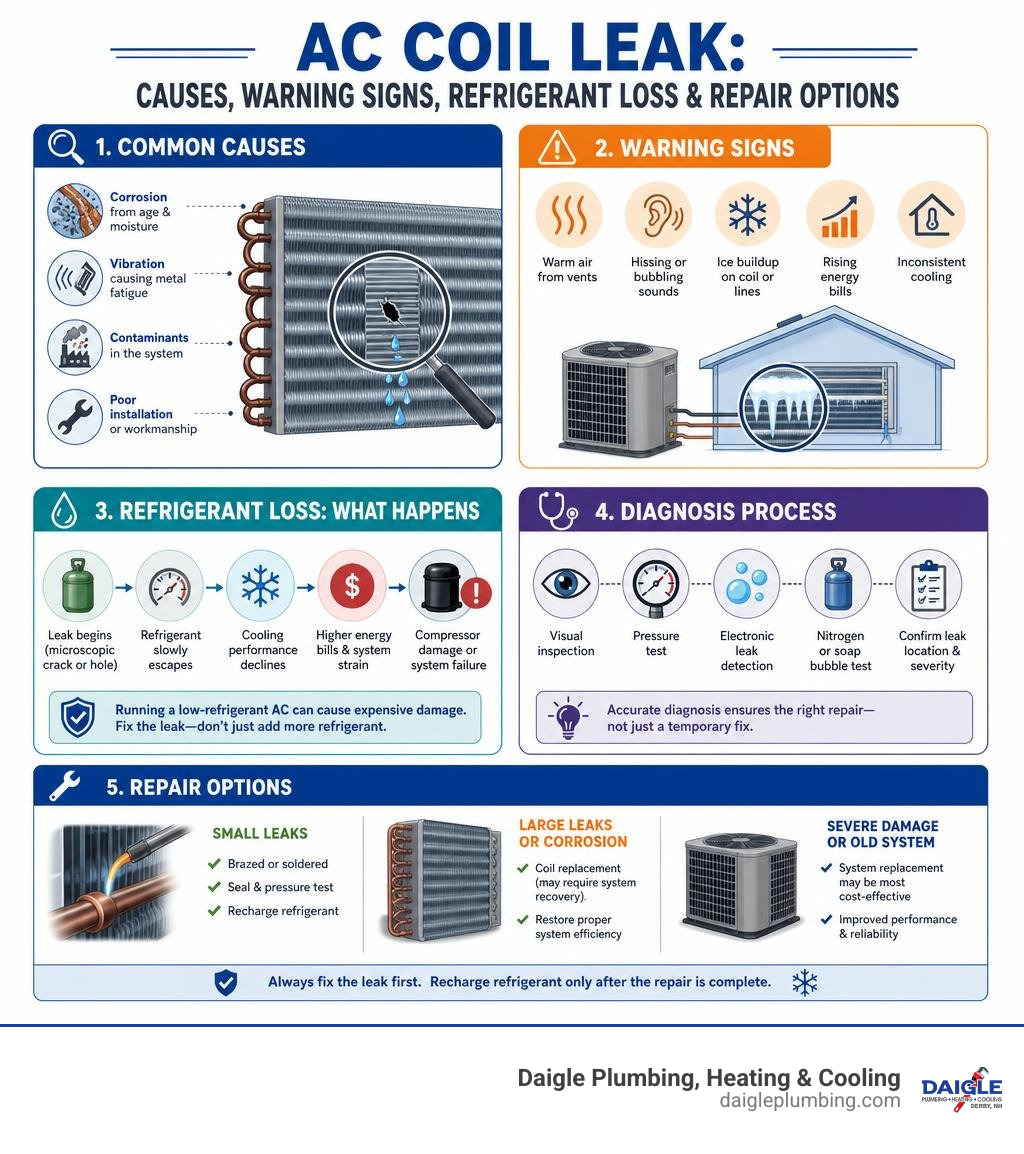
How to handle a leaking AC coil:
- Confirm the leak: look for warm air, hissing sounds, ice buildup, or rising energy bills
- Turn off the system: running a low-refrigerant AC can destroy the compressor
- Call a licensed HVAC technician: refrigerant handling requires EPA Section 608 certification
- Repair or replace: small leaks can sometimes be brazed or soldered; major corrosion usually means coil or system replacement
- Recharge refrigerant: only after the leak is fixed, not instead of fixing it
A leaking coil doesn’t always mean a full system replacement. But ignoring it or simply topping off the refrigerant can turn a $300 to $800 repair into a $2,500+ coil replacement or a complete system failure.
The gradual loss of cooling you’ve been noticing over the past few weeks? That could be a slow refrigerant leak escaping through a microscopic crack in your evaporator coil. It’s easy to miss until your energy bills spike and your home stops cooling down the way it should, especially during a New Hampshire summer.
At Daigle Plumbing, Heating & Cooling, our HVAC team diagnoses and resolves AC coil leak repair issues across a wide range of residential cooling systems. In this guide, we’ll walk you through what’s happening inside your AC, what your real options are, and how to avoid costly mistakes.
What Causes AC Coils to Leak?
To understand why your air conditioner is struggling, we first have to look at what causes these delicate metal tubes to fail. AC coils are typically made of copper or aluminum, both of which are excellent heat conductors but are vulnerable to specific chemical and physical stresses.
The single biggest culprit behind indoor coil leaks is formicary corrosion. This occurs when the copper tubing in your evaporator coil reacts with moisture and volatile organic compounds (VOCs) found in your indoor air. These VOCs come from everyday household items like:
- Air fresheners and scented candles
- Household cleaning products and disinfectants
- Paints, varnishes, and cosmetics
- Off-gassing from new carpets or furniture
When these airborne chemicals mix with the condensation naturally forming on your cold indoor coil, they form a mild acid. Over time, this acid eats microscopic, ant-nest-shaped tunnels through the copper tube walls. These pinhole leaks are virtually invisible to the naked eye, but they allow refrigerant to slowly hiss out of your system.
Aside from chemical corrosion, your coils are subjected to thermal cycling. Every time your AC turns on, the coils rapidly cool down and contract. When the system shuts off, they warm up and expand. This constant expansion and contraction puts physical stress on the metal, eventually leading to stress fractures at the joints or bends.
Finally, physical damage can occur, especially on the outdoor unit from flying rocks, lawnmowers, or weed whackers. Because many coil failures start with dirt, moisture, and airflow problems, routine preventive AC maintenance in Derry, NH can help reduce the conditions that lead to premature leaks.
How to Spot a Leaking AC Coil
Refrigerant leaks are sneaky. Because they often start as microscopic pinholes, you won’t always see a sudden puddle of fluid or hear a dramatic hiss. Instead, look out for these classic warning signs:
- Warm Air from the Vents: If your AC is running constantly but the air coming out of your registers feels lukewarm, your system likely lacks the refrigerant needed to absorb heat.
- Unusual Hissing or Bubbling Sounds: A distinct hissing sound near your indoor air handler or outdoor unit points to pressurized gas escaping through a crack.
- Spike in Utility Bills: When refrigerant levels drop, your system has to work twice as hard and run much longer to cool your home, causing your electricity bills to soar.
- Short Cycling: If your AC turns on and off rapidly in short bursts, the low refrigerant level is likely tripping the system’s safety pressure switches.
- Ice Buildup on the Coils: When refrigerant levels are low, the pressure inside the evaporator coil drops, causing the coil’s surface temperature to fall below freezing. Moisture from the air freezes instantly on contact, insulating the coil and completely blocking heat transfer. If your system is icing over, the warning signs often overlap with the causes explained in our blog on why an air conditioner freezes up.
Indoor Evaporator Coils vs. Outdoor Condenser Coils
Your air conditioning system relies on two distinct coils to facilitate heat exchange, and they experience very different types of wear and tear:
- Indoor Evaporator Coil: Located inside your home (usually sitting on top of your furnace or inside your air handler). Its job is to absorb heat from your indoor air. Because it is constantly wet with condensation, it is highly susceptible to formicary corrosion from indoor VOCs and dust accumulation.
- Outdoor Condenser Coil: Located in the outdoor cabinet. Its job is to release the absorbed heat into the outside air. It doesn’t suffer from formicary corrosion, but it is exposed to harsh New England weather, dirt, leaves, dog urine (which is highly corrosive), and physical impacts.
The Realities of AC Coil Leak Repair: Can It Be Fixed?
When homeowners hear they have a leak, their first question is usually, “Can’t you just patch it?”
The honest answer is: sometimes, but rarely permanently.
If a leak is caused by a single, clean puncture, such as a screw accidentally driven into a copper line during home renovations, a professional technician can often fix it. This involves recovering the remaining refrigerant, cutting out the damaged section, brazing (welding) a new piece of copper in place, pulling a vacuum to remove moisture, and recharging the system.
For homeowners in Derry, NH and nearby communities, professional AC repair in Derry, NH is the safest way to confirm whether the leak is repairable, whether the coil should be replaced, and whether the system is still worth investing in.
However, if the leak is caused by formicary corrosion, patching is a losing battle. Corrosion is never isolated to just one spot. If the metal has thinned enough to create one pinhole leak, there are likely dozens of other micro-leaks about to break through. Brazing a corroded coil is like trying to sew a patch onto wet tissue paper; the heat from the torch often blows open new holes right next to the one you’re trying to fix.
Before attempting any fix, weigh the pros and cons of DIY versus professional AC repair. Handling refrigerant requires specialized recovery machines, vacuum pumps, and legal certifications that DIYers simply don’t have.
When to Choose AC Coil Leak Repair vs. Replacement
Deciding whether to patch a leak, replace the coil, or replace the entire AC system comes down to three main factors:
- Warranty Status: If your system is under its manufacturer’s parts warranty (typically 5 to 10 years), the replacement coil itself will be free. You will only be responsible for the cost of labor and the new refrigerant. In this scenario, replacing the coil is a no-brainer.
- System Age: If your AC is over 10 to 12 years old and out of warranty, investing thousands of dollars into a new coil is rarely wise. Older systems are also much less efficient than modern units.
- Refrigerant Type: Older systems manufactured before 2010 run on R-22 (Freon), which has been phased out globally. If you have an R-22 system, the refrigerant alone can cost $75 to $150+ per pound, making repairs financially impractical. Even R-410A systems are seeing changes as the industry transitions to newer, environmentally friendly refrigerants.
If repeated leaks, obsolete refrigerant, or an aging condenser make repairs less practical, planning an AC installation in Derry, NH may be more cost-effective than putting more money into a failing system.
Is It Safe to Use DIY Sealants for AC Coil Leak Repair?
If you search online, you’ll find plenty of articles and videos promoting chemical leak sealants, often called “leak stop” or “AC weld” products.
While these sealants can occasionally buy you time on a tiny micro-leak in an older, out-of-warranty system, they carry significant risks:
- TXV Clogging: Modern high-efficiency AC units use highly sensitive thermostatic expansion valves (TXVs) with tiny orifices. If a sealant reacts prematurely, it can clog these valves, destroying your system’s efficiency and requiring an expensive valve replacement.
- Equipment Damage: Many HVAC manufacturers explicitly state that using leak sealants voids your warranty.
- No Substitute for Metal: Sealants cannot fix structural cracks, vibrating joints, or large punctures.
The Cost of Repairing vs. Replacing an AC Coil
Understanding the financial side of HVAC repairs helps prevent sticker shock. Below is a realistic breakdown of what you can expect to pay for various coil-related services in the Derry, NH area:
| Service Option | Average Cost Range | What’s Included? | Best For… |
|---|---|---|---|
| Minor Leak Repair (Brazing) | $300 to $800 | Leak detection, brazing/soldering a single puncture, system testing. (Excludes refrigerant cost). | New systems with isolated, accidental physical damage. |
| Refrigerant Recharge | $200 to $600 | Adding new refrigerant (typically R-410A) to the system, priced at roughly $70 per pound. | Performed only after a leak has been successfully repaired. |
| Coil Replacement (Under Warranty) | $400 to $800 | The manufacturer provides the replacement coil for free; you pay only for professional labor and refrigerant. | Systems under 10 years old with registered manufacturer warranties. |
| Coil Replacement (Out of Warranty) | $1,200 to $2,500 | The cost of the new coil part (approx. $800) plus labor and a full refrigerant recharge. Total is often $2,000 to $2,500. | Mid-aged systems (6 to 10 years) where the rest of the unit is in excellent condition. |
| Full AC System Replacement | $5,000 to $10,000+ | Brand new indoor coil, outdoor condenser, copper lineset, and thermostat with a fresh 10-year warranty. | Systems over 12 years old, R-22 units, or systems with multiple component failures. |
The Risks of Skipping Professional AC Repair
When faced with a $2,000 coil replacement quote, some homeowners decide to take a shortcut: they ask a technician to simply “top off” the refrigerant every summer.
This is a dangerous and expensive mistake. First, refrigerant does not get “used up” like gas in a car; it operates in a closed loop. If you are low on refrigerant, you have a leak.
Adding refrigerant without fixing the leak guarantees that the expensive gas will simply leak back out into the atmosphere. More importantly, operating an AC with low refrigerant levels prevents the compressor from being properly cooled and lubricated by the returning oil. This causes the compressor to overheat, seize, and burn out. Replacing a burned-out compressor is so expensive that it almost always forces a complete system replacement.
Frequently Asked Questions about AC Coil Leaks
How long do AC coils typically last?
With proper maintenance and regular cleaning, high-quality evaporator coils typically last 12 to 18 years in New England. However, in homes with high indoor VOC levels, poor air filtration, or neglected maintenance, coils can develop formicary corrosion and fail in as little as 6 to 10 years.
Are AC coil leaks covered under warranty?
Yes, most major manufacturers offer a 10-year parts warranty on the evaporator and condenser coils, provided the system was registered within 90 days of installation (unregistered systems usually default to a 5-year warranty). That warranty only covers the cost of the replacement part itself. You will still need to pay for the technician’s labor, leak diagnostic fees, and the refrigerant required to recharge the system.
Can I just add refrigerant instead of fixing the leak?
Legally and practically, no. While minor, slow leaks in residential systems aren’t always explicitly banned from being topped off under EPA regulations, doing so is highly discouraged. It is an environmental hazard, a waste of money, and it will eventually destroy your compressor. Always fix the leak first, or replace the failing component.
Conclusion
A leaking AC coil can feel like a major headache, but you don’t have to navigate it alone. Whether your system needs a precise professional weld, a warranty coil replacement, or a transition to a modern, energy-efficient cooling system, our team at Daigle Plumbing, Heating & Cooling is here to help.
With over 40 years of family-owned experience serving Derry, NH and surrounding communities, our licensed and insured experts provide transparent pricing, outstanding financing options, and a satisfaction guarantee.
Don’t let a slow leak burn out your system. Contact our professional AC repair technicians to schedule your diagnostic visit and keep your home cool and comfortable all summer long!