When to Call for Professional Drain Cleaning
Call for professional drain cleaning if several fixtures drain slowly, a clog keeps coming back, or you notice gurgling, sewage odors, or a backup. If sewage backs up, stop using water and arrange prompt service. For a single slow sink or shower, try removing visible debris with a drain strainer or hand tool first. If that does not help, the blockage may be farther down the line. According to the United States Environmental Protection Agency, maintaining household plumbing and wastewater lines helps protect both your home and the surrounding environment.
Our team at Daigle Plumbing, Heating & Cooling draws on more than 40 years of family-owned experience serving homeowners throughout New Hampshire. Our residential plumbing services address drainage concerns alongside related pipe, fixture, and sewer-line issues. Our licensed and insured technicians use camera inspections and mechanical clearing methods to restore proper flow without relying on harsh chemicals.
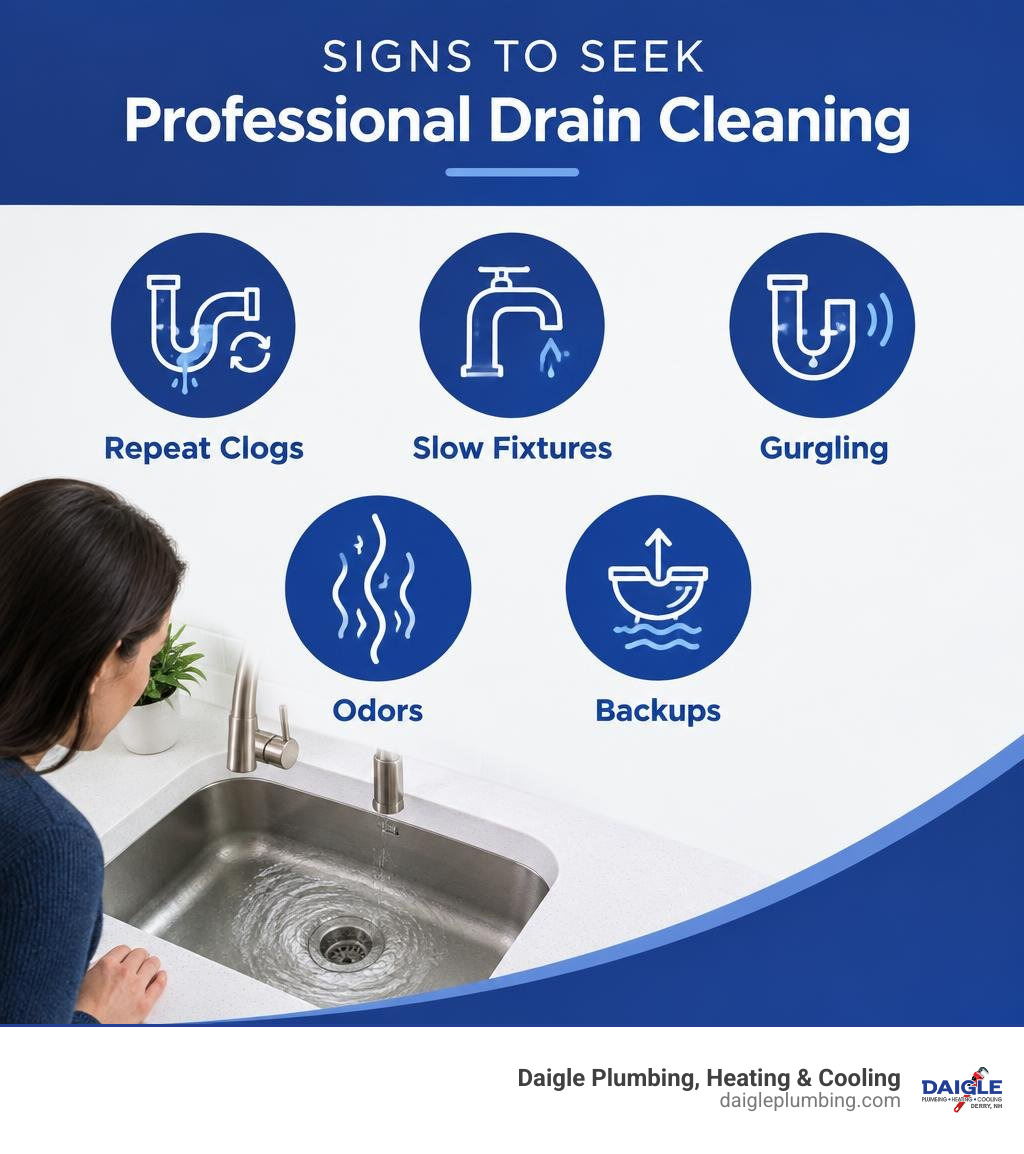
Telltale Signs Your Home Needs Urgent Drain Service
Plumbing issues rarely start as catastrophic floods. Instead, they give off subtle warning signs long before wastewater begins pooling across your floors. Recognizing these symptoms early protects your living space from property damage, unhealthy bacteria, and costly emergency repairs.
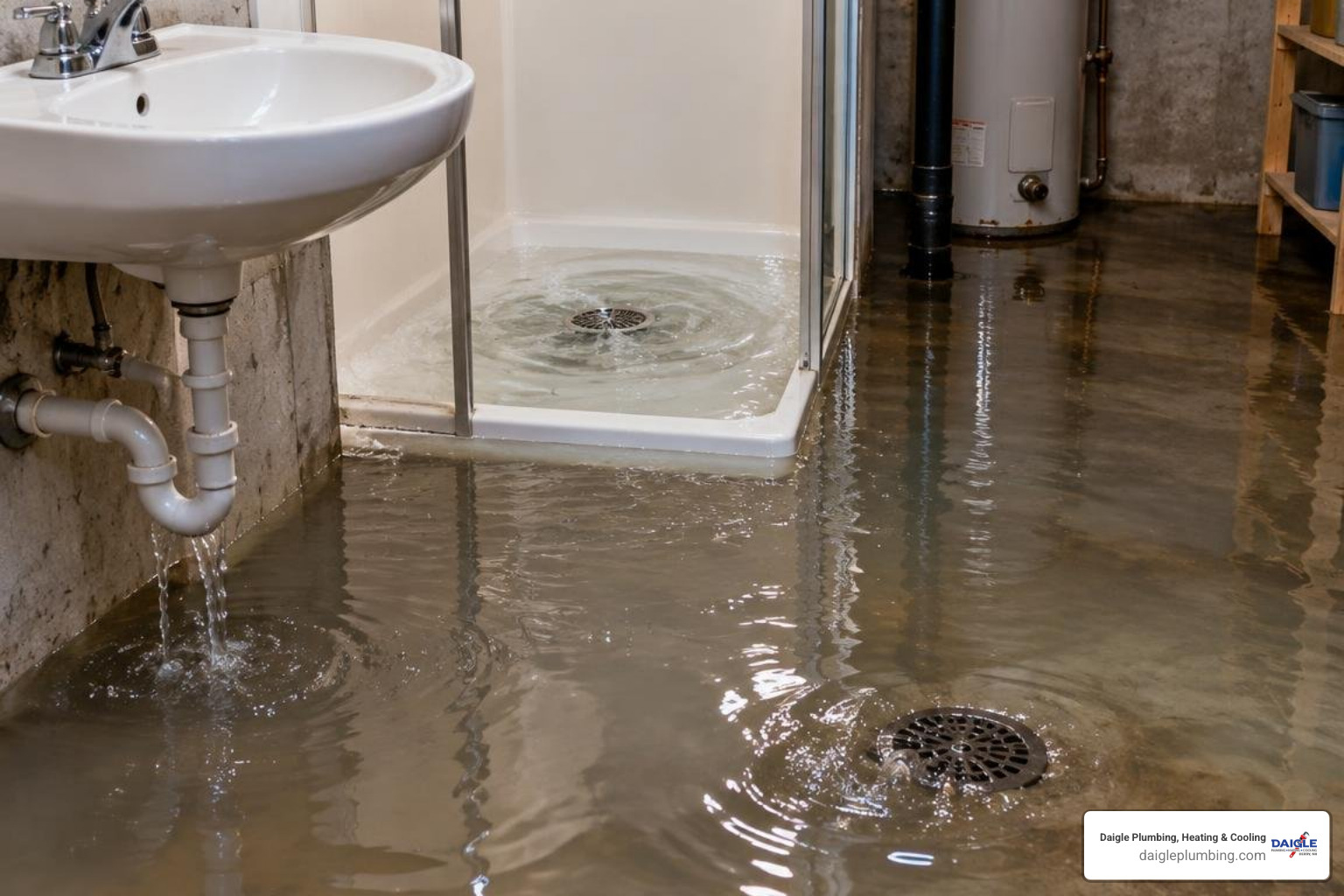
When you manage a busy household across Derry NH, Londonderry NH, or Manchester NH, keeping an eye on your plumbing fixtures is essential. Here are the clear indicators that your home requires urgent professional service:
- Multiple slow drains at once: If a single bathroom sink drains sluggishly, the issue is likely isolated to the nearby trap. However, when your kitchen sink, shower, and basement utility sink all drain slowly at the same time, the blockage sits deep inside your main sewer line.
- Persistent standing water: Showers that fill up around your ankles or washing machines that fail to discharge properly indicate downstream restrictions that standard plungers cannot reach.
- Foul odors and sewer gas: Unpleasant smells resembling rotten eggs or raw sewage wafting from floor drains or sinks mean trapped organic waste is decomposing or sewer gas is escaping past dry, compromised traps.
- Gurgling sounds in pipes: Hearing bubbling or gurgling when you flush the toilet or drain the tub means air is trapped in the line by an advancing clog, forcing displaced air bubbles backward through the nearest water seal.
- Water backups in low-lying fixtures: Running a washing machine on the first floor should never cause wastewater to bubble up inside a basement floor drain or lower-level bathtub. When this happens, wastewater has nowhere to go but up through the lowest plumbing openings.
- Unexplained moisture and leaks: Severe drain restrictions increase internal line pressure, creating vulnerable connection points. Homeowners can avoid major property damage by identifying and fixing hidden pipe leaks before structural framing absorbs wastewater.
Why Chemical Cleaners Fail and Damage Pipes
When faced with standing water, reaching for a bottle of liquid drain opener from the grocery store is tempting. Unfortunately, store-bought chemical cleaners are among the most destructive products you can pour into your plumbing system.
These chemical mixtures rely on caustic ingredients like sulfuric acid or sodium hydroxide to dissolve organic matter through an exothermic (heat-generating) chemical reaction. While that heat may melt a small pathway through soft grease, it also causes significant collateral damage. The extreme heat softens and warps PVC pipes, breaks down the glue at pipe joints, and accelerates internal corrosion in older cast iron or galvanized steel lines throughout Merrimack NH and Bedford NH homes.
Worse yet, chemical openers create an immediate safety hazard for everyone in your household. If the chemical fails to clear the clog, you are left with a fixture full of toxic, corrosive liquid that splashes during plunging attempts and releases noxious fumes into your living areas. Over time, recurring chemical exposure weakens pipe walls and substantially increases your risk of catastrophic leaks. Homeowners who know the dangers of spotting burst pipe hazards understand that chemical cleaners often turn a simple clog into an emergency line replacement.
| Feature / Metric | Store-Bought Chemical Cleaners | Professional Mechanical Clearing |
|---|---|---|
| Clog Removal Efficiency | Only burns a narrow hole through soft organic matter | Clears the entire interior diameter of the pipe |
| Impact on Plumbing Pipes | Causes corrosion, softens PVC, and damages pipe joints | 100% safe for all approved pipe materials when performed by experts |
| Safety and Health Risks | Toxic fumes, chemical burns, and splashing hazards | Safe, contained, and completely free of toxic household fumes |
| Root and Mineral Removal | Completely ineffective against tree roots and hard scale | Easily cuts roots, clears hard water scale, and removes heavy grease |
| Long-Term Protection | Temporary fix; clogs quickly return around remaining residue | Long-lasting results verified by high-definition camera inspection |
Professional Drain Cleaning Methods and Equipment
Professional drain cleaning relies on specialized diagnostic technology and mechanical clearing equipment rather than harsh chemicals. By diagnosing the exact cause and location of a clog, our team removes the blockage safely without compromising your plumbing pipes.
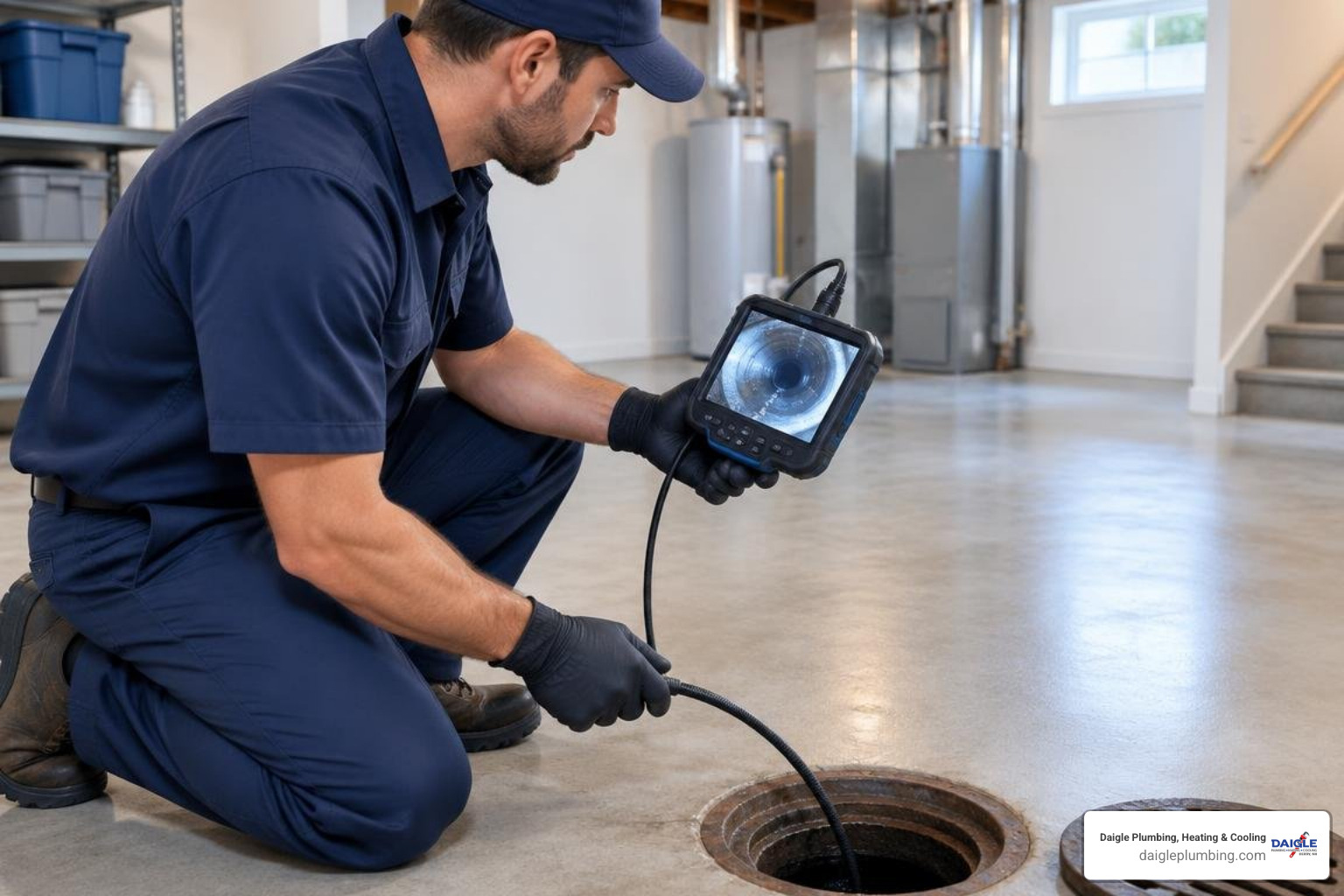
Modern diagnostic procedures start with high-definition sewer camera inspections. A flexible, fiber-optic camera equipped with high-output LED lighting is fed through your plumbing lines. This allows our technicians to view the real-time condition of your pipe walls, identify structural defects like cracked clay or sagging lines, and pinpoint the exact location of heavy scale buildup or tree root intrusion. Sonde transmitters built into the camera head send signals to handheld locators above ground, mapping the precise depth and position of deep underground blockages in yards across Salem NH and Windham NH.
Specialized Kitchen and Bathroom Drain Cleaning
Different rooms present unique drainage challenges. Bathroom clogs typically stem from a dense binding of hair strands, soap scum, and personal care products caught inside the P-trap or pop-up assembly. Kitchen lines, by contrast, suffer from years of cooled cooking oils, fats, and food particles that create thick, sticky sludge along horizontal pipe runs.
To address these blockages without damaging bathroom fixtures or kitchen cabinetry, our team uses professional motorized drain snakes (cable augers). Equipped with specialized cutting heads, these heavy-duty steel cables rotate through the line, slicing through hair mats, retrieving foreign objects, and restoring full drainage flow. For businesses and heavy kitchen setups, ongoing care is critical; our insights on commercial grease trap care show how regular mechanical maintenance prevents sudden backups and costly operational downtime.
Main Sewer Line Drain Cleaning and Hydro Jetting
When blockages develop deep within the main sewer lateral connecting your home to the municipal sewer or private septic tank, cable snaking is often only the first step. For a permanent solution to recurring buildup, professional drain cleaning in Derry, NH may include hydro jetting when the line and blockage are suitable for it.
Hydro jetting uses specialized, truck-mounted equipment that propels clean water through flexible hoses at pressures up to 4,000 PSI. Fitted with specialized forward- and reverse-facing nozzles, the jetter acts like a complete internal pressure wash for your pipes. While forward jets blast through solid obstructions, high-velocity reverse jets scour the full circumference of the pipe wall, flushing out heavy grease, mineral deposits, and intrusive tree roots.
Tree roots are a frequent culprit for main line blockages throughout older neighborhoods in Hooksett NH, Auburn NH, and Hampstead NH. Fine root hairs enter tiny pipe joints in search of water and nutrients, rapidly expanding into thick root masses that catch toilet paper and solid waste. Hydro jetting cuts these roots flush against the pipe wall and washes the debris entirely out of your system. Pairing sewer maintenance with proper yard drainage and exterior line maintenance ensures your entire property handles water flow reliably both inside and out.
Step-by-Step Guide: What to Expect During a Professional Visit
Understanding the professional drain clearing process helps homeowners prepare for a service visit. Here is the comprehensive workflow our licensed technicians follow:
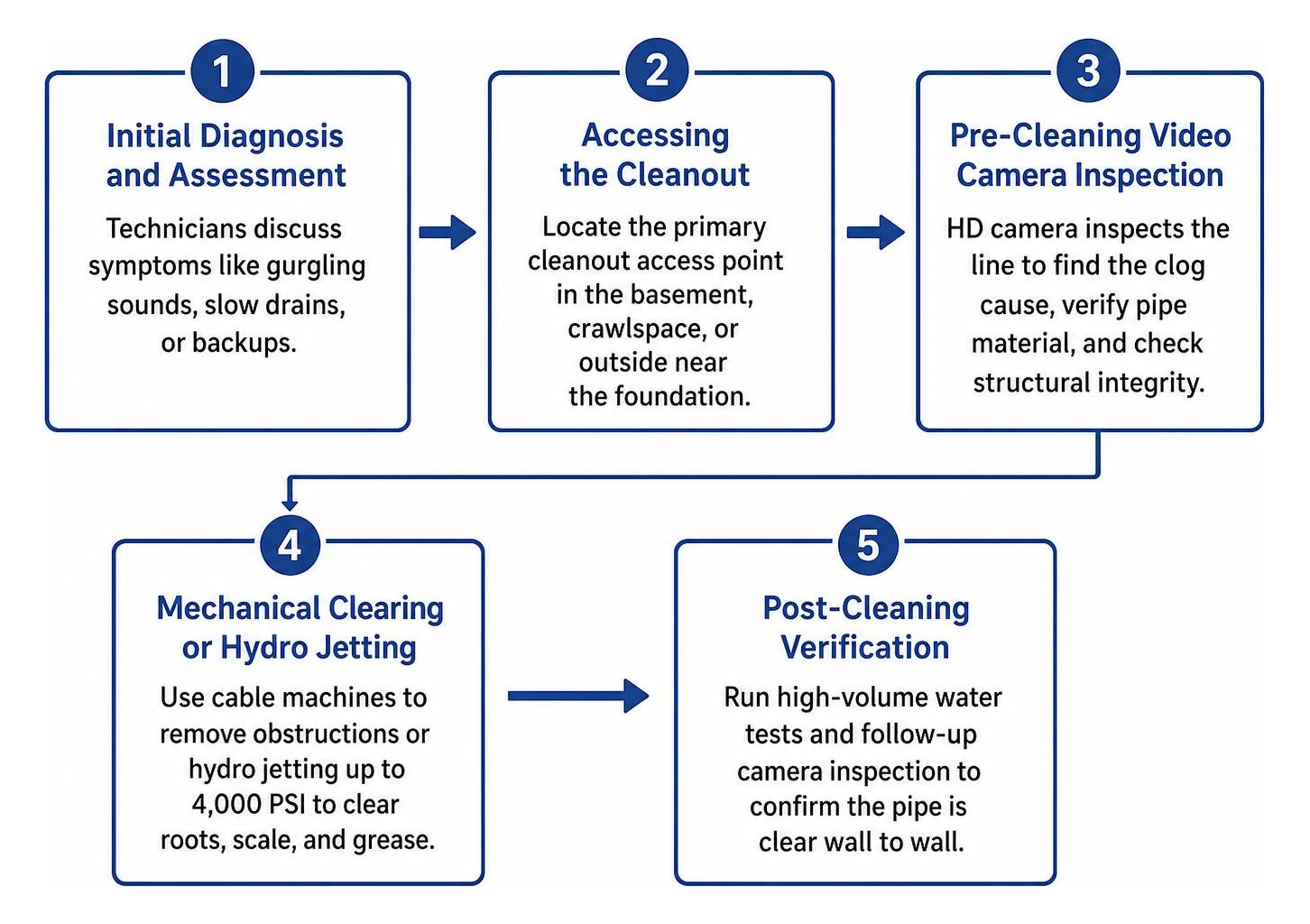
- Initial Diagnosis and Assessment: Our technicians discuss the specific symptoms you noticed, such as gurgling sounds, slow-draining tubs, or specific fixtures that back up when others drain.
- Accessing the Cleanout: We locate the primary cleanout access point, typically situated in your basement, crawlspace, or outside near your foundation wall. Using dedicated cleanouts keeps messy wastewater contained outside of your living areas.
- Pre-Cleaning Video Camera Inspection: For complex or recurring blockages, an HD sewer camera travels down the line to identify the exact cause of the clog, verify pipe material (such as PVC, cast iron, or clay), and check structural integrity.
- Mechanical Clearing or Hydro Jetting: Depending on the nature of the blockage, our team deploys heavy-duty cable machines to retrieve solid obstructions or applies hydro jetting at up to 4,000 PSI to scour away roots, scale, and grease.
- Post-Cleaning Verification: We run high-volume water tests and, when necessary, perform a follow-up camera inspection to verify that the pipe is completely clear from wall to wall.
- Preventive Guidance and Next Steps: Our technicians review the camera findings with you, explain what caused the blockage, and provide personalized maintenance advice to ensure your plumbing system continues draining smoothly.
How to Prevent Clogged Drains in Your Home
While professional equipment is unmatched for clearing established clogs, proactive home habits significantly reduce how often you need service. Simple adjustments to daily routines protect your pipes and keep wastewater moving freely:
- Install mesh drain strainers: Place fine mesh catchers over every shower, bathtub, and bathroom sink drain to capture hair, soap shards, and foreign items before they enter the P-trap.
- Keep fats, oils, and grease out of the sink: Never pour warm cooking grease, bacon fat, or dairy down your kitchen sink or garbage disposal. Pour liquid fats into a sealable can to cool before throwing them in the trash.
- Be mindful of garbage disposal use: Avoid running fibrous foods (celery, corn husks, onion skins), starchy items (pasta, potato peels, rice), coffee grounds, or eggshells down your disposal. Always run cold water before, during, and after running the disposal unit.
- Flush only toilet paper: Toilets are designed strictly for human waste and water-soluble toilet paper. Never flush facial tissues, paper towels, dental floss, feminine hygiene products, or wipes, even those labeled flushable.
- Perform regular hot water flushes: Once a week, run hot tap water down kitchen and bathroom drains for two to three minutes to help flush away soft, fresh residue before it hardens along pipe walls.
Frequently Asked Questions
How often should home plumbing lines be serviced?
Most single-family homes benefit from professional drain maintenance every one to two years. However, if your home has mature trees near the sewer lateral, cast iron piping, or a large household with heavy daily kitchen and laundry usage, scheduling an annual inspection and cleaning provides excellent protection against unexpected sewer backups.
What is the difference between snaking and hydro jetting?
Drain snaking uses a flexible steel cable with a specialized cutting or retrieving tip to bore a hole through a blockage or pull out obstructions like hair and paper. Hydro jetting uses streams of high-pressure water (up to 4,000 PSI) to scour the entire inner wall of the pipe, completely removing tree roots, mineral scale, and hardened grease buildup for a more thorough, long-lasting cleaning.
Why do fixtures keep backing up after DIY clearing?
When a drain backs up repeatedly after plunging or using store-bought tools, the root cause is usually located farther down the line than standard tools can reach. DIY methods often punch a narrow hole through the center of a soft clog without removing the surrounding buildup, allowing soap scum, hair, and grease to quickly accumulate again. Recurring backups can also indicate advanced tree root intrusion, pipe sags (bellies), or broken sewer lines that require professional camera inspection.
Conclusion
A healthy plumbing system is vital for a clean, comfortable home. Ignoring warning signs like slow drains, gurgling pipes, and foul odors turns manageable clogs into costly water emergencies. By avoiding harmful chemical cleaners and relying on proven mechanical methods like camera inspections, augers, and hydro jetting, you protect your pipes and keep wastewater moving efficiently.
Whether you need routine preventive maintenance or prompt plumbing help for a stubborn sewer backup, our team is ready to assist. With over 40 years of family-owned experience, our licensed and insured experts deliver lasting solutions backed by our satisfaction guarantee. For homeowners in Derry NH, Salem NH, Manchester NH, Nashua NH, Londonderry NH, Hudson NH, and surrounding communities, contact our professional drain cleaning technicians at Daigle Plumbing, Heating & Cooling today.