Why Commercial Kitchens Rely on a Grease Trap Maintenance Service
Commercial kitchens produce significant volumes of fats, oils, and grease (FOG) alongside food solids every working day. Without proper containment, these substances quickly solidify inside drainage systems. Over time, accumulated grease coats pipe interiors, narrows waterways, and causes stubborn blockages that bring kitchen operations to an abrupt halt.
Local municipalities enforce strict environmental regulations to safeguard public sewer infrastructure. Discharging untreated grease into municipal sewers leads to sanitary sewer overflows, pipe blockages, and hazardous conditions in surrounding water supplies. Health inspectors and wastewater authorities throughout Southern New Hampshire require commercial food service establishments to maintain functional grease interceptors and verify routine servicing.
Neglecting this maintenance invites foul odors that escape kitchen drains and reach dining areas, driving away customers. Routine cleaning protects interior plumbing lines, prevents emergency backups during peak meal rushes, and supports ongoing compliance with municipal health and environmental mandates.
FOG Interception Mechanics and Drainage Protection
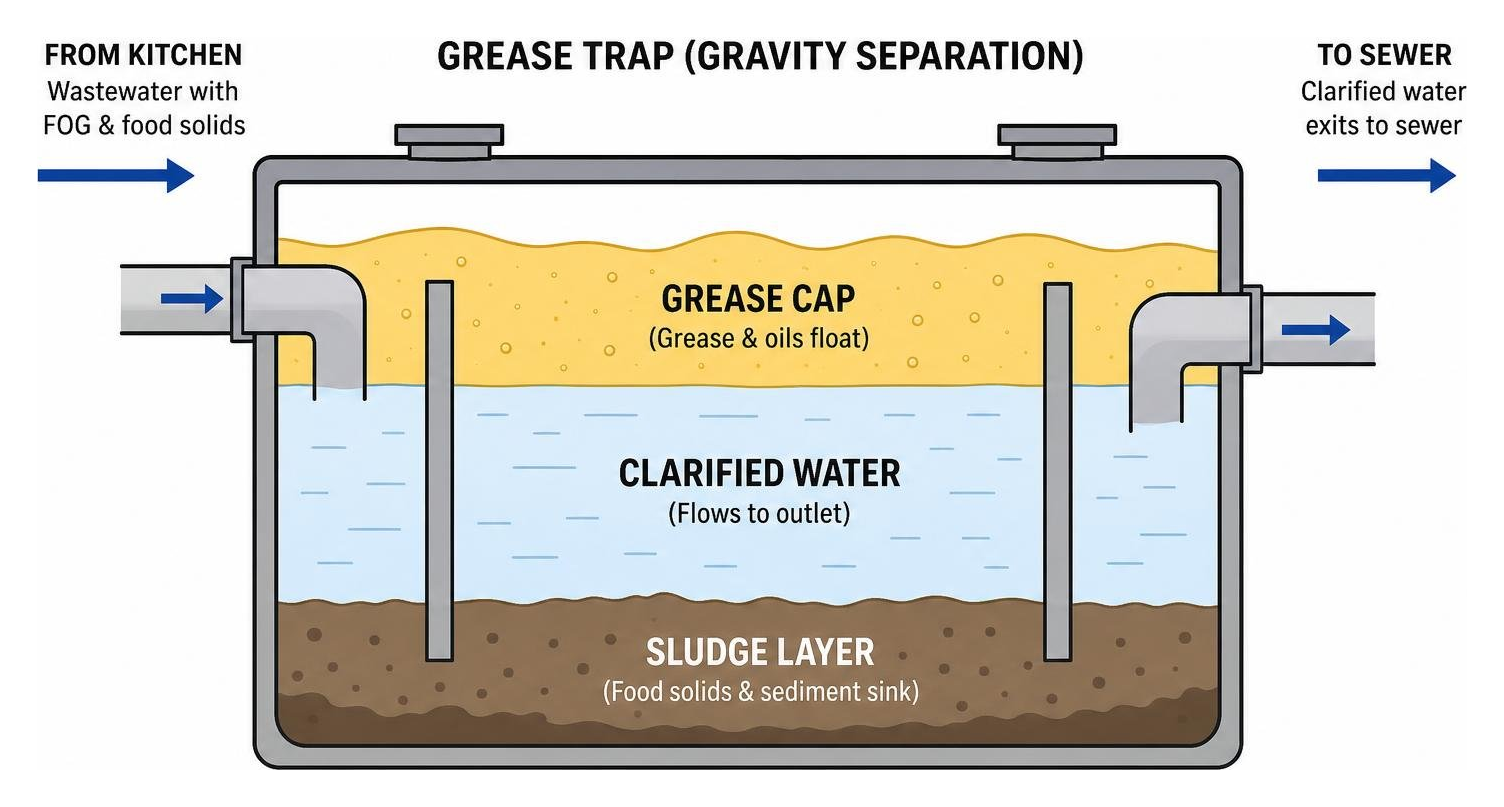
A grease trap functions through the fundamental principle of gravity separation. Wastewater originating from dishwashers, three-compartment sinks, and food prep stations enters the trap at high temperatures mixed with dissolved grease, oils, and particulate matter.
Inside the unit, specialized baffle systems slow down the wastewater flow, allowing the liquid to cool. As the water cools and velocity drops:
- Grease and oils, being lighter than water, float to the top to create a floating grease cap.
- Heavier food solids and sediment sink to the bottom of the tank, forming a sludge layer.
- Clarified gray water remains in the middle section, flowing beneath the baffles and exiting into the municipal sewer line.
When a trap is neglected, the grease cap thickens while the sludge layer rises. This reduces the retention time of incoming wastewater, forcing hot, untreated grease past the baffles directly into facility plumbing and downstream public sewer mains.
The 25 Percent Rule for Routine Service
The industry standard for commercial grease trap maintenance is the 25 Percent Rule. This operational threshold states that whenever the combined thickness of the top grease layer and bottom sludge layer reaches 25% of the trap’s total liquid depth, the unit should be fully pumped out.
Once grease and solids exceed 25% of the total capacity, the device loses its ability to slow down wastewater and separate grease effectively. Wastewater velocity increases, causing newly introduced fats to wash straight through into the main sewer pipes. Understanding how grease buildup forms in commercial pipes helps kitchen managers recognize why timely pump-outs matter.
| Grease & Sludge Level | Operational Impact | Recommended Action |
|---|---|---|
| 0% to 15% | Optimal separation; standard flow rate | Normal daily kitchen operations |
| 15% to 24% | Moderate accumulation; acceptable retention time | Monitor levels; prepare an upcoming schedule |
| 25% or greater | Capacity compromised; grease bypasses baffles | Schedule a complete pump-out |
| 40%+ | Severe blockage risk, foul odors, and drain failure | Urgent maintenance required; clear lateral lines |
What Happens During a Professional Cleaning Visit
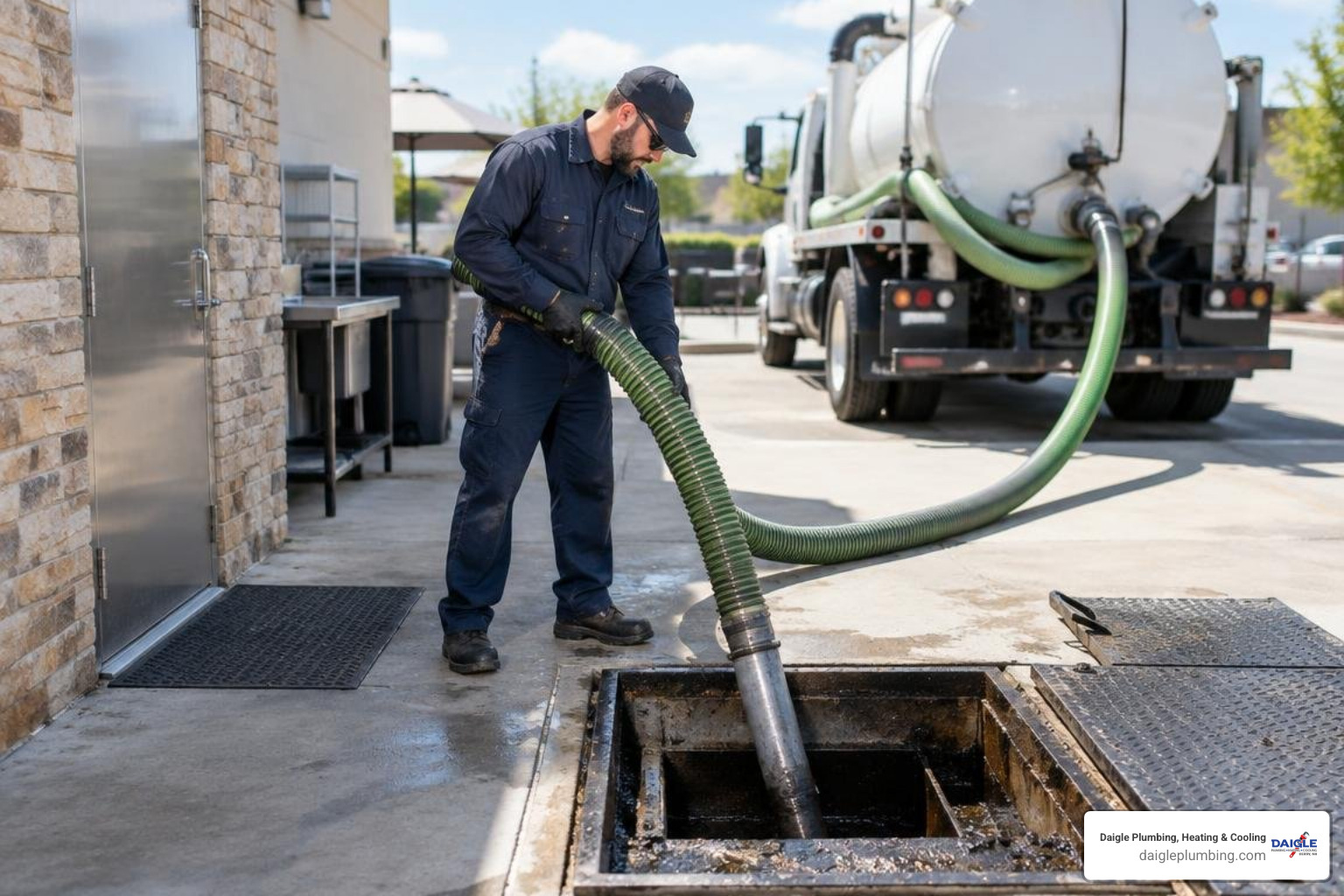
A professional cleaning visit is a thorough maintenance procedure designed to restore the trap to baseline efficiency. Simply skimming the top layer with a ladle or pouring chemical degreasers down the sink does not maintain the system. Chemical additives can liquefy grease temporarily, only for it to re-harden farther down the pipe run and create major obstructions.
Professional service involves specialized vacuum extraction equipment, thorough mechanical cleaning of all internal surfaces, inspection of critical mechanical components, and responsible waste hauling.
Step-by-Step Grease Trap Maintenance Service Protocol
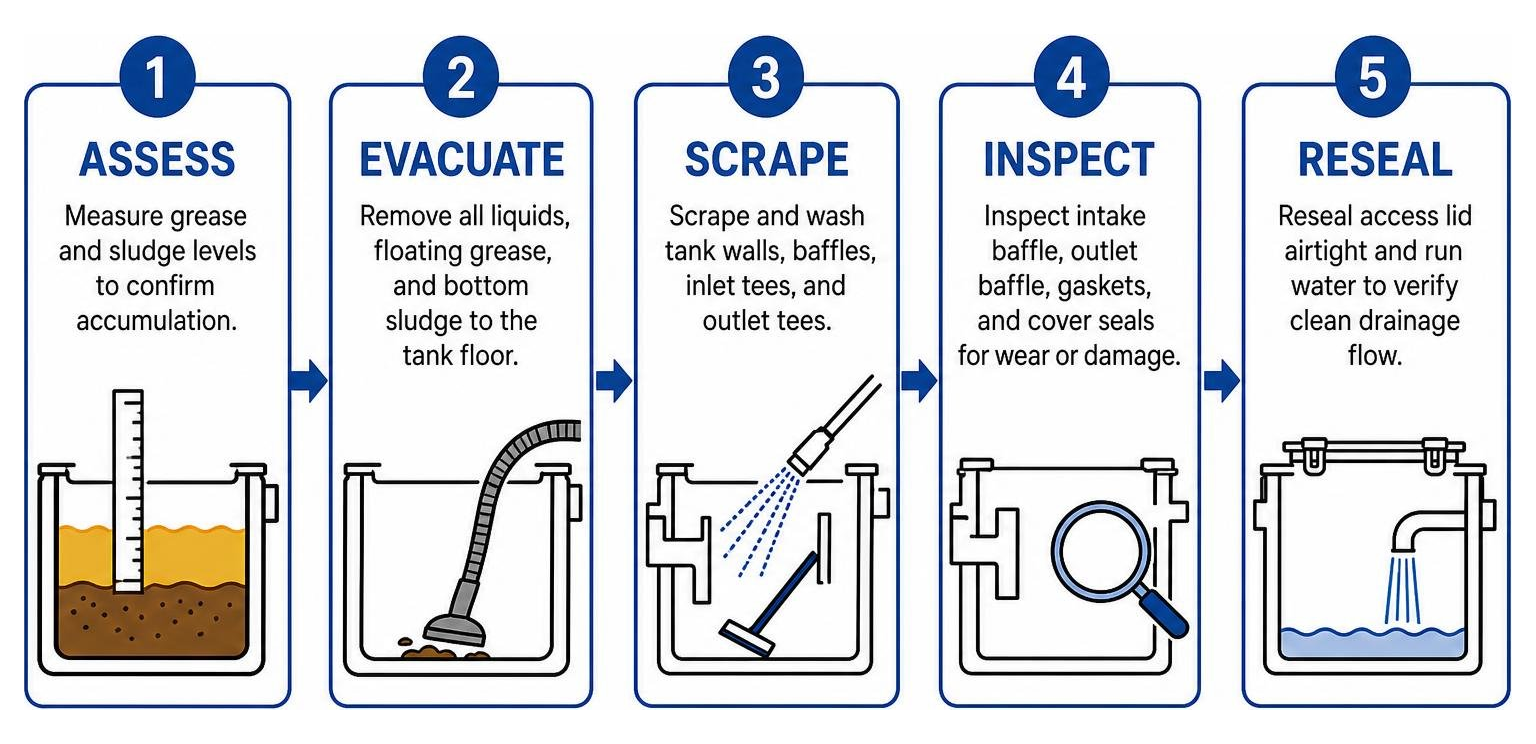
Certified technicians follow a structured protocol to support reliable drainage performance and code compliance:
- Initial assessment: The technician measures the depth of the floating grease layer and bottom sludge to confirm the accumulation percentage.
- Complete evacuation: A high-capacity vacuum hose removes all liquids, floating grease, and bottom sludge down to the tank floor.
- Scraping and washing: Technicians scrape interior tank walls, baffles, inlet tees, and outlet tees to remove hardened buildup, then rinse surfaces thoroughly.
- Lateral jetting when needed: High-pressure water jetting clears connecting drain lines of lingering residue and scale.
- Component inspection: The intake baffle, outlet baffle, gaskets, and cover seals are checked for physical wear, corrosion, or cracks.
- Re-sealing and testing: The access lid is securely fastened with an airtight seal to help prevent sewer gas leaks, and water is run to verify clean drainage flow.
Compliance Manifests and Health Inspection Documentation
Commercial kitchens must maintain meticulous compliance documentation to satisfy local health departments, plumbing inspectors, and environmental protection agencies. Following every service visit, the hauler provides an official service manifest.
A complete service manifest includes:
- Facility name, physical address, and contact information
- Date and time of service
- Specific trap or interceptor capacity in gallons or flow rate
- Total volume of grease waste removed
- Condition of internal baffles, tees, and mechanical seals
- Destination and EPA registration details of the licensed disposal facility
- Signatures of both the technician and the kitchen manager
A broader commercial plumbing service plan can help facility managers coordinate grease-trap care with other drainage, fixture, and piping needs in the kitchen.
Establishments in Southern New Hampshire, including Manchester, Nashua, and Derry, should keep these records on file on-site for at least three years. Organized service logs help the kitchen team demonstrate consistent maintenance during health inspections.
Grease Traps vs. Grease Interceptors: Key Differences
While the terms are often used interchangeably, grease traps and grease interceptors differ significantly in size, placement, flow-rate capacity, and structural engineering.
Sizing, Location, and Capacity Variations
Hydromechanical grease traps (indoor units): These compact units are installed directly under wash sinks, near dishwashers, or recessed into kitchen floors. They rely on internal flow-control devices that introduce air bubbles to accelerate grease separation within a smaller footprint. Because of their limited volume, high-volume restaurants in Salem or Merrimack may need these units serviced monthly to avoid exceeding the 25% capacity limit.
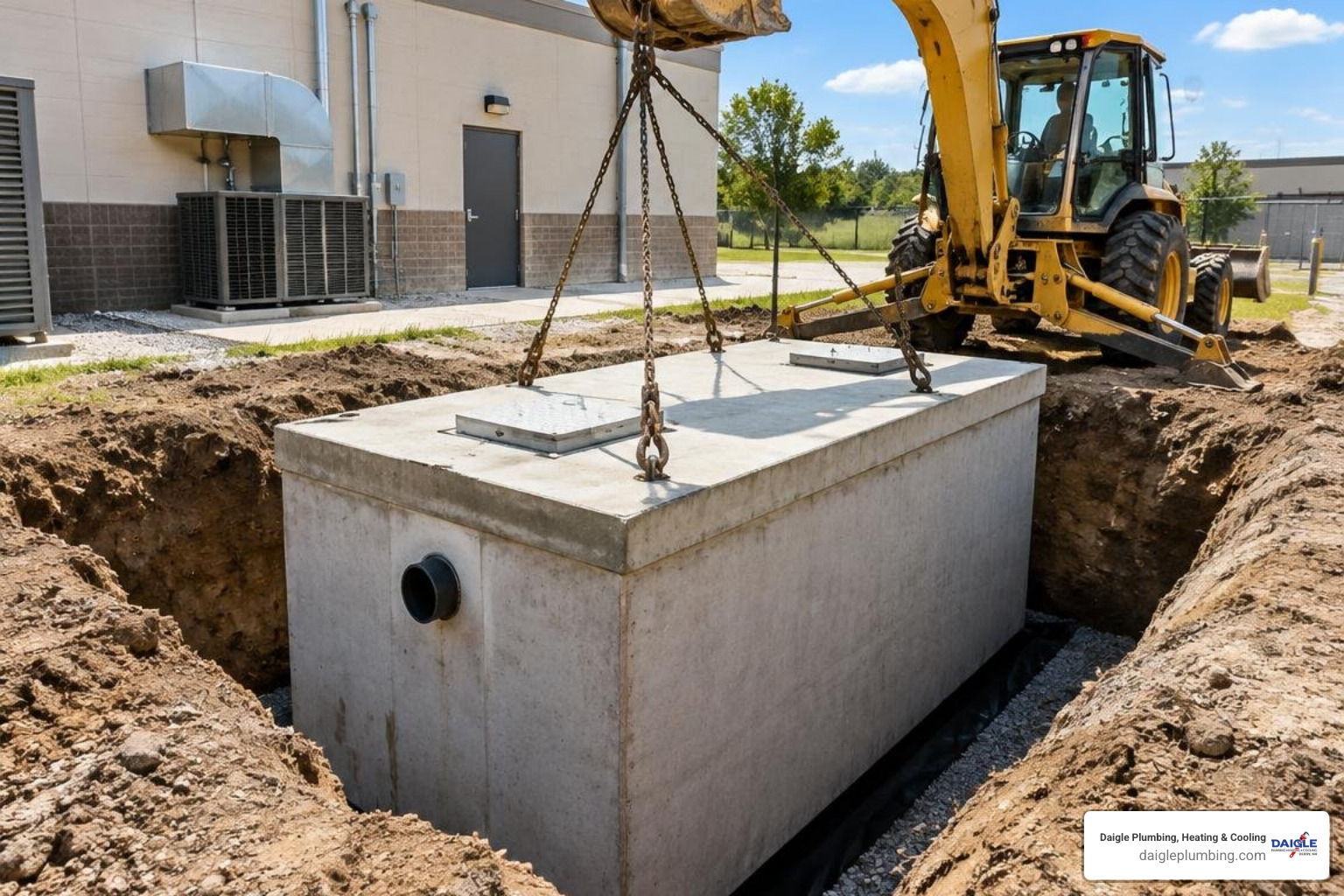
Gravity grease interceptors (outdoor units): Gravity interceptors are large underground containment vaults made of reinforced concrete or high-density polyethylene, located outside the building perimeter. They handle large volumes of wastewater from multiple fixtures simultaneously. Their larger volume provides extended retention time, allowing natural thermal cooling and gravity separation.
Selecting the Right Grease Trap Maintenance Service Provider
Partnering with an experienced service team helps prevent costly kitchen downtime. When evaluating providers in communities such as Bedford, Londonderry, or Windham, kitchen operators should consider these essential qualifications:
- Licensing and environmental compliance: Confirm that the provider holds required state and municipal waste-hauling permits and disposes of septage at licensed treatment facilities.
- Full-service capability: Look for teams equipped with vacuum pump trucks, high-pressure line-jetting tools, and plumbing repair capabilities to address worn baffles, damaged pipes, and failing gaskets during the same visit.
- Detailed manifest documentation: Ensure the contractor supplies clear, itemized service logs that fulfill local health authority requirements.
- Prompt service availability: Kitchen plumbing problems require timely attention. Choose a dependable team that can address unexpected backups before meal service begins.
- Sustainable recycling practices: Leading services coordinate with licensed facilities to process recovered fats, oils, and grease through approved recycling channels where available.
For kitchens with broader building upgrades or complex plumbing coordination, Daigle’s new construction heating, cooling, and plumbing services can help the project team plan reliable utility systems around commercial operations.
Kitchen teams can also reduce avoidable calls by applying plumbing maintenance practices that prevent common issues before a slow drain becomes a disruptive backup.
Frequently Asked Questions About Commercial Grease Traps
How often should a commercial grease trap be cleaned?
Most commercial kitchens require service every 30 to 90 days. The exact interval depends on your trap size, kitchen seating capacity, menu items, and dishwashing volume. Heavy fryer operations and barbecue restaurants accumulate grease quickly and often require monthly pump-outs. Facilities serving lighter fare, such as cafés or sandwich shops, can often maintain compliance on a quarterly schedule, provided total waste accumulation remains below 25% of total capacity.
What are the main warning signs that a grease trap is failing?
Watch for these early indicators that your trap needs immediate attention:
- Sinks and floor drains emptying sluggishly across multiple kitchen stations.
- Persistent, sour, or rancid odors emanating from floor drains.
- Gurgling sounds inside drainage lines when water drains from sinks.
- Standing wastewater backing up into floor sinks during peak dishwashing hours.
- Visible grease accumulation or thick scum layers escaping into sample access ports.
Can kitchen staff clean grease interceptors instead of hiring a professional?
In most jurisdictions across Southern New Hampshire, kitchen staff are legally prohibited from pumping and transporting commercial grease interceptor waste. State and municipal environmental codes designate grease trap contents as regulated septage. Proper removal requires specialized vacuum extraction equipment, leak-proof transport tanks, and licensed disposal manifests. In addition, opening and cleaning large traps exposes untrained staff to hazardous sewer gases (such as hydrogen sulfide) and slick fall hazards. Professional servicing ensures kitchen safety and full legal compliance.
Conclusion
A well-maintained grease management system is the backbone of a sanitary, efficient, and code-compliant commercial kitchen. By understanding the mechanics of gravity separation, following the 25% capacity rule, and maintaining complete service logs for health inspectors, restaurant owners can help avoid sewer backups, business interruptions, and municipal fines.
At Daigle Plumbing, Heating & Cooling, our licensed and insured team brings more than 40 years of family-owned experience to commercial kitchens across Derry, Manchester, Salem, Nashua, and surrounding communities. For help with a maintenance plan or a drainage concern, contact our professional grease trap maintenance technicians.