What Every Homeowner Should Know About a Buried Pressure Tank
A buried pressure tank is a well system component installed underground to store pressurized water and regulate flow to your home. Here’s a quick overview of what you need to know:
- What it does: Maintains consistent water pressure, reduces pump wear, and stores a reserve supply
- Why it’s buried: Protects against freezing, saves above-ground space, and keeps the yard clear
- Common models: Purpose-built tanks like the Amtrol Well-X-Trol WX-202-UG (20-gallon capacity, rated to 150 PSI)
- Biggest challenge: Hard to access for maintenance, air pressure checks, or replacement
- Key rule: Pre-charge air pressure should always be set 2 PSI below your pump’s cut-in pressure
If you’ve just discovered a buried pressure tank on your property, you’re not alone. Many homeowners in New Hampshire and across the country inherit these systems with no paperwork from previous owners, and often do not learn about them until water pressure drops or the pump starts running nonstop.
Some buried tanks were installed on purpose, using underground-rated models built to handle soil pressure and moisture. Others are regular tanks that were simply placed below grade. In both cases, a buried setup offers real benefits and real drawbacks, especially when a problem starts and the tank is hard to access.
At Daigle Plumbing, Heating & Cooling, we have extensive experience working with well systems of all types, including the unique challenges that come with a buried pressure tank. In the sections below, you’ll learn what these systems are, how they work, and what to know about maintenance, troubleshooting, and replacement options.
What is a Buried Pressure Tank and Why Use One?
A buried pressure tank is a specialized vessel designed to be installed below the earth’s surface, typically near the well casing. While most modern homes in Derry, NH, and surrounding areas have their pressure tanks in a basement or utility closet, buried tanks remain a common sight in older properties, seasonal cottages, or homes where indoor space is at a premium.
We use these tanks to perform the same critical functions as an indoor tank: they act as a reservoir for your well system. When you turn on a faucet, the tank provides immediate water pressure. This prevents your well pump from having to kick on every single time you rinse a glass, which significantly extends the life of the pump and saves on energy costs.
Some pressure tank models are built specifically for underground use. They are not standard tanks buried in the ground. Instead, they are designed with durable steel construction and protective coatings that help resist soil moisture, corrosion, and the harsher conditions found below grade.
Advantages of a Buried Pressure Tank
Why would someone choose to put a tank in the ground instead of the basement? There are several practical reasons:
- Consistent Water Temperature: The earth is a natural insulator. By burying the tank, the water stays at a relatively constant temperature year-round. This is particularly helpful in the summer, as it keeps your drinking water cool and prevents the “sweating” (condensation) that often happens on indoor tanks.
- Space Maximization: In smaller homes, mobile homes, or “slab-on-grade” houses without a basement, finding room for a 20- or 34-gallon tank can be tough. Moving it outside frees up valuable closet or utility space.
- Freeze Protection: In our New Hampshire climate, the frost line is a major factor. A tank buried below the frost line (which is roughly 42 inches deep in regions like Detroit and similar northern climates) is naturally protected from freezing without needing a heated “doghouse” or enclosure.
- Curb Appeal: For homeowners who don’t want a bulky well house sitting in the middle of their front yard, a buried pressure tank offers a completely hidden solution.
Common Challenges with a Buried Pressure Tank
While the “out of sight, out of mind” aspect is nice, it leads to the biggest disadvantage: accessibility.
If your tank is buried in the bare ground without a vault or access pipe, you cannot easily check the air pressure. Standard maintenance, like ensuring the bladder hasn’t failed, requires a shovel and a lot of sweat. Furthermore, even with protective coatings, soil chemistry can eventually lead to corrosion. If a tank develops a pinhole leak underground, you might not know it until your yard becomes a swamp or your electric bill skyrockets because the pump is running 24/7.
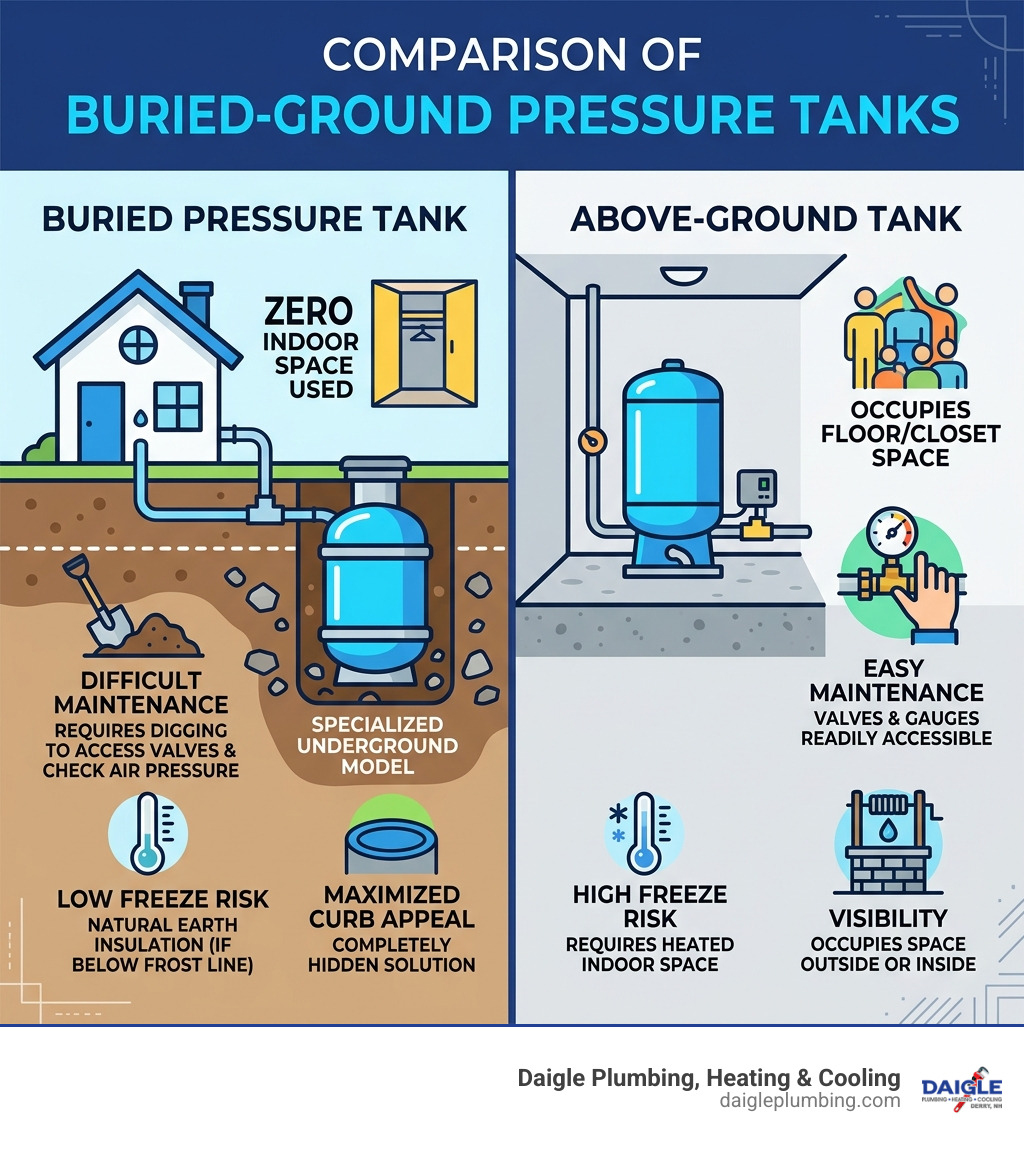
| Feature | Buried Pressure Tank | Above-Ground Tank |
|---|---|---|
| Space Usage | Zero indoor space used | Occupies floor/closet space |
| Maintenance | Difficult (requires digging) | Easy (valves are accessible) |
| Freeze Risk | Low (if below frost line) | High (requires heated space) |
| Lifespan | 10-20 years (model dependent) | 15-25 years |
| Visibility | Hidden | Visible |
Troubleshooting and Maintaining Your Buried Pressure Tank
Maintaining a buried pressure tank is a bit of a detective’s game. Since you can’t see the tank, you have to listen to what your plumbing is telling you.
The most common sign of trouble is pump short-cycling. This happens when the pump turns on and off rapidly (every few seconds) while you are using water. This is a red flag that your tank has lost its “drawdown” capacity—the amount of water the tank can provide before the pump needs to restart. For example, an Amtrol WX-202-UG provides about 5.9 gallons of drawdown at a 40/60 PSI setting. If you’re only getting a half-gallon before the pump clicks on, you have a problem.
If you notice these symptoms, it’s vital to act quickly. Short-cycling is the number one killer of well pumps. You can learn more about the specifics of these failures in our guide on what happens when well pressure tank goes bad.
Identifying a Waterlogged Tank
A “waterlogged” tank occurs when the air chamber in the tank is replaced by water. In a bladder-style tank, this usually means the internal rubber bladder has ruptured.
To check for this with a buried pressure tank:
- The Knock Test: If you can locate the tank and dig down to the top, knock on the side. It should sound hollow at the top (where the air is) and dull at the bottom (where the water is). If it sounds dull all the way to the top, it’s waterlogged.
- The Air Valve Test: Most tanks have a Schrader valve (like a tire valve). If you depress the center pin and water squirts out instead of air, the bladder is definitely blown.
- Drawdown Timing: Turn off the power to the pump and open a faucet. Measure how much water comes out before the flow stops. If it’s significantly less than the tank’s rated specs, you likely have a waterlogged pressure tank.
For more diagnostic tips, check out our article on common water pressure tank problems.
Adjusting Air Pressure and Pre-charging
To keep your system healthy, the air pressure inside the tank must be calibrated to your pump’s “cut-in” pressure. The cut-in pressure is the PSI at which your pump turns on.
The golden rule is the 2 PSI Rule: Your tank’s pre-charge pressure should be exactly 2 PSI below the cut-in setting.
- If your switch is set to 30/50 PSI, your tank needs 28 PSI of air.
- If your switch is set to 40/60 PSI, your tank needs 38 PSI of air.
To adjust this on a buried tank, you must turn off the pump, drain all water from the system by opening the lowest faucet in the house, and then use an air compressor at the tank’s air valve. If you’re unsure how to handle the electrical side of this, we have a helpful guide on how to adjust well pump pressure switch settings safely.
Solutions for Inaccessible or Failing Underground Tanks
What do you do if your buried pressure tank is failing, but you don’t want to dig up your entire front yard? Or perhaps the tank is under a paved walkway or a deck?
At Daigle Plumbing, Heating & Cooling, we often see homeowners in Londonderry or Bedford facing this exact dilemma. One of the most effective solutions is to “abandon” the buried tank in place and relocate the system’s pressure control components.
Adding a Second Accessible Tank Indoors
If your buried tank is losing its charge but isn’t completely ruptured, or if you simply want an easier way to monitor your system, you can install a second, smaller pressure tank inside your home (in a basement, garage, or closet).
By adding an indoor tank, even a compact option like in-line bladder pressure tanks or horizontal stainless-steel pressure tanks, you can increase total system capacity. When sized and connected properly, both tanks work together to deliver greater drawdown.
Pro Tip: When adding a second tank, ensure both are set to the same pre-charge pressure. We also recommend installing a check valve between the house and the buried tank if the buried one is known to be failing. This prevents the old, leaky tank from sucking the pressure out of your new indoor system. To ensure you get the right size for your home, read our guide to learn to properly size a well pressure tank.
Upgrading Your Pressure Switch and Relocation
Often, the pressure switch (the little box that tells the pump when to start) is located outside near the buried tank. These switches are prone to failure due to moisture, ants, and spiders.
If you’re having trouble with your switch, we highly recommend relocating it indoors. While you’re at it, many homeowners choose to upgrade from a 30/50 PSI switch to a 40/60 PSI switch to get that “city water” feel.
Wait! Before you swap that switch, you must ensure your well pump is capable of reaching the higher pressure. If your pump is old or the well is very deep, it might struggle to hit 60 PSI, leading to well pump short cycling or a pump that never turns off. Always check your pump’s “dead-head” pressure capability before making the jump.
Frequently Asked Questions about Buried Pressure Tanks
How do I locate a buried pressure tank if the location is unknown?
This is a common issue for new homeowners in places like Merrimack or Hampstead. Start by finding where the water line enters your basement or crawlspace. Follow that line’s trajectory out into the yard. Usually, the tank is located between the house and the well head. You can use a thin metal ground probe to gently feel for the tank’s shell, or look for a “hump” in the yard or a spot where the grass grows differently. If all else fails, a professional plumber with a metal detector or underground imaging can find it in minutes.
Can I replace the pressure switch if the tank is buried and inaccessible?
Yes. The pressure switch does not have to be physically attached to the tank. It just needs to be on the main water line between the pump and the tank. If your switch is buried and failing, we can often intercept the wire and plumbing line where it enters the house and install a new switch and gauge there. This makes future repairs significantly easier.
How does the frost line affect buried tank placement?
The frost line matters a lot when installing a buried pressure tank. In cold climates like New Hampshire, a tank set too shallow can freeze. When water freezes, it expands, which can crack the tank, fittings, or nearby piping. That is why underground tanks are typically placed below the local frost depth so the surrounding soil helps protect them from extreme temperature swings.
If site conditions like ledge, rocky soil, or a high water table make deep burial difficult, other tank layouts may be worth considering, such as low-profile pressure vessels or in-line bladder pressure tanks.
Conclusion
A buried pressure tank can be a great space-saving solution, but it requires a “proactive” rather than “reactive” maintenance mindset. Because you can’t see the tank, you must stay tuned to changes in your water pressure and pump behavior.
Whether you need to locate a mystery tank, troubleshoot a short-cycling pump, or want to relocate your system indoors for easier access, the team at Daigle Plumbing, Heating & Cooling is here to help. With over 40 years of experience serving Derry, NH, and the surrounding communities, we have the tools and expertise to handle the toughest well system challenges.
Don’t wait until you’re out of water to check on your tank. Contact our well pump specialists today for more info about well pump services and let us ensure your family has reliable, high-pressure water all year long!