The Role of a 40 Gallon Water Well Pressure Tank in Your Home’s Water System
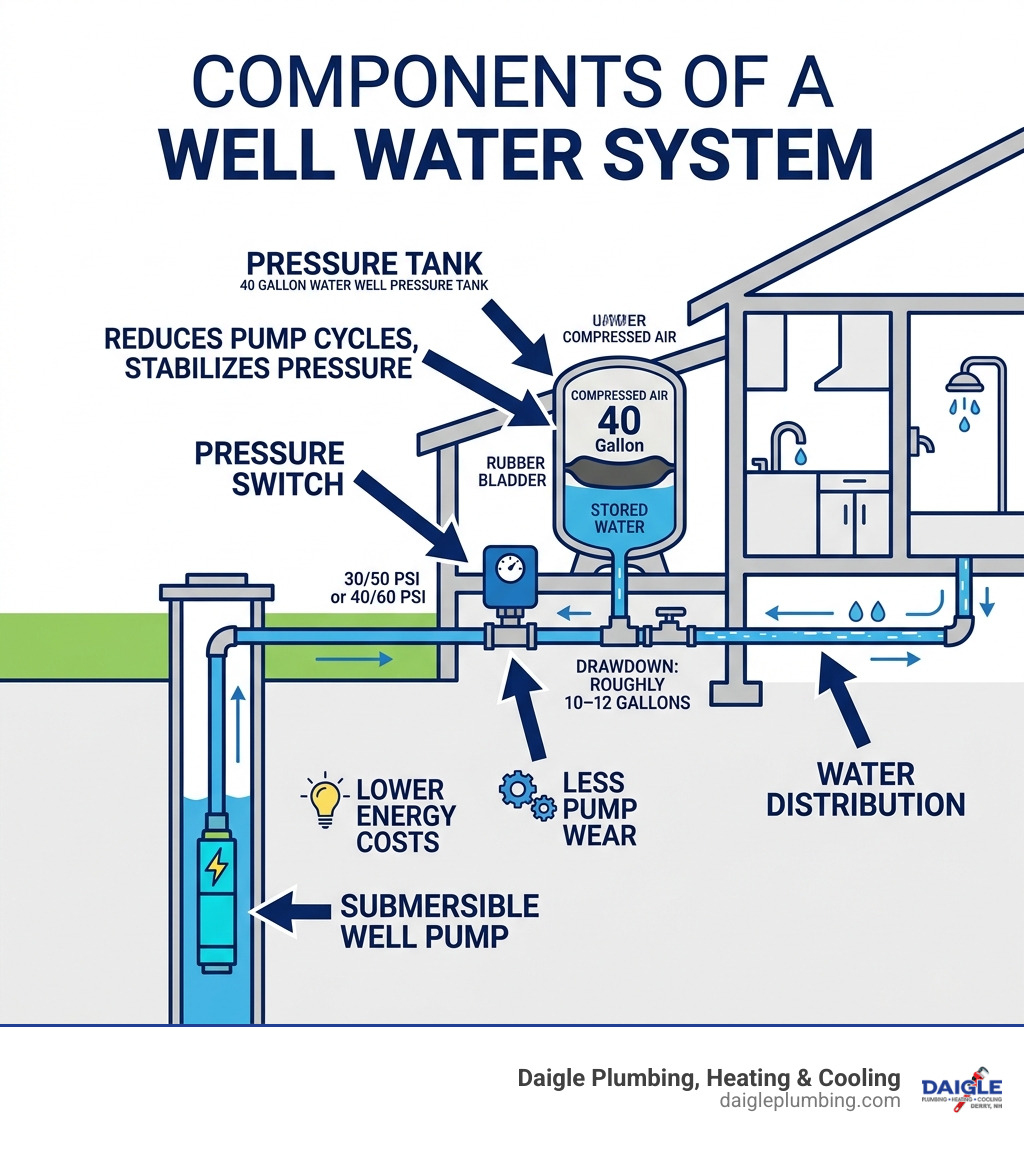
A 40 gallon water well pressure tank is one of the most common tank sizes for residential well systems, and for good reason. Here’s a quick summary of what it does and who it’s for:
- What it does: Stores pressurized water so your pump doesn’t run every time you turn on a faucet
- Who it’s for: Homes with 3-4 bedrooms and moderate daily water demand
- Usable water (drawdown): Roughly 10–12 gallons per cycle, depending on pressure settings
- Common pressure settings: 30/50 PSI or 40/60 PSI
- Key benefit: Reduces pump wear, stabilizes water pressure, and lowers energy costs
If you rely on a private well for your home’s water, the pressure tank is one of the most important components in the entire system. Without it, your pump would switch on and off constantly, wearing out faster and causing frustrating pressure swings throughout your home.
Choosing the right size and type matters more than most homeowners realize. Too small, and your pump short-cycles. Too large, and you’re paying for capacity you don’t need.
At Daigle Plumbing, Heating & Cooling, we’ve seen how the right 40 gallon water well pressure tank can improve system performance, water pressure, and long-term reliability. In this guide, we’ll cover how these tanks work, how to size them, what installation involves, and when to call for professional water well installation service or repairs.
What is a 40 Gallon Water Well Pressure Tank and How Does It Work?
At its core, a 40 gallon water well pressure tank acts as a storage reservoir and a pressure regulator for your home. While it is called a “40-gallon” tank, it doesn’t actually hold 40 gallons of water at all times. Instead, it uses a combination of water and compressed air to create the “push” needed to move water through your pipes.
How Compressed Air Makes the Tank Work
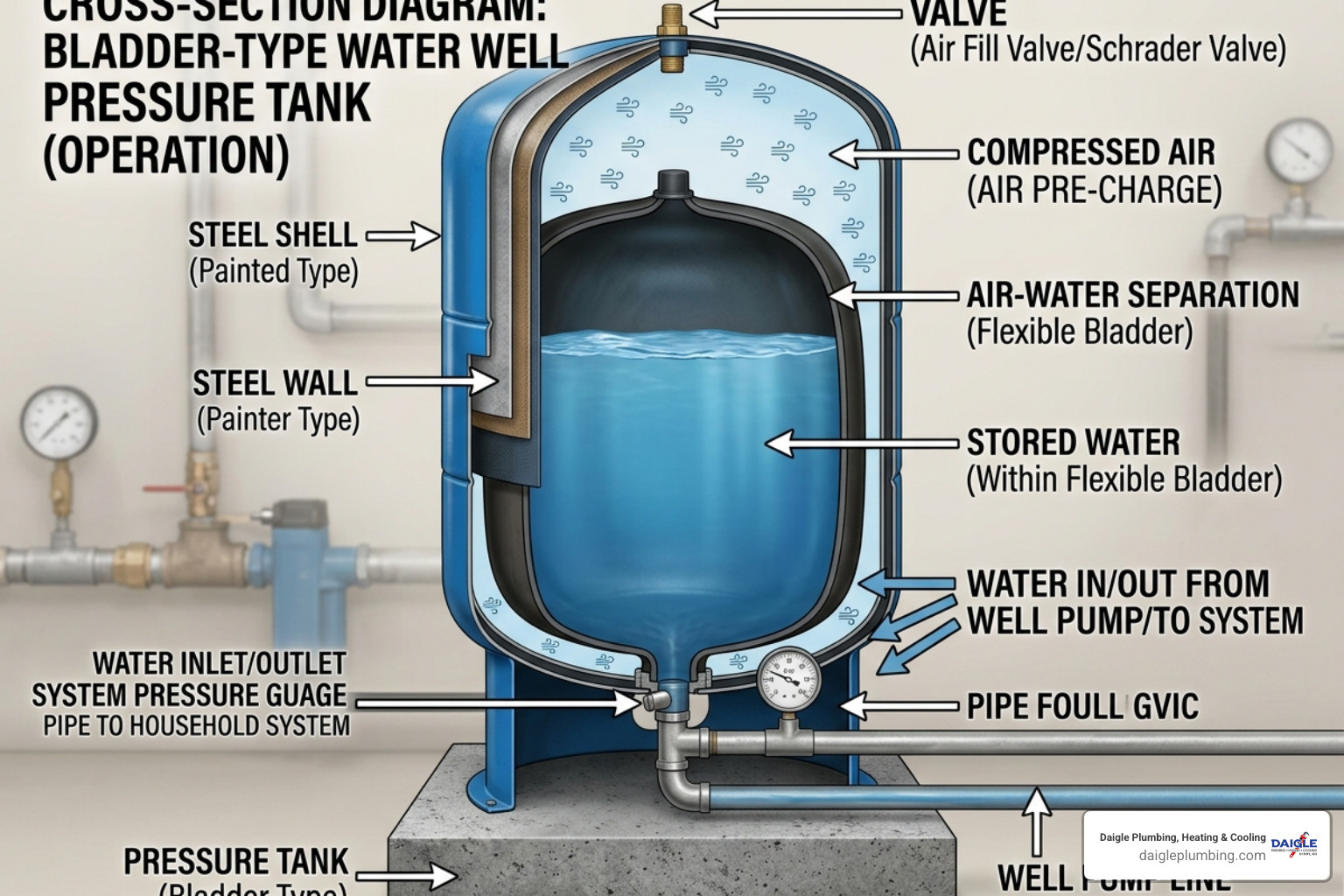
Most modern 40-gallon well pressure tanks are bladder-type tanks. Inside the steel or fiberglass outer shell is a flexible, balloon-like chamber called a bladder.
When your well pump turns on, it forces water into this bladder. As the bladder expands, it compresses the air trapped between the bladder and the tank wall. Once the pressure reaches a specific “cut-out” point (usually 50 or 60 PSI), the pump shuts off. When you turn on a faucet, that compressed air squeezes the bladder, pushing water out into your home. The pump stays off until the pressure drops to the “cut-in” point (usually 30 or 40 PSI), at which point the cycle repeats.
Bladder vs. Diaphragm
While both designs separate air from water, the bladder is generally preferred because it is replaceable in some models and less prone to sticking. Without this separation, air would eventually dissolve into the water, leading to a “waterlogged” tank. This is one of the 3 water issues well tanks can cause if they aren’t functioning correctly.
Understanding Drawdown Capacity
The term “drawdown” refers to the actual amount of usable water available before the pump has to kick back on. For a 40 gallon water well pressure tank, the drawdown is typically only about 25% to 30% of the total volume.
- At a 30/50 PSI setting, you might get about 12.2 gallons.
- At a 40/60 PSI setting, that drops to about 10.5 gallons.
By providing this buffer, the tank significantly reduces the number of times your pump has to start up, which is the most taxing part of a pump’s life.
Sizing Your System: Is a 40 Gallon Tank Right for Your Needs?
Sizing a pressure tank isn’t about how much water you want to have; it’s about protecting your pump. The goal is to ensure the pump runs for at least one minute every time it starts. This allows the motor to cool down and prevents the mechanical stress of frequent starts.
To determine if a 40 gallon water well pressure tank is right for you, we look at several factors:
- GPM (Gallons Per Minute) Flow Rate: How much water can your pump move? If you have a 10 GPM pump, you need a tank with at least a 10-gallon drawdown to meet the one-minute runtime rule.
- Pump Runtime: Most manufacturers recommend a 60-second minimum runtime for pumps up to 3/4 HP, and longer for larger pumps.
- Household Occupancy: A 40-gallon tank is often the “sweet spot” for a standard 3-bedroom, 2-bathroom home in areas like Derry or Londonderry, NH.
- Peak Demand: Do you run the dishwasher, laundry, and shower at the same time?
Capacity Comparison Table
| Total Tank Volume | Typical Drawdown (40/60 PSI) | Recommended Household Size |
|---|---|---|
| 20 Gallons | ~5-6 Gallons | 1-2 People / Small Cabin |
| 40 Gallons | ~10-12 Gallons | 3-4 People / Average Home |
| 44 Gallons | ~12-14 Gallons | 4+ People / High Demand |
| 86 Gallons | ~25-27 Gallons | Large Estates / Irrigation Needs |
If you are unsure, it is always better to go slightly larger. You can learn to properly size a well pressure tank by calculating your pump’s specific delivery rate.
Benefits of Using a 40 Gallon Water Well Pressure Tank
- Energy Efficiency: Because the pump runs less frequently, you consume less electricity.
- Consistent Water Pressure: You won’t notice the water pressure dropping to a trickle while you’re in the shower.
- Reduced Pump Wear: Fewer starts mean the mechanical seals and motor windings last years longer.
- Short Cycling Prevention: This is the #1 killer of well pumps. A properly sized tank prevents the pump from clicking on and off every few seconds. If you notice this happening, check out our guide on well pump short cycling causes and solutions.
Key Types and Features of 40 Gallon Pressure Tanks
When shopping for a 40 gallon water well pressure tank, you’ll encounter two primary materials: steel and fiberglass.
Steel vs. Fiberglass
Steel tanks are the traditional choice. They are rugged and often more affordable. However, in the humid basements common in New Hampshire, steel tanks can sweat and eventually rust.
Fiberglass models offer several advantages:
- Corrosion-Proof: They won’t rust, even in coastal or high-moisture environments.
- Lightweight: A 40-gallon fiberglass tank weighs about 30–35 lbs, compared to 60+ lbs for steel, making installation much easier.
- Durability: They are often seamless, reducing the risk of leaks at the joints.
Vertical vs. Horizontal
Most residential tanks are vertical to save floor space. However, if you have a crawlspace or want to mount the pump directly on top of the tank, a horizontal model might be necessary.
Certifications to Look For
Always ensure the tank is NSF/ANSI 61 certified. This ensures the materials (including the bladder and any internal liners) are safe for drinking water. Some high-end tanks also use food-grade PE (polyethylene) materials that are resistant to extreme cold—useful for systems located in unheated pump houses.
Installation and Maintenance Requirements
Installing a 40 gallon water well pressure tank is a task that requires precision. If the air pressure isn’t set correctly from day one, the tank won’t work properly, and you could damage your pump.
The 2 PSI Rule
The most critical step in installation is setting the “pre-charge” air pressure. This must be done while the tank is empty of water.
- The rule: The air pressure should be 2 PSI below the pump’s cut-in pressure.
- If your switch is set to 30/50, your tank air pressure should be 28 PSI.
- If your switch is set to 40/60, your tank air pressure should be 38 PSI.
Installation Components
A proper installation includes a “tank tee” or manifold. This assembly holds:
- The Pressure Switch: The “brain” that tells the pump when to run.
- Pressure Gauge: To monitor the system.
- Boiler Drain: For sampling water or draining the tank.
- Relief Valve: A vital safety feature that opens if the pressure exceeds 75 or 100 PSI, preventing the tank from exploding.
If your water pressure feels “off,” you might need to adjust the well pump pressure switch to better match your household needs.
Troubleshooting a 40 Gallon Water Well Pressure Tank
Even the best tanks eventually run into trouble. Here are the most common issues we see in the field:
- Waterlogging: This happens when the air charge is lost or the bladder ruptures. The tank becomes full of water with no air “cushion.” You’ll notice the pump starting every time you crack a faucet. For DIY fixes, see our guide on waterlogged pressure tank troubleshooting.
- Air Loss: Over time, air can seep through the charging valve (Schrader valve). We recommend checking your air pressure annually.
- Sediment Buildup: In areas with high iron or sand, sediment can collect in the bottom of the bladder, reducing capacity or clogging the intake.
- Ruptured Bladder: If you depress the air valve and water squirts out, the bladder is gone. The tank will likely need to be replaced.
Frequently Asked Questions
How much does a 40-gallon well pressure tank cost?
The cost of a 40 gallon water well pressure tank depends on the tank material, quality, warranty, and installation needs.
- Retail tank cost: Standard steel tanks from retailers are usually less expensive than premium models, but prices can change based on availability and specifications.
- Premium materials: Fiberglass or composite tanks often cost more upfront, but they may offer better corrosion resistance and longer service life.
- Professional installation: Labor costs vary depending on plumbing changes, pressure switch replacement, tank tee condition, access, and whether other well system parts need attention.
What is the actual water storage (drawdown) in a 40-gallon tank?
As mentioned earlier, you don’t get 40 gallons of water. The usable capacity depends on your pressure settings:
- \~12.2 gallons at 30/50 PSI.
- \~10.5 gallons at 40/60 PSI. If your household requires more than 12 gallons of water in a single minute (e.g., multiple high-flow showerheads running), you may need to step up to an 80-gallon tank or install two 40-gallon tanks in parallel.
What are the signs that my pressure tank has gone bad?
Don’t wait until you have no water to check your tank. Watch for these red flags:
- Fluctuating Pressure: The water flow pulses from strong to weak while you’re using it.
- Clicking Sounds: You hear the pressure switch clicking on and off rapidly.
- High Electric Bills: Your well pump is one of the biggest energy users in your home; if it’s running constantly due to a bad tank, your bill will spike.
- Air in the Lines: “Sputtering” faucets can indicate a ruptured bladder releasing air into the plumbing.
Knowing what happens when a well pressure tank goes bad can help you catch the problem before it burns out your expensive well pump.
Conclusion
A 40 gallon water well pressure tank is the unsung hero of your home’s plumbing system. It protects your pump, stabilizes your showers, and keeps your water flowing efficiently. Whether you choose a classic steel tank or a modern, rust-proof fiberglass model, proper sizing and maintenance are the keys to a long-lasting system.
At Daigle Plumbing, Heating & Cooling, we’ve been serving the Derry, NH community and surrounding towns like Salem, Nashua, and Londonderry for over 40 years. We understand the unique challenges of New Hampshire well water, from sediment issues to freezing temperatures. Our team of licensed and insured experts is here to help you choose, install, and maintain the perfect pressure tank for your home.
If you’re experiencing pressure issues or think it’s time for an upgrade, don’t hesitate to reach out. We offer a satisfaction guarantee and financing options to ensure your home stays comfortable and functional. For professional well pump installation and repair in Derry, NH, contact our experts today!