Your Well Pump Is Quietly Raising Your Energy Bills – Here’s How to Fix It
A well pump efficiency upgrade can cut your home’s water pumping energy costs by up to 60%, and the path to those savings is more straightforward than most homeowners realize.
Quick answer: How to upgrade your well pump efficiency
- Switch to a variable-speed pump to cut energy use by 20 to 60% compared to single-speed models
- Add a Variable Frequency Drive (VFD) to match pump speed to real-time demand and save 30 to 50% on pump energy costs
- Right-size your pump and pressure tank because oversized systems can waste 20 to 30% more energy
- Optimize your pipework to reduce bends, friction loss, and problems caused by undersized pipes
- Schedule semi-annual maintenance to help prevent the 10 to 25% efficiency loss that can quietly raise your bills
If your home uses a private well, your pump could be one of the biggest hidden energy users in the house. Well pumps can make up nearly 20% of a home’s electric motor energy use, but many homeowners overlook them when trying to cut utility costs.
The challenge with well pump inefficiency is that you usually cannot see it. A pump that is getting older, is too large for the job, or runs at full speed when less output would work can seem totally normal. But behind the scenes, it may be costing you far more to operate. In many homes, that can mean paying $300 to $500 a year, when a more efficient upgrade could lower that to about $120 to $200.
This guide walks you through exactly how to change that.
At Daigle Plumbing, Heating & Cooling, our team brings years of hands-on experience in HVAC, plumbing, and well pump efficiency upgrade work. In the sections ahead, we’ll walk through the practical steps we recommend to homeowners in Derry, NH, and the surrounding area who want real, lasting savings from their well system.
Recognizing the Need for a Well Pump Efficiency Upgrade
Most homeowners in New Hampshire don’t think about their well pump until the water stops flowing. However, waiting for a total breakdown is the most expensive way to manage your home. Long before a pump dies, it begins to “leak” money through your electric bill.
One of the most common red flags we see is short cycling. This happens when your pump turns on and off rapidly. Not only does this put massive strain on the motor, but it also consumes a huge amount of electricity during each start-up spike. If you notice your pump clicking on every time you turn on a single faucet, you should check out our guide on Well Pump Short Cycling: Causes and Solutions to understand the underlying mechanics.

The Lifespan Factor
Most well pumps last about 8-15 years. Once a pump gets closer to the 10-year mark, internal parts like impellers and wear rings often start to wear out. As that happens, efficiency can drop by 10-25% even before the pump stops working. In simple terms, you may still be paying for full power while getting much less performance in return.
Other signs that it’s time for a well pump efficiency upgrade include:
- Spiking electric bills: If your water use has stayed about the same but your power bill keeps climbing, your pump may be working harder than it should because of a leak, worn parts, or a weakening motor.
- Pressure fluctuations: If shower pressure drops when a toilet flushes or another fixture turns on, your system may be struggling to keep up. This often ties back to issues like common water pressure tank problems that make the pump run longer and less efficiently.
- Noisy operation: Grinding, rattling, or constant humming can point to internal wear and extra friction, which usually means more wasted energy.
The Power of Variable Speed Technology and VFDs
The traditional way to pump water is simple but inefficient: the pump is either fully on or fully off. Think of driving a car with only two options, full throttle or full brake. You would waste fuel and wear out parts fast. That is how a standard single-speed well pump works.
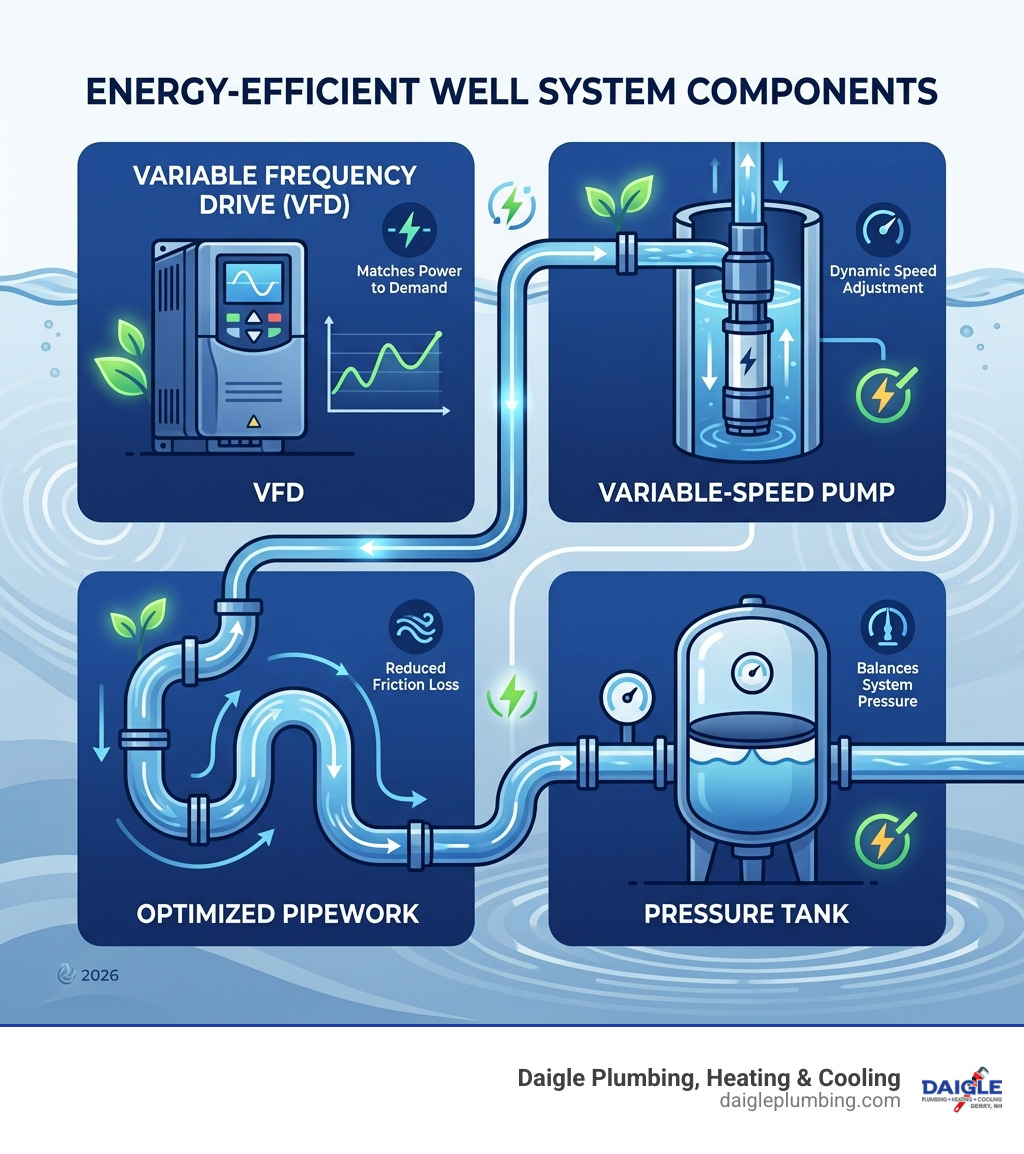
A well pump efficiency upgrade involving Variable Frequency Drives (VFDs) changes the game. A VFD acts like cruise control for your well. It adjusts the motor speed to match exactly how much water you are using at that moment.
Why VFDs are Efficiency Champions
When you install a VFD, you can see energy savings of 30% to 80% on pump motors with varying loads. Because the motor “soft starts” (ramping up slowly rather than slamming on), it reduces mechanical wear and extends the life of the entire system.
| Pump Type | Estimated Annual Energy Cost | Potential Savings |
|---|---|---|
| Traditional Single-Speed | $300 – $500 | $0 (Baseline) |
| Variable-Speed (VFD) | $120 – $200 | Up to 60% |
| Smart-Controlled High Efficiency | $150 – $250 | Up to 50% |
Upgrading your motor is one of the smartest ways to boost pump performance with a motor upgrade. High-efficiency motors can operate about 28.4% more efficiently than standard models, helping reduce energy use and lower long-term operating costs.
How VFDs Drive Your Well Pump Efficiency Upgrade
The magic of a VFD lies in its ability to respond to real-time demand. If you are just brushing your teeth, the VFD tells the pump to spin slowly. If you are running the dishwasher, the shower, and the irrigation system at once, it ramps up to maintain constant pressure.
This helps prevent the power surges often seen with old single-speed pumps. Many newer VFD systems also include smart controllers with automatic monitoring. If a pipe starts leaking, the controller may notice the pump running when it should not and warn you early, before water damage or a much higher electric bill follows. To make sure the system responds properly to changing speeds, it is often necessary to adjust well pump pressure switch settings so everything works together.
Selecting the Right Model for a Well Pump Efficiency Upgrade
Not all pumps are created equal. The best choice for your home depends on your well’s depth and your family’s water needs.
- Submersible Pumps: These are placed deep inside the well. They are incredibly efficient because they push water up rather than pulling it. They typically use between 500W and 2,500W and are the gold standard for deep wells in New Hampshire.
- Jet Pumps: Usually mounted above ground, these are common for shallow wells. While reliable, they are generally less efficient than submersibles.
- Centrifugal Pumps: These are great for high-flow, shallow applications but can be prone to losing prime if not maintained.
When selecting a pump, we look at horsepower matching and flow rate. A standard two-bathroom home usually requires 8-12 Gallons Per Minute (GPM). Many older systems were oversized by 20-30% “just in case,” but this leads to massive energy waste. Programs like the Advanced Pumping Efficiency Program (APEP) emphasize that matching the pump to the actual load is the first step toward true efficiency.
Optimizing System Components for Maximum Savings
A pump doesn’t work in a vacuum. It is part of a larger ecosystem that includes your pressure tank and pipework. If these components aren’t optimized, even the most expensive pump won’t save you money.
Right-Sizing the Pressure Tank
A pressure tank gives your well system a reserve of pressurized water, so the pump does not have to start every time someone turns on a tap. If the tank is undersized, the pump can short cycle, which increases wear and wastes energy. That is why it helps to learn to properly size a well pressure tank so your pump runs less often and more efficiently. It is also smart to know what happens when well pressure tank goes bad, because a failing tank can lead to waterlogging, poor performance, and eventually pump damage.
Pipework and Friction Loss
Think of your pipes like a highway. If the highway has too many sharp turns, narrow lanes, and construction zones, traffic slows down and fuel consumption goes up. In your plumbing, every 90-degree elbow and every foot of undersized pipe creates “friction loss.” Your pump has to work harder to overcome that resistance. During a well pump efficiency upgrade, we look to optimize the pipework by:
- Using larger diameter pipes where possible.
- Reducing the number of unnecessary bends.
- Replacing corroded pipes that have internal “scale” buildup, which narrows the flow path.
Maintenance Strategies to Prevent Efficiency Degradation
You wouldn’t buy a brand-new car and never change the oil. The same logic applies to your well system. To keep your well pump efficiency upgrade performing at its peak, we recommend a semi-annual inspection.
The Maintenance Checklist
Leak Detection: Even a small leak in the well system or household plumbing can make your pump cycle far more often than it should, which wastes electricity and adds wear.
Wear Ring Inspection: As wear rings wear down, more water slips backward inside the pump instead of moving where it should. That internal recirculation can reduce efficiency and force the motor to work harder.
Impeller Cleaning: Sediment, sand, and mineral buildup on the impeller can slow performance and increase energy use. Cleaning these components helps the pump move water more efficiently.
Pressure Tank Maintenance: We check for problems linked to a waterlogged pressure tank: troubleshooting, fixes & prevention. When the tank loses its air cushion, the pump short cycles, which raises electric costs and shortens equipment life.
Water Quality Check: Hard water and mineral-heavy water can create scale that restricts flow and stresses the pump. We also look for 3 water issues well tanks can cause so the system stays clean, balanced, and efficient.
Frequently Asked Questions about Well Pump Efficiency
How much can I save by upgrading to a variable-speed pump?
Many homeowners can cut well pump energy use by as much as 60% with a variable-speed upgrade. If your current pump costs about $400 per year to operate, that could drop to roughly $160. That adds up to a $240 yearly savings. If rebates are available, the payback can happen even faster. Some programs offer up to $320 back for ECM variable-speed pumps, which can shorten the ROI timeline to about 2 to 3 years.
What is the typical ROI for a high-efficiency well pump?
The initial cost for a high-efficiency pump and VFD setup typically ranges from $500 to $2,000, depending on the depth of your well and the complexity of the installation. However, the “maintenance dividends” are huge. Because these systems use soft-start technology, they last significantly longer than traditional pumps. Additionally, a modern, reliable water system can increase your property value by up to 10%, as rural buyers prioritize high-quality well infrastructure.
Does a faulty well pump really impact my electric bill that much?
Absolutely. Since well pumps account for nearly 20% of a home’s electric motor energy usage, a pump that is struggling against a leak or a bad pressure tank can easily double your monthly water-related energy costs. We have seen cases where a malfunctioning pump was running 24/7, adding $100 a month to a homeowner’s bill without them even knowing it.
Conclusion: Start Saving Today
A well pump efficiency upgrade is one of the smartest investments you can make for your New Hampshire home. Not only does it put money back in your pocket every month, but it also provides the peace of mind that comes with consistent water pressure and a reliable system.
At Daigle Plumbing, Heating & Cooling, we’ve served the Derry, NH area for over 40 years. As a family-owned business, we understand the demands local well systems face, from changing water tables to site-specific installation challenges. Our licensed experts can help size the right system, install modern VFD technology, and keep your home running efficiently for years to come.
Whether you need a quick repair or a full system overhaul, we offer a satisfaction guarantee and flexible financing to make your upgrade as stress-free as possible.
Ready to slash those energy bills? Contact our specialists for well pump installation & repair, Derry, NH, or more info about well pump services today!