A Leaking Water Tank Is Costing You More Than You Think
Water tank leak repair is something most homeowners don’t think about until a small drip becomes a big problem. Here’s a quick breakdown of what to do:
Quick Answer: How to Repair a Water Tank Leak
- Find the leak — look for damp patches, dropping water levels, or discoloration
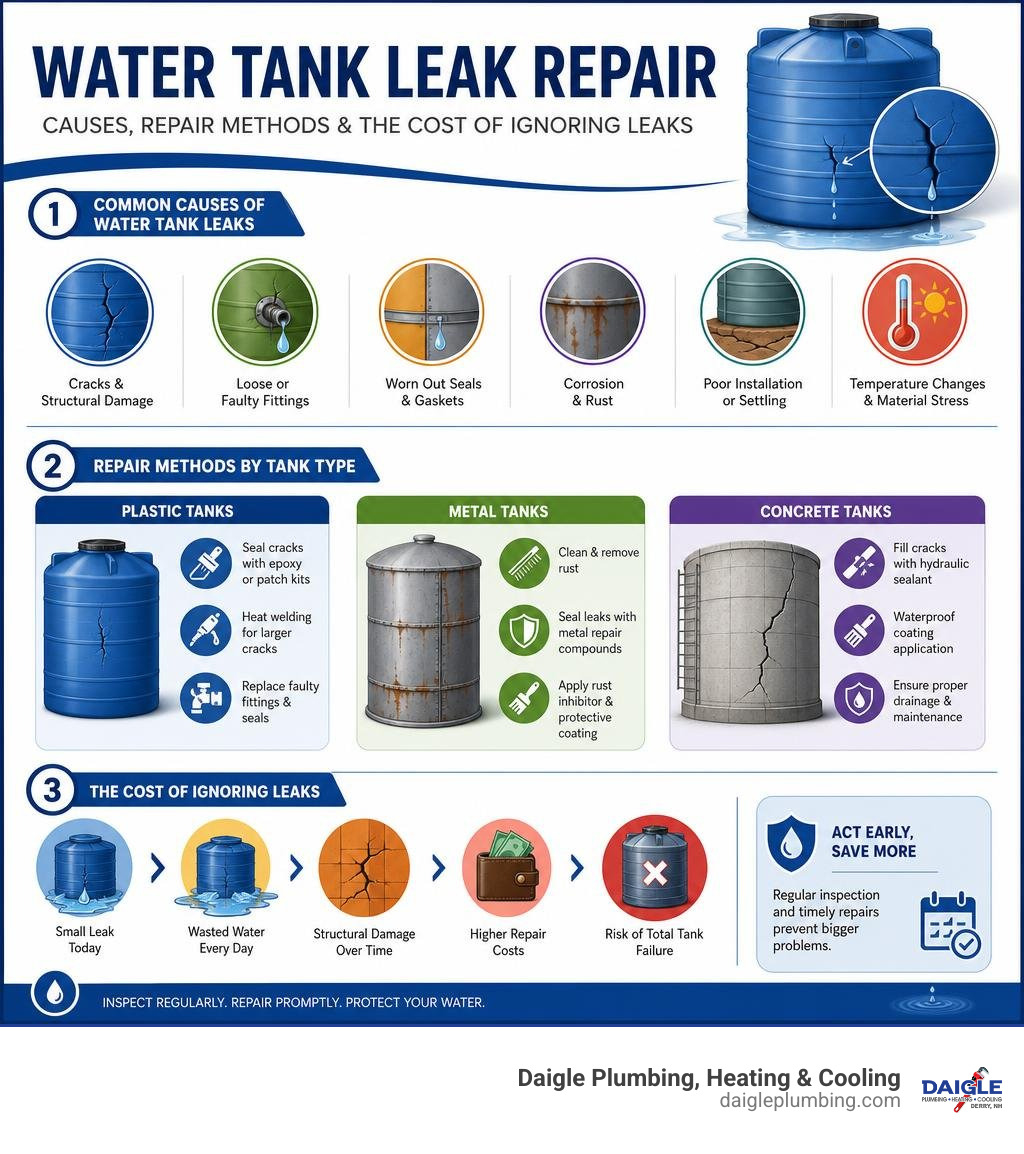
- Choose your repair method based on tank material and leak severity:
- Concrete tanks: hydraulic cement, epoxy injection, or polyurethane grout
- Steel tanks: cold-applied epoxy patching or plate bonding systems
- Minor leaks (tank full): underwater epoxy sealant — no draining required
- Prep the surface — clean, degrease, and roughen the area around the leak
- Apply the repair material and allow full cure time before refilling
- Test the repair — monitor water levels for 24–48 hours after refilling
- Prevent future leaks — schedule inspections and apply protective coatings
Even a slow, steady leak quietly drains your wallet. According to EPA data, U.S. community water systems lose an average of 8.4% of their water supply to infrastructure leaks — and that’s just what gets measured. For homeowners, an undetected tank leak can mean wasted water, rising utility bills, and serious structural damage over time.
The frustrating part? Leak paths are often indirect. Water travels along seams, behind coatings, and through hairline cracks before it ever becomes visible on the outside. By the time you notice a damp wall or an unexplained drop in water pressure, the damage may already be significant.
The good news is that most water tank leaks — whether in concrete, steel, or underground tanks — can be repaired without a full replacement, and in many cases, without even draining the tank.
At Daigle Plumbing, Heating & Cooling, our hands-on experience with residential and commercial plumbing systems gives us a clear, practical understanding of water tank leak repair. In this guide, we’ll walk you through what you need to know — from finding the source of a leak to choosing the right fix that lasts.
Basic water tank leak repair terms:
Identifying the Source: Common Causes of Tank Failure
Before we can jump into the water tank leak repair, we have to play detective. In our 40+ years of experience serving New Hampshire families from Derry to Nashua, we’ve seen that leaks rarely start where you see the puddle.
Steel Tanks: The Corrosion Battle
For steel tanks, the primary enemy is corrosion. Over time, protective interior coatings wear away, leading to “pinhole” leaks. A particularly nasty version is Microbiologically Influenced Corrosion (MIC). This happens when sulfate-reducing bacteria create deep pitting beneath biofilms. These bacteria can literally eat through metal faster than standard oxidation. If you notice rust-colored water or small, localized spots of corrosion near seams, you’re likely looking at a through-wall defect.
Concrete and Masonry Tanks: The Stress of the Earth
Concrete tanks are durable, but they aren’t invincible. They often fall victim to:
- Hydrostatic Pressure: The sheer weight of the water pushing against the walls can force moisture through even tiny pores.
- Structural Cracks: These are often caused by ground movement, unstable foundations, or even tree root penetration. In New Hampshire, our “freeze-thaw” cycles are particularly brutal on concrete structures.
- Poor Construction: If the original pour had weak joints or air pockets, leaks are inevitable.
Underground Tanks: The Hidden Danger
Underground tanks are tough to diagnose because the problem stays out of sight. Watch for unexplained soggy soil above the tank, a sudden drop in water pressure, or unusually high water usage. Finding leaks early, especially around joints, pipe connections, and entry points, can help you avoid major excavation costs later.
If you are noticing these issues with a household water heater tank instead of a large storage cistern, check out our guide on Why Is My Water Heater Leaking Derry NH? for specific residential troubleshooting.
Comprehensive Strategies for water tank leak repair
Once we’ve identified the “why,” it’s time for the “how.” In May 2026, we have access to materials that would have seemed like science fiction a decade ago. We no longer always have to drain thousands of gallons of water just to fix a small crack.
Fixing Active or “Live” Leaks
If you have an active leak and can’t afford the downtime of draining the tank, we use live leak stemming. This involves using a rapid-curing epoxy putty (like a “stick” epoxy) that is kneaded until it turns a uniform color and then forced into the hole. For industrial applications, we might secure this with a 2×4 stud and a ratchet strap until it cures.
Hydraulic Cement for Concrete
For concrete tanks with structural cracks, hydraulic cement is a go-to. Unlike standard cement, hydraulic cement expands as it sets. This expansion creates a mechanical bond that “plugs” the leak even while water is trying to push through. It’s an incredibly effective external seal for active seepage.
Plate Bonding for Metal Tanks
When a steel tank has a large through-wall defect, a simple patch won’t cut it. We use cold-applied plate bonding systems. Instead of dangerous welding (which can ignite fumes or damage interior linings), we use high-strength, corrosion-resistant epoxies to bond a preformed metal plate over the defect. This creates a “molecular weld” that is often stronger than the original tank wall.
Surface Preparation for water tank leak repair
You could buy the most expensive epoxy in the world, but if you apply it to a dirty, oily surface, it will fail. Surface preparation is 90% of a successful water tank leak repair.
In our work across Derry and Manchester, we follow a strict protocol:
- Cleaning: Remove algae, dirt, and loose debris using a wire brush or pressure washer.
- Degreasing: Use a chemical cleaner to ensure no oils or biofilms remain.
- Roughening (The “Profile”): We use grinders or abrasive blasting to create a “profile” on the surface. Think of it like sanding wood before painting; the “teeth” in the metal or concrete give the repair material something to grab onto.
- Keying Cracks: For concrete cracks, we “key” the crack by widening and deepening it with a chisel. This increases the surface area for the hydraulic cement or epoxy to bond.
Table: Manual vs. Mechanical Cleaning Methods
| Feature | Manual (Wire Brush/File) | Mechanical (Grinder/Blasting) |
|---|---|---|
| Speed | Slow | Fast |
| Surface Profile | Shallow/Inconsistent | Deep/Uniform |
| Best For | Small pinholes, emergency fixes | Large repairs, permanent bonding |
| Dust/Debris | Low | High (requires PPE) |
Advanced Sealing Techniques for water tank leak repair
For high-pressure or large-scale leaks, we move beyond simple putties.
- Polyurethane Grout Injection: This is common for concrete tanks. We drill small holes along the crack and inject a liquid polyurethane. When it hits the moisture inside the crack, it foams up and expands, filling every tiny void.
- Hydrophobic Sealants: These materials actually “hate” water. They push water away from the surface as they cure, making them perfect for wet-surface applications.
- Curing Protocols: Every product has a specific cure time. In New Hampshire’s humid summers or freezing winters, these times change. We monitor the repair for at least 24 hours before returning the tank to full service.
Standards like AWWA D110 mandate that for a repair to be successful, the water-level drop must not exceed 0.05% of the tank capacity over a 24-hour period. We take these standards seriously to ensure your repair is permanent.
Repair vs. Replace: Evaluating Long-Term ROI
The biggest question we get in the field is: “Is it worth fixing, or should I just get a new one?”
A standard water tank (whether it’s a well tank or a water heater) typically has a 20-year design life, though water heaters often lean closer to 10-15 years in our region due to hard water.
When to Repair:
- The leak is isolated (one or two spots).
- The surrounding structure is sound (no widespread thinning).
- The tank is less than 10-12 years old.
- The cost of repair is less than 30% of replacement.
When to Replace:
- Structural Thinning: If a metal tank has lost significant wall thickness, it’s a ticking time bomb.
- Widespread Corrosion: If you fix one leak and three more pop up next week, the material has reached its end.
- Safety Triggers: If the tank no longer meets current NSF/ANSI 61 health standards for potable water.
A U.S. Navy study found that combining cathodic protection (sacrificial anodes) with interior coatings can double or even triple the time between required repairs. If your tank is older, you might want to read How Often Does a Water Heater Need to Be Replaced? to see if your residential unit is nearing its end.
Frequently Asked Questions about Tank Leaks
Can I fix a leak while the tank is full?
Yes! Thanks to modern underwater epoxy, we can often perform a water tank leak repair while the tank remains online. These materials are hydrophobic, meaning they displace water and cure even when completely submerged. For small pinholes, a “stemming” putty can stop the flow instantly, followed by a permanent patch.
How long do epoxy repairs typically last?
It depends on the “film” thickness:
- Thin-film epoxies: Usually last 8–15 years.
- Medium-film/Ultra-high solids: Can provide 17–20 years of durability.
- FRP (Fiberglass Reinforced Plastic) linings: Often last 10–20 years.
Is hydraulic cement safe for potable water?
Most modern hydraulic cements are safe once fully cured, but you must look for the NSF/ANSI 61 certification on the label. This ensures the material won’t leach harmful chemicals into your drinking water. Always allow for the full manufacturer-recommended curing and rinsing protocol before drinking from the tank.
Conclusion
A leaking water tank is more than just a nuisance; it’s an environmental and financial drain. Whether you’re dealing with a concrete cistern in Bedford or a well tank in Londonderry, timely water tank leak repair is the key to protecting your property and your wallet.
At Daigle Plumbing, Heating & Cooling, we’ve spent over 40 years mastering the art of leak detection and repair. As a family-owned business, we pride ourselves on giving our New Hampshire neighbors honest advice—whether that means a quick epoxy patch or a full system upgrade. We stand behind our work with a satisfaction guarantee and the expertise that only comes from decades in the trenches.
Don’t wait for a small drip to become a flood. If you’re worried about your water tank, contact us today for expert water heater and tank services. We’ll help you keep your water where it belongs—inside the tank!