A Dripping Faucet Is Costing You More Than You Think
If you’re looking for affordable faucet repair in NH, here’s what you need to know right away:
- Typical cost: $80–$160 for most faucet repairs in New Hampshire
- Average repair time: 2–3 hours
- Most common issues: dripping faucets, low water pressure, leaking handles, worn cartridges
- Best first step: Turn off the water supply valve under the sink, then call a licensed NH plumber for an assessment
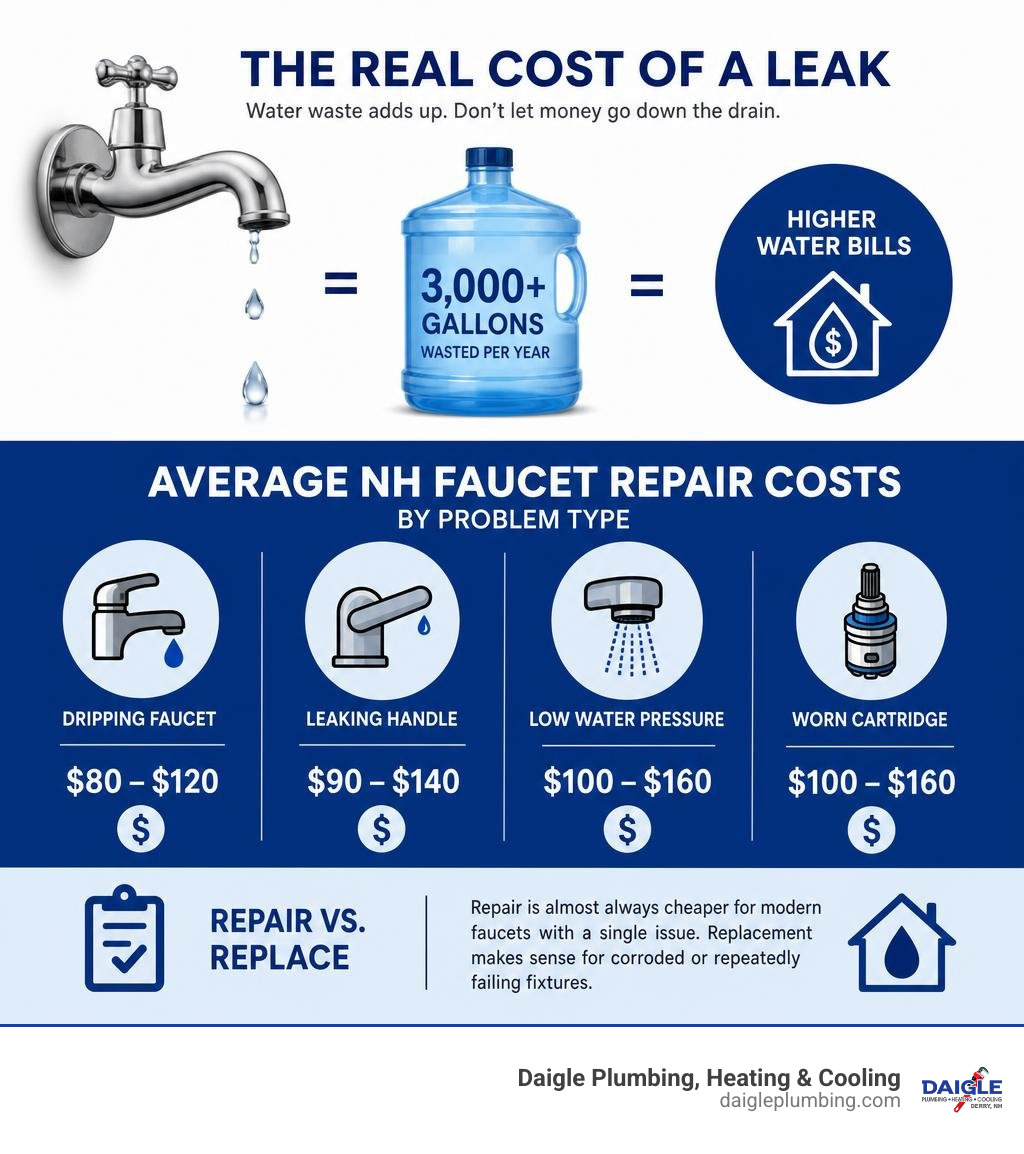
- Repair vs. replace: Repair is almost always cheaper for modern faucets with a single issue; replacement makes sense for corroded or repeatedly failing fixtures
A dripping faucet might not feel urgent. But that slow, steady drip can waste more than 3,000 gallons of water per year, adding real dollars to your utility bill every single month. For homeowners in Southern New Hampshire, where hard water and mineral buildup are common, faucet problems tend to get worse, not better, when ignored.
The good news? Most faucet problems are fixable quickly and affordably by a professional. You don’t need to replace the whole fixture. You just need the right diagnosis and the right repair.
At Daigle Plumbing, Heating & Cooling, our licensed plumbing team has years of hands-on experience repairing fixtures across Southern NH. We’ve seen how affordable faucet repair in NH saves homeowners hundreds of dollars compared to putting off a small fix. In this guide, we’ll walk you through everything you need to make a smart, budget-friendly decision about your faucet.
Common Faucet Problems Facing New Hampshire Homeowners
Living in Southern New Hampshire brings unique plumbing challenges. From Hooksett down to Windham, our local water supplies can take a heavy toll on household fixtures. Over our 40+ years of family-owned service, we have found that most faucet calls stem from a few predictable culprits.
When you understand what is happening inside your plumbing, it is much easier to address issues before they turn into major water damage. Our team explains the mechanics behind worn washers, damaged O-rings, and mineral buildup in more detail in our blog on leaking faucet causes and fixes, especially for homeowners deciding whether a drip needs professional attention.
Dripping Faucets and Water Waste
The classic “drip, drip, drip” is more than just an annoying background noise keeping you up at night. It is a direct drain on your wallet. A single faucet dripping just once per second wastes over 3,000 gallons of water annually. If you have two or three neglected leaks in your home, you could easily be wasting up to 9,000 gallons of water every single year.
This water waste directly impacts your local utility bills. Worn-out washers, damaged O-rings, and corroded valve seats are the typical offenders behind these persistent drips. Because water pressure in Southern NH can sometimes fluctuate, high pressure, anything above 80 PSI, can also accelerate wear and tear on these delicate internal seals, causing them to fail prematurely.
Low Water Pressure and Mineral Buildup
If your kitchen or bathroom faucet has transitioned from a strong stream to a sad, uneven trickle, you are likely dealing with mineral buildup. New Hampshire is known for having groundwater with noticeable mineral content. Over time, calcium and magnesium deposits accumulate inside your faucet’s aerator, the small mesh screen at the tip of the spout.
While cleaning the aerator is a simple task you can often do yourself by soaking it in vinegar, persistent low pressure can point to deeper issues. Corroded supply lines, partially closed shutoff valves under the sink, or clogged internal cartridges can also restrict flow. When simple cleaning does not restore your water pressure, calling for professional faucet repair services is the safest way to clear out the blockage without damaging your pipes.
Leaking Handles and Worn Cartridges
Have you noticed a small puddle of water pooling around the base of your faucet handle whenever you turn the water on? This is a classic handle leak, and it usually means water is escaping past an internal seal or cartridge that has degraded.
Modern single-handle faucets rely on internal cartridges, often made of ceramic discs, to control the blend of hot and cold water. When these cartridges crack or the surrounding rubber seals dry out, water slips past the barrier and leaks out of the handle assembly. If left unaddressed, this water slowly runs down the back of the fixture, seeping through the mounting holes and rot-damaging your vanity, cabinets, and countertops below.
The Cost of Affordable Faucet Repair in NH
When homeowners realize they have a leak, the very first question they ask is: “How much is this going to cost me?” We believe in complete transparency, which is why we want to break down exactly what you can expect to pay for professional repairs in Southern New Hampshire.
| Type of Faucet Issue | Average Southern NH Repair Cost | What the Repair Typically Involves |
|---|---|---|
| Dripping Spout / Leak | $80 – $170 | Replacing worn O-rings, washers, or springs |
| Leaking Handle / Base | $90 – $160 | Cartridge replacement and seal renewal |
| Low Water Pressure | $75 – $150 | Aerator cleaning, cartridge flush, or supply line inspection |
| Loose / Wobbly Faucet | $70 – $170 | Tightening or replacing worn mounting hardware |
| Bathroom Sink Faucet | $100 – $110 | Standard cartridge or washer replacement |
| Kitchen Sink Faucet | $90 – $110 | Standard cartridge, sprayer hose, or seal repair |
Average Repair Costs in New Hampshire
Across Southern NH—including communities like Londonderry, Hudson, and Auburn—most homeowners spend an average of $100 to $116 for professional faucet repairs, with overall costs typically ranging from $80 to $160.
This is incredibly affordable when you consider that a professional repair completely resolves the issue, protects your home from water damage, and preserves your existing fixture. It is a small price to pay to avoid the much higher costs of mold remediation or cabinet replacement caused by a hidden leak.
Key Factors Influencing Faucet Repair Pricing
While the averages above give you a solid benchmark, a few key variables will determine your final estimate:
- Faucet Type: Simple double-handle compression faucets are generally faster and cheaper to fix than complex, high-end touchless models or wall-mounted fixtures.
- Repair Complexity: A straightforward washer replacement takes less time than diagnosing a mysterious leak hidden deep inside a multi-jointed pull-out kitchen faucet.
- Replacement Parts: If your plumber needs to source a specialized, manufacturer-specific cartridge, the material costs will be slightly higher than using standard, universally sized seals.
- Emergency Service: If your faucet supply line bursts at 2:00 AM on a Sunday, emergency dispatch fees will apply. Standard, scheduled daytime repairs are always the most budget-friendly option.
Repair vs. Replace: Making the Right Choice for Your Fixtures
How do you know when it is time to salvage your existing fixture or when you should bid it farewell and buy a new one? Making the right choice can save you a lot of money and frustration. If the faucet problem is part of a larger pattern, such as recurring leaks, slow drains, or water stains, our blog on signs it’s time to call a plumber can help you decide when a licensed technician should inspect the wider plumbing system.
When to Choose Affordable Faucet Repair in NH
Repairing your faucet is almost always the most cost-effective path if:
- The fixture is relatively new: If your faucet is less than 5 to 7 years old, a simple repair will easily restore it to like-new condition.
- The problem is isolated: If the faucet only has a single, clear issue, like a steady drip from the spout or a loose handle, a quick part replacement is all it needs.
- You love the style: If you have high-end designer fixtures that match your bathroom or kitchen aesthetic perfectly, keeping them in service through affordable repairs is highly desirable.
When Complete Faucet Replacement is Necessary
Sometimes, continuing to repair an old faucet is simply throwing good money after bad. You should consider a complete replacement if:
- Severe Corrosion is Present: If the metal body of the faucet is corroded, rusted, or pitted, the structural integrity of the fixture is compromised, and leaks will keep returning.
- The Model is Outdated: Older faucets are incredibly inefficient. Upgrading to modern WaterSense labeled bathroom faucets can reduce your sink’s water flow by 30% or more, dropping from the old 2.2 GPM standard to a highly efficient 1.5 GPM, without sacrificing performance.
- Parts are Unavailable: If you have an obsolete, discontinued faucet model, finding matching replacement parts can be nearly impossible or incredibly expensive.
- You are Experiencing Frequent Failures: If you have already repaired the same faucet multiple times over the last year, it is telling you that its working lifespan has come to an end.
Faucet Types and Repair Complexity
Faucets might look similar on the outside, but their internal mechanisms vary wildly. Understanding your faucet type helps set expectations for the repair:
- Compression Faucets: These are traditional double-handle faucets. They utilize rubber washers that compress against a valve seat to stop water flow. They are simple to repair, but the washers wear out more frequently than other designs.
- Cartridge Faucets: Available in both single and double-handle designs. They use a hollow metal or plastic cartridge that aligns holes to control water flow. They are highly reliable and quick to service.
- Ball Faucets: Commonly found in kitchen sinks, these single-handle faucets use a slotted metal ball resting on rubber seals. They have many moving parts, making them slightly more complex to rebuild.
- Touchless / Motion-Activated Faucets: These modern fixtures rely on electronic sensors, solenoid valves, and battery packs. While highly hygienic and efficient, troubleshooting them requires specialized electrical and plumbing expertise.
What to Expect During a Professional Faucet Repair Service
When you schedule a professional plumbing visit, you should never have to guess what is happening in your home. A reputable service provider will make the process smooth, clean, and entirely stress-free.
The Professional Repair Process and Timeline
A typical faucet repair is a highly efficient process that rarely takes more than two hours. Here is exactly what we do when we arrive at your home:
- Listen & Inspect: We begin by asking you about the symptoms you’ve noticed. We then inspect the faucet, the supply lines, and the shutoff valves underneath the sink to locate the exact source of the problem.
- Protect & Prep: Before pulling out any tools, we protect your countertops, sink basin, and surrounding cabinets using protective mats and painter’s tape to prevent scratches or water spills.
- Isolate the Water: We shut off the local water supply valves under your sink. If those old valves are frozen or corroded, we will safely use the main water shutoff for the house.
- Execute the Repair: We carefully disassemble the fixture, clean out any mineral deposits, replace the failing cartridges, seals, or washers with high-quality parts, and reassemble the unit.
- Flush & Finish: We turn the water back on, flush out any loose debris from the lines, clean the aerator, and thoroughly test the faucet under both hot and cold pressures to guarantee there are zero lingering leaks.
For homeowners in Derry and nearby towns, our local plumbing Derry NH services make it easier to get prompt help when a faucet leak, clogged fixture, or failing shutoff valve needs professional attention.
Why DIY Faucet Repair Can Cost You More
It is incredibly tempting to grab a wrench and try to tackle a leaky faucet over the weekend. However, DIY plumbing often leads to unexpected headaches and higher costs:
- Lack of Specialized Tools: Faucets often require unique tools, like basin wrenches or cartridge pullers, to disassemble without scratching the expensive finish.
- Hidden Structural Leaks: A professional plumber knows how to check for micro-leaks behind the wall or underneath the sink deck that a homeowner might easily miss.
- Risk of Catastrophic Water Damage: Overtightening a plastic fitting or failing to seat a clip correctly can cause a supply line to blow completely off, flooding your kitchen or bathroom in minutes.
- Warranty Voiding: Many high-end faucet manufacturers will only honor product warranties if the parts are installed by a licensed professional.
If you are closer to the western portion of our service area, our plumbing Nashua NH team can help you avoid these DIY pitfalls with careful diagnostics, clean repairs, and fixture service that protects your home from preventable water damage.
Finding Quality Guarantees and Affordable Faucet Repair in NH
You deserve peace of mind when someone works on your home. To ensure you are getting the best value for your hard-earned money, always look for a plumbing partner who provides:
- Licensed and Insured Technicians: This protects your property and guarantees the work meets strict local NH plumbing codes.
- Written Warranties: Your plumber should stand behind their work with a clear, written warranty on both labor and replacement parts.
- Satisfaction Guarantees: A commitment to making things right if you are not completely happy with the service.
- Transparent, Upfront Estimates: You should always know exactly what the job will cost before any work begins, no hidden fees, no surprises.
Frequently Asked Questions About NH Faucet Repairs
How much water does a leaking faucet actually waste?
A faucet that leaks at a rate of just one drip per second wastes approximately 3 gallons of water every single day. Over the course of a year, that single, seemingly minor leak wastes more than 3,000 gallons of water.
Not only is this a terrible waste of a precious natural resource, but it also forces your water heater to work harder if the leak is on the hot water side, driving up your energy bills alongside your water utility costs.
Can touchless or high-end faucets be repaired affordably?
Yes! Many homeowners assume that because their touchless or designer faucet was expensive to buy, it will be astronomical to fix. In reality, touchless faucets are highly modular.
Most issues are caused by simple, easily replaceable components like a worn cartridge, a dead battery pack, a dirty sensor eye, or a failing solenoid valve. A professional plumber can pinpoint the exact failing part and replace it, saving you from having to purchase an entirely new high-end fixture.
How often should faucet supply lines be replaced?
We highly recommend replacing your flexible faucet supply lines—specifically the braided stainless steel hoses under your sink—every 5 to 10 years.
Even if these lines look perfectly fine from the outside, the inner rubber tubing degrades and becomes brittle over time due to constant water pressure and temperature fluctuations. Replacing them proactively during a routine faucet repair is an incredibly cheap way to prevent a catastrophic rupture and subsequent home flooding.
Conclusion
At Daigle Plumbing, Heating & Cooling, we have spent more than 40 years helping our neighbors across Southern New Hampshire keep their homes comfortable, efficient, and dry. As a family-owned business, we pride ourselves on offering reliable, highly professional plumbing services that fit your household budget. We back all of our work with a 100% satisfaction guarantee, ensuring you get the top-tier service you deserve.
Whether you are dealing with a maddening kitchen drip in Derry, low bathroom water pressure in Windham, or need a complete fixture upgrade in Bedford, our licensed experts are ready to help.
Don’t let your hard-earned money slowly drip down the drain. Contact our professional faucet repair technicians and let our family take care of yours!